Telehealth has changed how patients see doctors. A tap now replaces a waiting room. But turning that idea into a safe, working app needs the right telemedicine mobile app development company, one that understands healthcare, not just code.
A genuine telehealth app development company treats patient trust as the product, not an afterthought. Pick wrong, and you risk data leaks, compliance trouble, and an app nobody trusts.
Here’s exactly what to check before you hire.
Key Highlights
- Healthcare experience and compliance knowledge matter more than price when you hire telemedicine mobile app developers.
- A strong telemedicine mobile app development company should show real HIPAA-compliant, EHR-integrated projects, not just promises.
- Ask about security, ownership, and support before signing anything with any telemedicine software development company.
- Costs range from $20,000 for a simple MVP to $100,000+ for a full-featured platform.
What Does a Telemedicine Mobile App Development Company Actually Do?
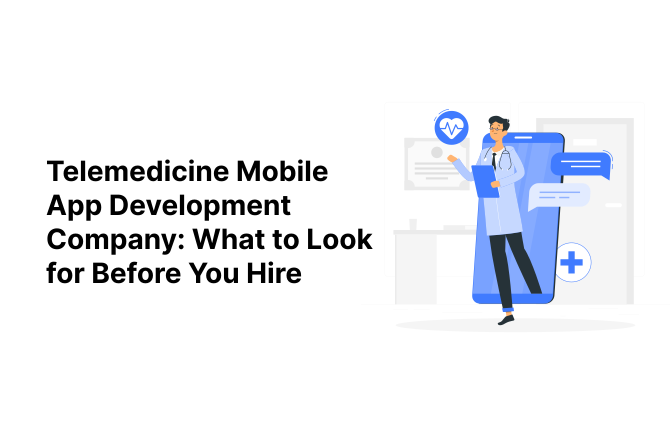
A good telemedicine app development company builds much more than just a video call button. Think of it as stitching together several moving parts into one smooth experience.
Patients get a portal to book appointments, view prescriptions, and check reports. Doctors get a dashboard to manage schedules and consultation notes.
Behind the scenes, the mobile app connects with EHR/EMR systems so patient history stays centralized, and often plugs into wearables for remote monitoring, plus secure payment gateways for consultations.
A reputable healthcare software development company treats these pieces as a single connected ecosystem, not as separate add-ons bolted together.
That’s the real difference between a template mobile app and a purpose-built telemedicine software development company solution.
If you’re planning a broader digital healthcare ecosystem beyond telemedicine, our guide to healthcare software development explains the key features, development process, technology stack, and cost considerations for modern healthcare solutions.
Key Factors to Look for Before You Hire
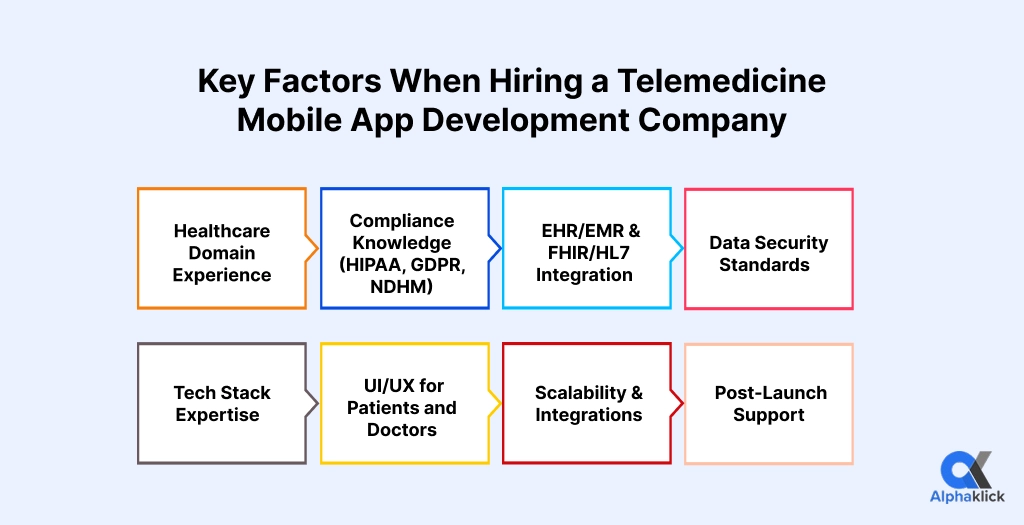
Here’s exactly how to choose telemedicine mobile app developer teams that can deliver something safe, usable, and built to last.
1. Healthcare Domain Experience
Don’t just ask “have you built apps?” Ask “have you built healthcare apps?” A mobile app development team that understands patient consent flows, doctor workflows, and medical terminology will design a smarter product from day one, instead of learning healthcare on your budget.
2. Compliance Knowledge (HIPAA, GDPR, NDHM)
Patient data is sensitive by law, not just by choice. Your mobile app developers should bake compliance into the architecture from the very first sprint, not patch it in right before launch when it’s expensive and risky to fix.
3. EHR/EMR & FHIR/HL7 Integration
Hospitals and clinics run on existing systems. If your healthcare mobile app can’t talk to them using standard formats like FHIR and HL7, doctors will end up double-entering data, and that kills adoption fast.
Want to understand how FHIR, HL7, and AI-powered EHR systems work together? Read our detailed guide on AI-powered EHR software development to learn about integrations, compliance, architecture, and implementation best practices.
4. Data Security Standards
Look past buzzwords. Ask specifically about encryption in transit and at rest, role-based access control, and multi-factor authentication. These aren’t optional extras in healthcare software; they’re the baseline.
5. Tech Stack Expertise
Frameworks like React Native and Node.js let teams build for iOS and Android from one codebase, cutting both cost and time to market, without sacrificing speed or reliability for patients and doctors.
6. UI/UX for Patients and Doctors
Your grandmother should be able to book a consultation without calling for help, and a busy doctor should finish notes in seconds, not minutes. Good design quietly does the heavy lifting for both.
7. Scalability & Integrations
Today it’s video calls; tomorrow it might be pharmacy delivery, lab bookings, or wearable syncing.
Real custom telemedicine mobile app development means building an architecture that can grow with you, not one you’ll outgrow in a year.
A team skilled in custom telemedicine app development will design your database and APIs with room to expand, so adding new features later doesn’t mean rebuilding from scratch.
Many modern telemedicine platforms now use AI healthcare agents for appointment scheduling, patient triage, follow-ups, and clinical assistance. Explore our complete guide to learn the real-world use cases, compliance requirements, and development costs.
8. Post-Launch Support
Launch day is the beginning, not the finish line. Bugs surface, OS updates roll in, and features evolve. Confirm what support looks like, and what it costs, before you sign anything.
Working through these eight points is the most practical way to answer the common question of how to choose telemedicine app developer teams you can actually trust with patient data, instead of guessing based on a flashy website alone.
A telemedicine app may also include medication management features, such as dose reminders and medication tracking. For a deeper look at the features, development process, and technology involved, read our Medication Reminder Mobile App Development Guide.
Portfolio & Proven Track Record
Before you commit, ask to see real, live apps, not just polished mockups. Talk to past clients if you can, and don’t be shy about asking pointed questions; skilled mobile app developers will welcome the scrutiny.
A genuinely strong portfolio, backed by healthcare-specific case studies, is one of the clearest signs you’ve found the best telemedicine app development company for your project, not just a good sales pitch.
The best telemedicine app development company for you is the one whose past work looks closest to what you’re trying to build.
Still comparing development partners? Explore our list of the best healthcare mobile app developers in India to evaluate companies with proven expertise in AI, IoT, telemedicine, and healthcare software solutions.
What I’ve Seen Founders Get Wrong
In my years doing this, I’ve noticed the founders who struggle later almost always skipped the same step early on: they hired based on a nice portfolio and a good pitch, without asking hard questions about compliance or data ownership. A few months in, they’d discover the vendor had no real HIPAA process, or that switching providers meant rebuilding half the app from scratch because the code wasn’t truly theirs.
The founders who get it right usually do one thing differently, they treat the first conversation like an interview, not a sales call. They ask about past healthcare work in detail, push on security specifics, and clarify IP ownership before a single line of code is written. It’s a small habit, but it saves months of pain later.
Red Flags to Avoid
Watch for these warning signs when evaluating any telemedicine app company:
- No healthcare projects anywhere in their portfolio
- Vague or dodgy answers about HIPAA compliance
- Unrealistic timelines paired with unusually low pricing
- No real explanation of how patient data is stored or secured
- Slow, unclear communication even before the contract starts
If a healthcare mobile app development company can’t explain its data practices in plain language, treat that as a dealbreaker, not a detail.
A trustworthy telemedicine app company will always welcome tough questions instead of dodging them.
AI is transforming telemedicine through symptom checkers, virtual assistants, and predictive analytics. See how these features affect pricing in our On-Demand Doctor Consultation Mobile App Development: Cost & Company Comparison Guide.
Questions to Ask Before Signing a Contract
| Question | Why It Matters |
| Do you have HIPAA/GDPR compliance experience? | Protects you from legal and financial risk |
| Who owns the app’s source code and IP? | Avoids costly ownership disputes later |
| What is your data handling and storage policy? | Keeps patient data genuinely safe |
| What is the realistic project timeline? | Sets honest expectations upfront |
| Is pricing transparent, with no hidden costs? | Prevents budget surprises mid-project |
| What support do you offer after launch? | Ensures the app stays reliable long-term |
Cost to Hire a Telemedicine Mobile App Development Company
Pricing depends heavily on features and complexity. Here’s a simple breakdown to set realistic expectations:
| App Type | Key Features | Estimated Cost |
| Basic MVP | Appointment booking, video/chat consultation | $20,000 – $40,000 |
| Mid-Level App | EHR integration, e-prescriptions, payments | $40,000 – $80,000 |
| Full-Featured AI-Platform | AI doctor matching, RPM, wearables, multi-role dashboards | $80,000 – $100,000+ |
Experienced mobile app development teams that understand healthcare from the start often save money long-term, because they avoid the costly rebuilds and compliance fixes that come from working with generalist teams.
If you’re budgeting beyond telemedicine, our mobile app development cost in 2026 guide breaks down pricing based on app complexity, platform, technology stack, and development approach, helping you estimate your overall investment accurately.
Why Choose Alphaklick as Your Telemedicine Mobile App Development Partner
I’m Abhishek Bhatnagar, founder of Alphaklick. Led by me, our team has spent years building healthcare tech, not just reading about it; we’ve delivered 50+ healthcare projects, including telemedicine platforms, EHR systems, and patient monitoring apps for clients across the US and India.
We build on React Native, Node.js, and cloud infrastructure, and we’re backed by strong, verified Clutch reviews from healthcare clients who came back for their next project.
That’s the kind of track record you want in a telemedicine mobile app development company, or any mobile app development company you trust with patient data.
Have a healthcare Mobile app idea? Don’t let it sit in a notes app. Contact us today, or connect with me directly- no sales pitch, just a straight answer about whether it makes sense and what it will really take to build.
FAQs
Question: How much does it cost to hire a telemedicine mobile app development company?
Answer: Costs typically range from $20,000 for a basic MVP to $100,000+ for a full-featured, compliant platform, depending on integrations and features.
Question: How long does it take to build a telemedicine app?
Answer: A basic version can take 3–4 months, while a complex, fully integrated platform may take 6–9 months.
Question: Is HIPAA compliance mandatory for telemedicine mobile apps?
Answer: Yes, if you handle patient data in the US, HIPAA compliance is essential to avoid legal penalties and protect user trust.
It’s equally important to partner with an experienced development company that understands HIPAA requirements, security best practices, and regulatory obligations. Read our guide on HIPAA & FERPA Compliant App Development Company: What to Verify Before Signing before choosing your development partner.
Question: What should I check first when I hire mobile app developers?
Answer: Start with their healthcare portfolio, compliance knowledge, and data security practices before discussing price or timeline; the right mobile app developers will happily walk you through all three.
Question: Can a telemedicine app be built for both iOS and Android?
Answer: Yes, using cross-platform frameworks like React Native, apps can be built for both platforms from a single codebase, saving time and cost.