A founder came to us with a clear request. He wanted an AI assistant that could answer customer queries, predict which leads would convert, and write follow-up emails on its own. He had a budget, a deadline, and a lot of excitement.
Then we asked where his customer data lived. It was spread across two spreadsheets, a WhatsApp group, and a CRM nobody had updated in months.
We see this many times at AlphaKlick. The idea is strong, but the foundation is not ready yet. And building on a weak foundation is the fastest way to burn an AI budget.
What Is an AI Readiness Assessment?
An AI readiness assessment is a structured look at whether your business has the goals, data, systems, people, and budget to use AI in a way that actually pays off.
It answers one honest question every founder should ask before signing a contract: is my business ready for AI, or do we need to fix a few things first?
Why Readiness Matters More Than the AI Tool You Pick
Most founders who reach out to us start with the tool. A ChatGPT integration, a recommendation engine, a voice bot. The tool is rarely the problem. The models available today are powerful and affordable.
What decides success is everything around the tool: clean data to feed it, a clear process for it to improve, and people who will actually use what it produces.
In our experience, an average AI model on top of good data beats a brilliant model on top of messy data every single time.
Signs a Business Is Jumping Into AI Too Early
A few signals tell our team a project needs a pause:
- The goal is “we need AI” instead of a specific problem like reducing support response time.
- Nobody can say where the relevant data is stored or who owns it.
- The team expects AI to replace a process that is not even documented yet.
- Success has not been defined in numbers.
If two or more of these sound familiar, you are not alone. It simply means the readiness work should come first.
Before choosing an AI solution, it is also important to understand what your business actually needs. For example, an AI assistant may help answer questions or support employees, while an AI agent can handle multi-step tasks with some level of autonomy. Understanding the difference between AI agents and AI assistants can help you choose the right solution for your business goals and current level of readiness.
The 6 Pillars of AI Readiness
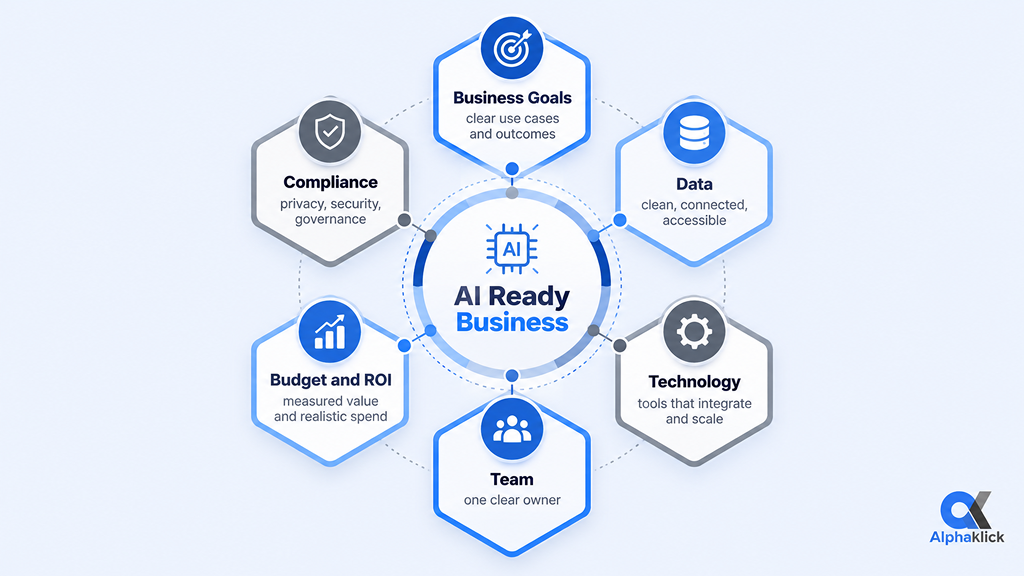
Over the years, our team has shaped a simple AI readiness framework that we use in every discovery call. It looks at six pillars. Weakness in one pillar rarely stops a project, but weakness in three usually does.
1. Business Goals and Use Case Clarity
The strongest projects we have delivered started with a narrow, painful problem. One ecommerce client wanted to cut the hours their team spent tagging products every week. That clarity made everything else easy to plan, price, and measure.
2. Data Quality, Volume, and Accessibility
AI data readiness is where most businesses struggle. You need enough relevant data, in a consistent format, that the systems you plan to connect can actually reach. Duplicate records, missing fields, and data locked inside PDFs all slow things down.
3. Technology Infrastructure and Integrations
Your AI solution must integrate with your existing website, mobile apps, CRM, or ERP. If your current systems do not offer APIs or run on outdated software, integration becomes a project of its own.
4. Team Skills and Internal Ownership
You do not need a data science team. You do need one person inside the business who owns the initiative, makes decisions, and pushes the team to adopt what gets built.
5. Budget and Expected ROI
AI costs include development, cloud usage, maintenance, and model updates. We always ask founders to estimate what success is worth to them in saved hours or added revenue, so the budget has a clear return to measure against.
6. Security, Privacy, and Compliance
If you handle customer data in India, the Digital Personal Data Protection Act applies. Businesses serving Europe also need to think about GDPR, and healthcare and fintech carry extra rules. This pillar decides what data the AI is allowed to touch at all.
AI Readiness Checklist: Questions to Ask Before You Invest
Here is the AI readiness checklist we walk founders through in our first conversation. Answer each question with a simple yes or no.
| Pillar | Question to Ask | Yes / No |
| Business Goals | Have we defined one specific problem AI should solve? | |
| Business Goals | Do we know how we will measure success? | |
| Data | Is the relevant data stored in one place or easy to combine? | |
| Data | Is the data reasonably clean, complete, and up to date? | |
| Technology | Do our current tools offer APIs or integration options? | |
| Team | Is there a named owner for this AI initiative? | |
| Budget | Have we set aside budget for maintenance, not just the build? | |
| Compliance | Do we know which data we are legally allowed to use? |
Mostly yes means you can move into planning. Mostly no means your next step is preparation, not development.
How to Score Your AI Readiness (Simple Scoring Model)
An AI readiness checklist tells you where the gaps are. A score tells you how big they are.
Scoring Each Pillar From 1 to 5
Rate each of the six pillars from 1 (not in place) to 5 (fully in place). Be honest here. We have seen founders give themselves a 5 on data and then discover during our review that half their customer records had no email address.
What Your Total Score Means
Add your six scores for a total between 6 and 30. The total maps neatly to the stages of AI readiness we see across our client base.
| Total Score | Readiness Stage | What It Means | Recommended Next Step |
| 6 to 10 | Exploring | AI is still an idea and foundations are missing | Define one use case and review your data |
| 11 to 16 | Preparing | Some pieces are in place but gaps are significant | Fix data issues and assign an owner |
| 17 to 21 | Ready to Pilot | Core foundations exist | Run a small proof of concept |
| 22 to 26 | Ready to Scale | Pilot results are proven | Expand to more teams or use cases |
| 27 to 30 | AI Driven | AI is part of daily operations | Optimize, monitor, and keep improving |
AI Readiness by Business Type
The answer to “is my business ready for AI” depends heavily on your size and industry. Here is how readiness tends to look across the businesses we work with.
1. Startups and Small Businesses
An AI readiness assessment for small business owners should be light and fast. Small teams usually have less data but far more flexibility. We often recommend starting with ready-made AI APIs for chat support or content workflows instead of custom models.
2. Ecommerce and Retail
Online eCommerce stores often sit on rich data about orders, browsing, and customers. The common gap is that this data lives across Shopify, payment gateways, and marketing tools without being connected. Product recommendations, smart search, and support automation are usually the first wins.
3. Healthcare, Fintech, and Regulated Industries
Here, compliance comes before everything else. Data access rules, audit trails, and explainable outputs need to be designed in from the start. These projects take longer, but the impact is often bigger.
4. Enterprises With Legacy Systems
Large companies have data in abundance but struggle with old systems that were never built to share it. Integration and change management usually take more effort than the AI itself.
Common AI Readiness Gaps We See in Client Projects
After many discovery calls and builds, the same gaps keep showing up.
1. Scattered or Unstructured Data
A logistics client once shared delivery records spread across three tools and a handwritten register that was scanned every week. Before building their route prediction feature, we spent the entire first phase simply bringing that data together.
2. No Clear Owner for the AI Initiative
When AI is everyone’s project, it becomes no one’s project. We have watched good pilots stall because nobody inside the company had time to review outputs or push the team to use them.
3. Expecting Full Automation From Day One
Founders often imagine AI taking over an entire workflow on launch day. In reality, the best results come when AI assists people first, learns from their corrections, and gradually handles more.
4. Ignoring Integration With Existing Apps and CRMs
An AI feature that lives outside your daily tools gets forgotten. If your sales team works inside a CRM, the AI insights need to show up there, not in a separate dashboard nobody opens.
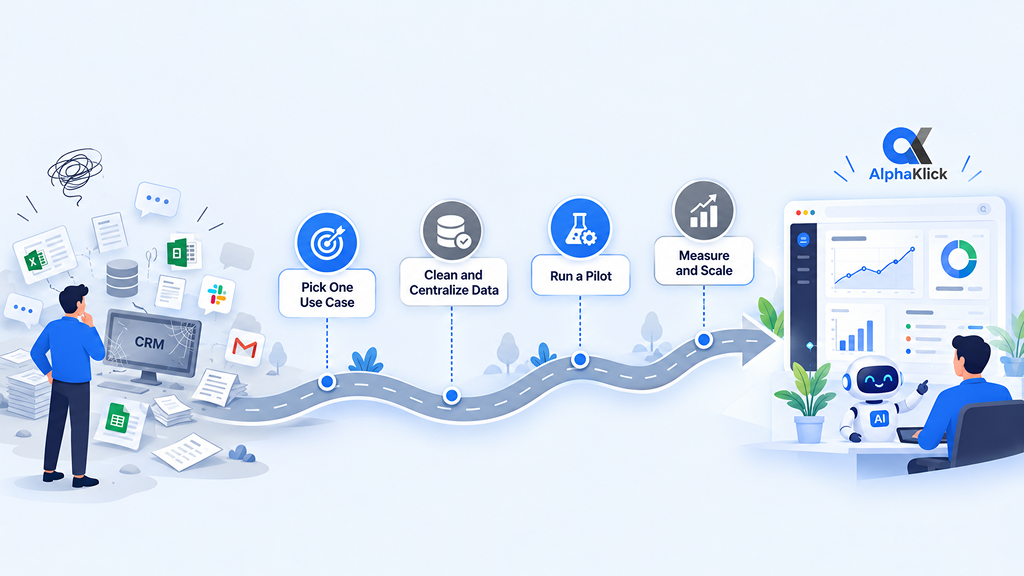
How to Close the Gaps Before Starting an AI Project
The good news is that most gaps can be closed in weeks, not years. This is the AI adoption strategy for business that we recommend to almost every client.
1. Start With One High-Impact Use Case
Pick the problem that costs you the most time or money and is easy to measure. One clear win builds confidence and budget for the next.
2. Clean and Centralize Your Data
Remove duplicates, fill missing fields, and bring data into one accessible place. This step alone often improves your reporting before any AI is added.
3. Run a Small Pilot or Proof of Concept
Build a limited version, test it with real users, and track results for a few weeks. A pilot costs very little compared to a full build that misses the mark.
Once your data, systems, and workflows are ready, you can move from testing an idea to planning a practical AI solution. If your use case requires AI to complete tasks, make decisions, or coordinate multiple steps, learning how to build a custom AI agent can help you understand the development process, technology requirements, and costs before committing to a full-scale project.
4. Measure Results Before Scaling
Compare pilot results against the success numbers you defined at the start. Scale only what proves its value.
AI Readiness Assessment Template
This template follows the same AI readiness framework we use with clients. Fill it in with your team, not alone, because different departments see different gaps.
| Pillar | Current State (Notes) | Score (1 to 5) | Biggest Gap | Action Needed |
| Business Goals | ||||
| Data | ||||
| Technology | ||||
| Team | ||||
| Budget | ||||
| Compliance | ||||
| Total | /30 |
How AlphaKlick Helps You Assess Readiness and Build AI Solutions
Remember the founder with the scattered spreadsheets and the forgotten CRM? He did not need a chatbot first. He needed a plan. Here is the path we took with him, and the same path we follow with every business that comes to us with an AI idea.
Step 1: We start by listening, not building
Our AI readiness audit begins with a working session with your team. We look at your goals, where your data sits, the tools you use daily, and any compliance limits.
You walk away with: a clear readiness score and an honest explanation of what is holding you back.
Step 2: We find the one idea worth building first
Most founders arrive with five AI ideas. We rank them by impact and effort, then check which ones your current data can actually support.
You walk away with: one priority use case that has a realistic chance of paying off.
Step 3: We fix the foundation
Our developers clean, structure, and connect your data. As a mobile app development company in India that also builds web platforms and CRM integrations, we make sure the AI lives inside the mobile apps your team already opens every morning.
You walk away with: data and systems that are finally ready for AI.
Step 4: We prove it with a pilot, then scale it
We build a focused pilot, measure it against the numbers you care about, and only then grow it into full AI solutions such as chatbots, recommendation engines, document automation, or predictive models.
You walk away with: proof that it works before you commit your full budget.
Step 5: We stay after launch
AI needs care. We monitor performance, retrain models as your data changes, and help you expand into new use cases as your AI adoption strategy for business matures.
You walk away with: an AI solution that keeps improving instead of quietly fading out.
For that founder, the chatbot came later. When it did, it worked from day one because the groundwork was already done.
Not sure where your business stands yet? Talk to the AlphaKlick team, and we will start with a clear, practical readiness review.
FAQs
Question: What are the five stages of AI readiness?
Answer: The five stages of AI readiness are Exploring, Preparing, Ready to Pilot, Ready to Scale, and AI Driven. Each stage reflects how strong your goals, data, systems, team, budget, and compliance are, and tells you whether to fix foundations, test, or expand.
Question: How to evaluate AI data readiness?
Answer: Check four things: whether you have enough relevant data, whether it is accurate and consistent, whether it is stored somewhere your systems can access, and whether you have the legal right to use it. If any of these fail, AI data readiness work should come before development.
Question: What is the cost of an AI readiness assessment in India?
Answer: Cost depends on scope. An AI readiness assessment for small business teams with one or two use cases is a short engagement, while an enterprise review across many departments and legacy systems takes longer and costs more. Most agencies, including AlphaKlick, share a quote after an initial discovery call once they understand the systems and use cases involved.
Question: What is an AI Readiness Audit?
Answer: It is a deeper, expert-led version of a self-assessment. An experienced team reviews your data, systems, processes, and compliance in detail, then gives you a readiness score, a list of gaps, and a step-by-step plan to close them.