Ask any doctor what slows them down, and you will hear the same answer: paperwork. Physicians in the US spend nearly 2 hours on administrative tasks for every 1 hour of actual patient care. Old, disconnected software is a big reason why.
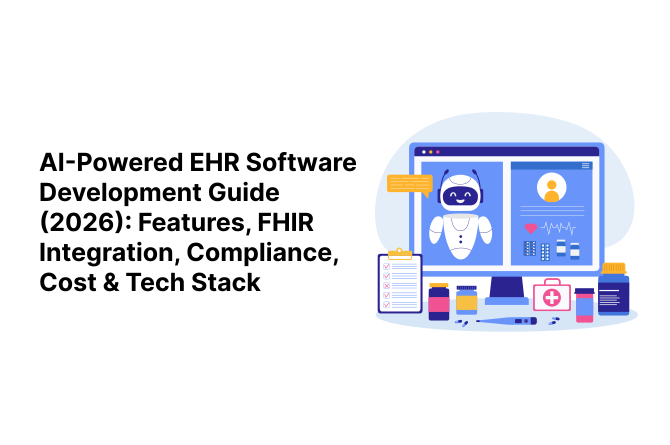
That is where AI-powered EHR software development comes in, to change how hospitals, clinics, and health networks manage patient data, automate workflows, and improve outcomes.
This AI EHR software development guide walks you through everything you need to know in 2026, from core features and FHIR integration to compliance, tech stack choices, and real development costs.
Whether you are a hospital CTO, a healthcare startup founder, or a product manager, this guide is to help you make smart decisions.
What is AI-powered EHR software, and why does it matter?
An Electronic Health Record (EHR) system is a digital version of a patient’s medical history. A modern, AI-powered EHR goes far beyond storing records. It uses artificial intelligence, machine learning, and automation to help doctors make better decisions faster.
Here is why AI in healthcare records is no longer optional in 2026:
- Physician burnout: Doctors spend too much time on data entry. AI automates this.
- Interoperability mandates: US federal regulations now require EHR systems to share data using standard formats like FHIR.
- Rising patient volumes: Hospitals need smarter tools to handle more patients without compromising care quality.
- Value-based care: Payers and providers are shifting to outcome-based models that need real-time data and analytics.
The global EHR market is expected to surpass $47 billion by 2027, with AI-integrated systems growing the fastest. If your organization is still running on a legacy EHR, you are already behind.
If you’re evaluating broader digital transformation initiatives, our guide on Healthcare Software Development: Complete Guide, Cost, Features & Solutions explores the technologies, costs, and development approaches shaping modern healthcare platforms.
Basic EHR vs AI-Powered EHR, Feature Comparison:
| Feature | Basic EHR | AI-Powered EHR | Clinical Impact |
| Documentation | Manual data entry | Voice-to-text + NLP auto-structuring | Saves 2–3 hrs/day per physician |
| Diagnosis Support | None | Real-time CDSS alerts | Reduces diagnostic errors |
| Medical Coding | Manual ICD/CPT | Automated NLP coding | Faster billing, fewer denials |
| Patient Risk | Not available | Predictive risk stratification | Early intervention enabled |
| Interoperability | Limited or manual | FHIR R4 API-native | Seamless data exchange |
| Workflow Automation | None | AI-driven task routing | 30–40% admin time reduction |
Still comparing traditional systems with AI-enabled platforms? Read our detailed comparison of Custom AI Healthcare Software vs Traditional Software: Which Is Better? to understand the long-term benefits of AI-driven healthcare solutions.
Core features of AI-powered EHR software
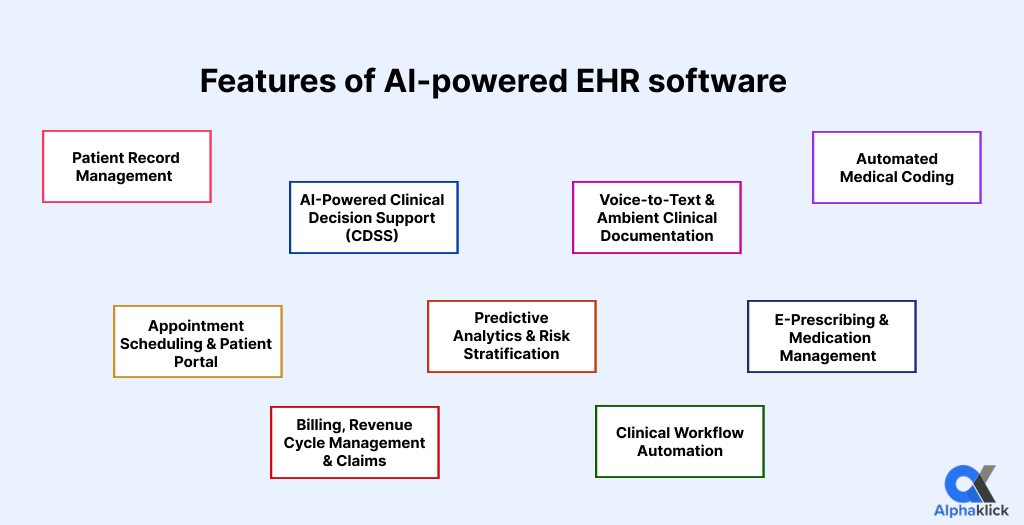
When planning your custom EHR software development, the feature set you choose will define how much value the system delivers.
Here are the must-have features for a 2026-ready EHR:
1. Patient Record Management
Store and retrieve structured and unstructured patient data, from lab results and medications to doctor notes and imaging files. AI helps organize and surface the most relevant information automatically.
2. AI-Powered Clinical Decision Support (CDSS)
This is where AI in EHR systems makes the biggest difference. CDSS tools analyze patient data in real time and alert clinicians to potential drug interactions, missed diagnoses, or high-risk conditions, like a smart co-pilot for every doctor.
Many healthcare organizations are also adopting AI healthcare agent development solutions to automate patient interactions, care coordination, clinical support, and administrative workflows.
3. Voice-to-Text & Ambient Clinical Documentation
Instead of typing notes during or after a visit, doctors simply speak. AI transcribes and structures the conversation into clinical notes automatically. This feature alone can save 90+ minutes per physician per day.
4. Automated Medical Coding
Natural language processing (NLP) reads clinical notes and assigns the correct ICD-10 and CPT codes, reducing billing errors, speeding up claims, and cutting revenue cycle costs.
5. Predictive Analytics & Risk Stratification
AI models flag patients most likely to be readmitted, develop complications, or miss appointments, enabling proactive, preventative care rather than reactive treatment.
6. Appointment Scheduling & Patient Portal
Smart scheduling reduces no-shows with AI-driven reminders. The patient portal gives individuals access to their records, test results, and messaging with their care team.
7. E-Prescribing & Medication Management
Electronically send prescriptions directly to pharmacies, with AI checks for dosage accuracy and drug interactions built in.
8. Billing, Revenue Cycle Management & Claims
End-to-end billing automation, from charge capture to claim submission and denial management.
9. Clinical Workflow Automation
Clinical workflow automation is one of the most requested features in 2026. It eliminates manual steps in care delivery, from lab order routing to discharge planning, so staff can focus on patients, not processes.
FHIR integration for EHR: what you need to know
FHIR integration for EHR (Fast Healthcare Interoperability Resources) is now a federal requirement in the US for certified EHR systems.
Under the 21st Century Cures Act, EHR software must support FHIR R4 APIs to prevent information blocking and enable data sharing across providers, payers, and patients.
Learn how modern EHR integration tools improve interoperability, security, and healthcare data exchange across connected healthcare ecosystems.
What Is HL7 FHIR?
HL7 FHIR is an international standard for healthcare data exchange. It defines how information, called “resources”, like Patient, Observation, Medication, and Appointment, should be structured and shared using RESTful APIs. FHIR R4 is the current required version, with R5 gaining adoption in 2026.
Key FHIR Concepts for EHR Developers
- FHIR Resources: Standardized data objects (Patient, Encounter, Condition, Procedure, etc.)
- RESTful API: FHIR uses standard HTTP methods (GET, POST, PUT) for data exchange
- SMART on FHIR: A security framework that allows third-party apps to connect to EHR data securely using OAuth 2.0
- CDS Hooks: Real-time integration points that allow external clinical decision support tools to trigger inside the EHR workflow
- Bulk FHIR: Used for population health analytics, pulling large datasets for research or reporting
How to Implement HL7 FHIR Integration
- Choose a FHIR server: Azure Health Data Services, Google Cloud Healthcare API, or open-source HAPI FHIR.
- Map your data model to FHIR resources; every patient record, encounter, and lab result needs a corresponding FHIR resource.
- Build or integrate a FHIR API gateway that handles authentication, authorization, and rate limiting.
- Test with FHIR validators and sandbox environments before going live.
- Monitor for ongoing compliance with ONC certification requirements.
Looking to connect your EHR with external healthcare systems? Read our FHIR Integration Guide: Connecting EHR, EMR & Healthcare Systems to understand interoperability, APIs, compliance requirements, and implementation best practices.
EHR Compliance: HIPAA, HITECH & ONC Requirements
EHR compliance is non-negotiable. A single data breach in healthcare costs an average of $10.9 million, the highest of any industry.
Here is what your EHR system must address:
HIPAA Compliance for EHR
HIPAA-compliant EHR software must meet three safeguard categories:
- Technical safeguards: Data encryption (AES-256), unique user IDs, automatic logoff, audit controls, and secure transmission (TLS 1.3)
- Administrative safeguards: Access management policies, workforce training, and security officer designation
- Physical safeguards: Workstation controls, device security, and facility access policies
For a deeper understanding of regulatory requirements, explore our guide on building HIPAA-compliant AI-powered healthcare apps and implementing secure healthcare architectures.
HITECH Act
The HITECH Act strengthened HIPAA by requiring EHR systems to maintain detailed audit logs, support breach notification protocols, and demonstrate meaningful use of electronic records.
21st Century Cures Act & ONC Certification
Any EHR sold or used in the US must not block the sharing of health information. ONC certification requires your system to support FHIR R4 APIs, provide patient access to data, and submit to regular compliance audits.
GDPR for Global EHR Systems
If your EHR is used in Europe or handles data of EU citizens, GDPR applies, including explicit patient consent for data processing, the right to erasure, and data residency requirements.
Quick EHR Compliance Checklist
- AES-256 encryption at rest and TLS 1.3 in transit
- Role-Based Access Control (RBAC) with multi-factor authentication
- Complete audit trails for all data access and changes
- Breach notification workflow (72-hour rule under GDPR, 60-day under HIPAA)
- FHIR R4 API support for ONC certification
- Business Associate Agreements (BAA) with all third-party vendors
- Annual HIPAA risk assessments and penetration testing
EHR tech stack: What to build with in 2026
Choosing the right EHR tech stack means balancing clinical performance, regulatory compliance, and scalability.
Here is what leading custom EHR teams are using in 2026:
- Frontend: React.js (web), Flutter or React Native (mobile), for fast, responsive clinician and patient-facing interfaces
- Backend: Node.js, Python (FastAPI or Django), or Java Spring. Node.js and Python are preferred for AI service integration
- AI/ML Layer: TensorFlow, PyTorch, Hugging Face Transformers, or GPT-4 API for NLP, CDSS, and predictive models
- Database: PostgreSQL for structured records, MongoDB for unstructured data, plus FHIR-native stores (Azure FHIR API, Google FHIR API, or HAPI FHIR)
- Cloud Infrastructure: AWS HealthLake, Azure Health Data Services, or Google Cloud Healthcare API, all HIPAA-eligible
- Integration Layer: HL7 FHIR R4, HL7 v2, CDA, X12 EDI (for insurance claims), and DICOM (for imaging)
- Security: OAuth 2.0, OpenID Connect, SMART on FHIR, HashiCorp Vault for secrets management
- DevOps: Docker, Kubernetes, GitHub Actions CI/CD, for secure, scalable deployments
Alphaklick’s own stack, React.js, React Native, Node.js, Python, and cloud services, maps directly to this EHR tech stack architecture, meaning our teams can start building on day one.
EHR software development cost breakdown
One of the most common questions: “How much does custom EHR software development actually cost?” The honest answer depends on features, compliance requirements, integrations, and team location.
Here is a realistic breakdown of EHR development cost in 2026:
| EHR Type | Estimated Cost | Best For |
| Basic Custom EHR (MVP) | $40,000 – $80,000 | Small clinics, solo practices |
| Mid-Size EHR with AI Features | $80,000 – $200,000 | Multi-specialty hospitals |
| Enterprise-Grade AI EHR | $200,000 – $500,000+ | Large health networks, SaaS |
| FHIR Integration Add-On | $15,000 – $40,000 | Interoperability-focused builds |
| Compliance & Security Audit | $10,000 – $25,000 | Pre-launch HIPAA certification |
To reduce EHR development cost without cutting corners: start with a focused MVP, use cloud-managed FHIR services instead of building from scratch, and partner with a team that already understands healthcare compliance.
Step-by-step EHR development process
Step 1: Discovery & System Architecture
Analyze clinical workflows, user roles, compliance requirements, and integrations. Define the technology stack, cloud infrastructure, FHIR-first architecture, and scalability strategy before development begins.
Step 2: FHIR Data Modeling & API Development
Structure healthcare data using HL7 FHIR standards and build secure APIs for patient records, appointments, prescriptions, lab reports, and third-party healthcare integrations.
Step 3: Security & Compliance Implementation
Implement HIPAA-compliant security measures, including role-based access control (RBAC), encryption, audit logs, secure authentication, and protected cloud infrastructure.
Step 4: Core EHR Module Development
Develop essential modules such as patient records, appointment scheduling, clinical documentation, e-prescriptions, billing, and workflow automation to streamline healthcare operations.
Step 5: AI & Smart Healthcare Features Integration
Integrate AI-powered capabilities such as clinical decision support, medical documentation assistance, predictive analytics, automated coding, and intelligent patient monitoring.
Step 6: Testing, Deployment & Continuous Optimization
Perform FHIR validation, security testing, performance audits, and clinical workflow testing before deployment. Continuously monitor system performance, security, and AI model accuracy after launch.
Why choose Alphaklick for AI-powered EHR software development?
As a trusted provider of Healthcare Software Development Services, Alphaklick Solutions combines healthcare expertise, compliance knowledge, and AI engineering to build secure, scalable, and future-ready EHR platforms.
- Healthcare-first experience: We have delivered hospital management systems, telemedicine platforms, patient monitoring systems, and healthcare CRM solutions for clients across the US and India.
- Full-stack AI capabilities: Our team builds AI features natively, from NLP-powered documentation to predictive analytics and CDSS.
- FHIR & compliance ready: We design systems with FHIR R4 integration and HIPAA compliance as foundational requirements, not optional add-ons.
- Proven EHR tech stack: React.js, React Native, Node.js, Python, and cloud infrastructure, the same stack used by leading digital health companies.
- Transparent, milestone-based delivery: Clear sprints, documented deliverables, and regular demos, no surprises.
- End-to-end support: From the first architecture decision to post-launch AI model maintenance, we stay with you.
Whether you need to build a new EHR from scratch, integrate clinical workflow automation into an existing system, or add AI layers to your current platform, we have done it before, and we can do it for you.
Frequently asked questions (FAQs)
Question: How much does AI-powered EHR software development cost?
Answer: The cost of AI-powered EHR software development typically ranges from $40,000 to $300,000+, depending on features, AI functionality, integrations, compliance requirements, and overall platform complexity.
Question: How long does it take to develop a custom EHR system?
Answer: A basic EHR platform can be developed in 4–6 months, while an enterprise-grade AI-powered EHR system with advanced integrations and automation may take 8–12 months.
Question: Can AI be integrated into an existing EHR system?
Answer: Yes. AI features such as clinical documentation automation, predictive analytics, medical coding assistance, and clinical decision support can be integrated into existing EHR platforms.
Question: What compliance standards should an EHR system support?
Answer: Modern EHR systems should comply with HIPAA, HL7 FHIR, ONC certification requirements, and healthcare data security regulations to ensure secure and compliant patient data management.
Question: Why is FHIR integration important in EHR software development?
Answer: FHIR enables seamless and secure data exchange between healthcare providers, laboratories, pharmacies, and third-party applications, improving interoperability and patient care outcomes.