Last month, one of our clients called our team with a simple-sounding question:
“Should we build an AI assistant or an AI agent?”
He’d spoken to three vendors; two called their product an “AI agent,” one called it an “AI assistant”, and all three demos looked basically the same.
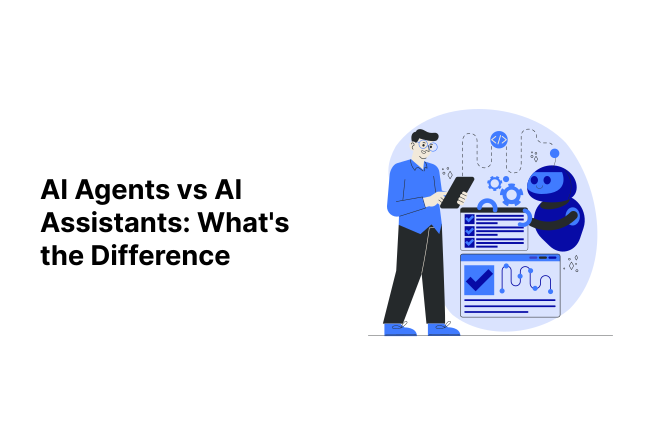
He wasn’t wrong to be confused. AI agents vs AI assistants difference is one of the most searched, most misunderstood topics in tech right now.
So let’s answer what is the difference between an AI agent and an AI assistant, really, in simple language, with real comparisons, the way we walked our client through it.
AI Agents vs AI Assistants
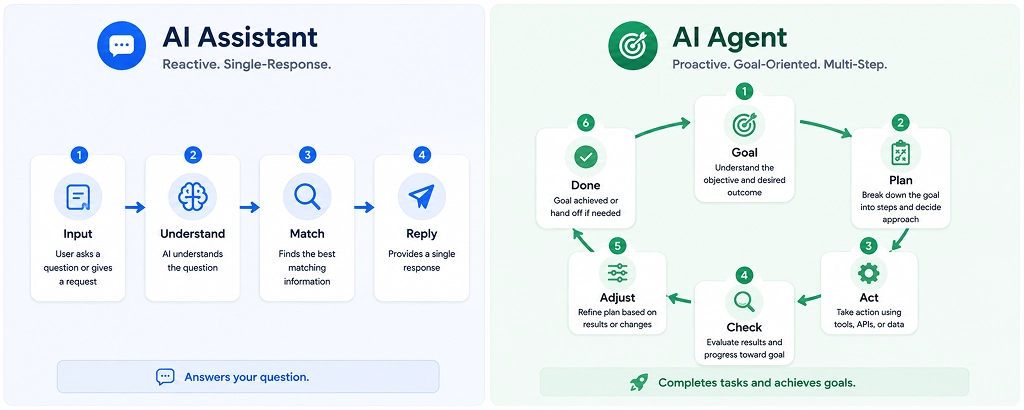
What is an AI Assistant?
Think of an AI assistant like a very capable front-desk employee. You ask, it answers. You give an instruction, it follows it. It doesn’t make judgment calls on its own; it waits for your input, processes it, and responds.
Technically, most AI assistants run on natural language processing (NLP) layered over predefined workflows or scripts. They understand what you’re asking and match it to the best pre-built response or action.
Siri setting a reminder, Alexa playing a song, or a chatbot answering “What are your business hours?”- these are all AI assistants at work.
In business settings, AI assistants show up as:
- Customer support chatbots answering FAQs
- Scheduling and calendar assistants
- Internal helpdesk bots that route tickets
- Voice assistants for basic commands
They’re reactive by nature; a reactive AI assistant vs proactive AI agent comparison starts right here. An assistant waits for a trigger. It doesn’t wake up and decide to do something on its own.
AI assistants are already changing how developers write, test, and debug software. For a deeper look at how these tools fit into the development lifecycle, see our guide to AI-assisted software development, including its benefits, common use cases, and practical workflow.
What is an AI Agent?
Now picture a project manager instead of a front-desk employee. You give them a goal, “increase our email open rates”, and they figure out the steps: research subject lines, run tests, analyze results, adjust strategy, and report back. You didn’t tell them how; you told them what.
That’s an AI agent, built to be autonomous and goal-driven, capable of breaking a big task into smaller steps, using tools (APIs, databases, other software) along the way, and adjusting its approach based on what it learns mid-task.
Under the hood, this is where AI agent tool use and goal-driven tasks come into play; agents don’t just respond to one prompt; they plan, execute, evaluate, and often loop back to try again if something didn’t work.
Common examples include:
- AI sales agents that research leads, personalize outreach, and follow up automatically
- Autonomous research agents that pull data from multiple sources and compile reports
- Workflow agents that manage multi-step business processes like invoice reconciliation or inventory reordering
This is the essence of multi-step AI agent workflows explained simply: one goal, many steps, minimal hand-holding.
If you’re considering building one for your business, see our guide on how to build a custom AI agent, including its features, tech stack, development process, and cost.
Key Differences: AI Agents vs AI Assistants (Comparison Table)
Here’s the table we sketched out on a whiteboard for our client; it’s the fastest way to see the gap.
| Factor | AI Assistant | AI Agent |
|---|---|---|
| Autonomy | Low — waits for user input | High — acts independently toward a goal |
| Decision-making | Follows predefined rules/scripts | Makes real-time decisions, adapts on the fly |
| Task complexity | Single-step, simple requests | Multi-step, complex workflows |
| Learning & adaptability | Limited, mostly static responses | Learns mid-task, adjusts strategy |
| Human oversight | Minimal supervision needed for basic tasks | Often needs checkpoints for high-stakes actions |
| Tool/system integration | Basic API calls (e.g., check weather, set reminder) | Deep integration — uses multiple tools/APIs to complete a goal |
This table captures the AI agent vs AI assistant autonomy and use cases question in one glance, autonomy is really the dividing line between the two categories.
How They Work Under the Hood
We get asked this a lot by technical founders. The easiest way to see it isn’t a paragraph, it’s watching each one work, step by step.
How an AI Assistant Works:
Your Input → Understand Intent (NLP) → Match to Pre-Built Response → Reply
That’s it. One question, one match, one answer. No planning, no tools, no memory of what happens next.
How an AI Agent Works:
Your Goal → Plan the Steps → Act (use tools/APIs) → Check the Result
↑ ↓
└───────────────── Adjust & Try Again ────────────────── Goal Met? No
↓
Yes → Done
See the difference? The assistant’s flow is a straight line. The agent’s flow is a loop; it keeps checking its own work and adjusting until the job is actually finished.
This is also where the AI agent vs AI chatbot vs AI assistant confusion comes from. A chatbot is the simplest of the three, rule-based, single-turn.
An assistant adds NLP and personalization on top. An agent adds planning, memory, and the loop above. Same ladder, three different rungs.
This distinction also helps explain Generative AI vs Agentic AI, generative AI primarily creates content, while agentic systems can plan and take actions toward a goal.
Real-World Use Cases by Industry
Having built AI-driven solutions across healthcare, ecommerce, and education, our team at Alphaklick has seen this play out in very different ways depending on the industry:
| Industry | AI Assistant Use Case | AI Agent Use Case |
|---|---|---|
| Healthcare | Symptom-checker chatbot answering basic queries | Agent that schedules appointments, checks insurance eligibility, and sends follow-up reminders autonomously |
| Ecommerce | Chatbot answering “Where’s my order?” | Agent that manages inventory, adjusts pricing, and triggers restocking based on demand |
| Education | Assistant answering FAQs about courses | Agent that tracks student progress across a video-based learning platform and auto-recommends next modules |
| Customer Service | Bot answering common support tickets | Agent that resolves a full complaint, checks order history, issues a refund, updates CRM, sends confirmation |
Notice the pattern: assistants handle the question, agents handle the outcome.
Healthcare is a strong example of where agents can move beyond answering questions to handling coordinated tasks. For a deeper look, see our guide to AI healthcare agent development, including use cases, compliance considerations, and costs.
Which One Does Your Business Need?
This is where our conversations with clients get interesting, because the honest answer is: it depends on what you’re trying to solve, not what sounds impressive.
Ask yourself these questions:
- Is the task single-step or multi-step? If it’s “answer this question,” you need an assistant. If it’s “handle this entire process,” you’re looking at an agent.
- Does it require decisions across multiple systems? Agents shine when they need to pull data from your CRM, check inventory, and update a spreadsheet, all in one flow. This is where AI workflow automation becomes especially valuable, connecting multiple tasks and systems into a more efficient end-to-end process.
- How much risk is involved? For high-stakes actions (refunds, medical info, financial transactions), you’ll want an agent with human checkpoints, not one running fully unsupervised.
- What’s your budget and timeline? Assistants are quicker and cheaper to deploy. Agents take more planning, more testing, and more oversight, but deliver deeper automation.
Our recommendation, based on what we’ve built for clients: start with an assistant if you’re automating conversations, and move to an agent once you’re ready to automate outcomes.
Knowing when to use an AI agent instead of an AI assistant often comes down to one test: if a human currently has to do five things in sequence to finish a task, that’s an agent’s job, not an assistant’s.
Because AI agents typically involve more complex workflows, integrations, and autonomous decision-making, their development costs can be higher. See our guide to AI agent development cost in 2026 for a detailed breakdown.
Market Insights: AI Assistants vs AI Agents
Numbers back up everything we just said:
| Metric | AI Assistants | AI Agents |
|---|---|---|
| 2026 Market Size | $10.11 billion | $12.06 billion |
| Projected by 2030 | $23.97 billion | $53.2 billion |
| CAGR | 24.10% | 44.90% |
| Enterprise Adoption | Widely deployed | 51%+ already in production |
Agents are growing nearly twice as fast as assistants, because businesses want AI that finishes the job, not just answers a question.
Sources: Research and Markets — AI Agents · Research and Markets — Virtual Assistants · Ringly.io — AI Agent Statistics 2026
How Alphaklick Can Help You Build the Right AI Solution
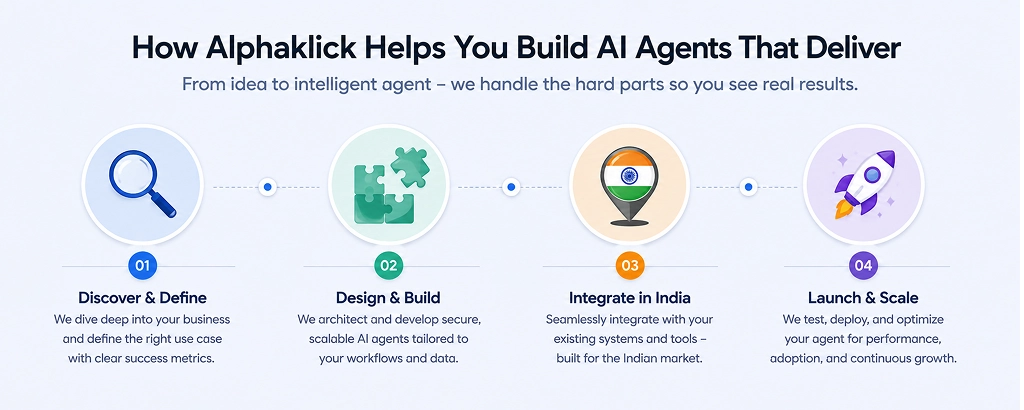
Not sure if your business needs a helper or a doer? That’s exactly the conversation our team at Alphaklick has with clients every week.
Here’s how we approach it:
- We map your workflow first: before recommending anything, we find out where your team is stuck answering the same questions vs. stuck doing the same multi-step process
- We build what fits, not what’s trendy: a lightweight AI assistant for conversations, or a goal-driven AI agent for full workflows
- Built by an AI mobile app development company in India: we’ve shipped AI assistants and agents inside mobile apps, web platforms, and backend systems for healthcare, ecommerce, and education clients
- End-to-end AI solutions: from strategy and architecture to deployment and support, so you’re not left managing the tech alone
Still deciding between an assistant and an agent? Let’s figure it out together. Book a free consultation with our team.
FAQs
Question: Is ChatGPT an AI agent or an AI assistant?
Answer: On its own, ChatGPT behaves like an AI assistant; it responds to your prompts. Connected to tools, memory, and multi-step actions (browsing, coding, calling APIs autonomously), it starts functioning as an AI agent.
Question: Can an AI assistant become an AI agent?
Answer: Yes. Many businesses start with an assistant and layer in tool use, memory, and autonomous decision-making over time, effectively evolving it into an agent.
Question: Are AI agents more expensive to build than AI assistants?
Answer: Generally, yes. Agents require more complex architecture, planning logic, tool integrations, and safety checkpoints, increasing development time and cost.
Question: What’s the difference between an AI agent and an AI chatbot?
Answer: A chatbot is rule-based and handles single-turn conversations. An assistant adds NLP and context-awareness. An agent adds autonomous planning and multi-step task execution. If a chatbot is the right fit for your app, here’s our complete guide to integrating an AI chatbot into your mobile app.
Question: Do AI agents need human supervision?
Answer: For most business use cases, yes, especially for high-stakes actions like payments or medical decisions. Human-in-the-loop checkpoints are best practice even for advanced agents.
Question: Which is better for customer support, an AI agent or AI assistant?
Answer: Simple FAQ handling works well with an assistant. If you want the system to fully resolve issues (refunds, order changes) without human intervention, an agent is the better fit.