If you’ve asked “how much does it cost to build an AI agent,” you’ve probably gotten wildly different answers, anywhere from a few thousand dollars to well over $200,000.
Both answers can be true. It depends entirely on what you’re building.
This guide breaks down AI agent development cost 2026 using real project patterns, not vague “it depends” answers.
You’ll see cost by agent type, by complexity, by industry, and by build approach, so you walk away with a number you can actually plan around.
AI Agent Market Size in 2026
Before getting into pricing, it helps to know why costs are moving the way they are. Demand is climbing fast across every major research firm’s forecast, and rising demand is exactly what pushes mobile app developer rates and specialization premiums up.
| Source | 2026 Market Value | Projected Value | CAGR |
|---|---|---|---|
| Grand View Research | $10.9 billion | $182.9 billion by 2033 | 49.60% |
| MarketsandMarkets | ~$10.9 billion | $52.62 billion by 2030 | 46.30% |
| Research and Markets | $12.06 billion | $53.2 billion by 2030 | 45.50% |
The numbers vary slightly by methodology, but the pattern is consistent across every firm: the AI agent market is roughly $10–12 billion in 2026 and growing at a 45–50% CAGR.
As more enterprises move from pilot projects into full production, competition for skilled AI agent developers increases too, which is a direct driver of the pricing you’ll see in this guide.
Types of AI Agents (and How Type Affects Cost)
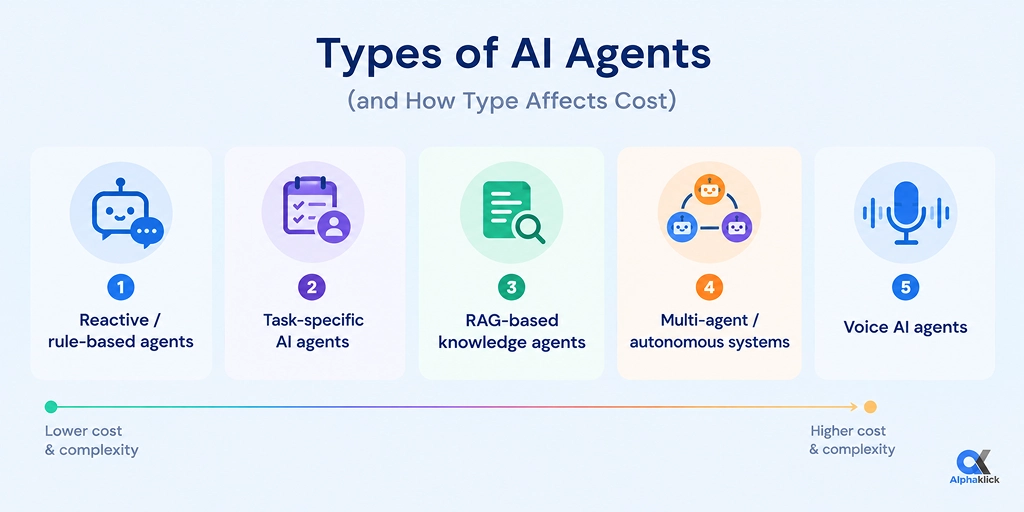
Not all “AI agents” are the same product, and that’s the biggest reason cost estimates vary so much online.
- Reactive/rule-based agents: follow scripted logic with no real reasoning, think FAQ bots. Cheapest and fastest to ship since there’s no fine-tuning involved.
- Task-specific AI agents: handle one defined job, like lead qualification or scheduling, using an LLM plus a CRM or database connection.
- RAG-based knowledge agents: pull answers from your own documents instead of general knowledge, requiring a vector database and retrieval logic, pushing cost into the mid-range.
- Multi-agent/autonomous systems use several agents working together to complete a workflow. They’re the most expensive because of orchestration and failure-handling logic.
- Voice AI agents: add speech-to-text, text-to-speech, and latency handling on top of the core agent, landing in the medium-to-high range.
Understanding how AI agents differ from AI assistants can also help you choose the right solution for your business.
What Actually Determines the Cost of an AI Agent
| Cost Factor | Why It Moves the Price |
|---|---|
| LLM/API choice | Premium models (GPT-5, Claude) cost more per call than smaller/open-source models |
| Integrations | Each CRM, ERP, or database connection adds development and testing time |
| Data engineering & RAG setup | Building a searchable knowledge base is a project in itself |
| UI/UX and channel | Web widget is cheapest; multi-channel (app, Slack, voice) adds cost |
| Security & compliance | Healthcare/fintech agents need extra guardrails, audits, and access controls |
| Team & location | Agency/offshore teams are typically 40–60% cheaper than US in-house hires |
These six factors explain almost every quote gap you’ll see between vendors. Two agencies quoting the same “AI agent” can be $10,000 apart simply because one is pricing in HIPAA-level compliance and the other isn’t.
AI Agent Development Cost
AI Agent Development Cost by Agent Complexity
| Agent Complexity | Typical Cost Range (2026) | Timeline | Example |
|---|---|---|---|
| Basic rule-based/chat agent | $3,000 – $15,000 | 2–4 weeks | Website chatbot, FAQ assistant |
| Single-task AI agent (custom) | $15,000 – $50,000 | 4–10 weeks | Sales qualification agent with CRM sync |
| Multi-agent / autonomous system | $50,000 – $150,000+ | 3–6 months | Order-to-fulfillment automation with handoffs |
| Enterprise-grade with full integrations | $100,000 – $250,000+ | 4–9 months | Multi-department agent with compliance layer |
This is where a custom AI agent build cost by complexity breakdown matters more than a single “average price.”
Here’s what each tier actually includes:
- Basic rule-based/chat agent ($3,000–$15,000): Scripted flows, simple intent matching, no session memory. Features: web chat widget, pre-set responses, human handoff. Ships in 2–4 weeks with no fine-tuning needed.
- Single-task AI agent ($15,000–$50,000): Uses an LLM for real understanding, plus one or two live integrations (CRM, calendar, database). Features: context memory, structured data capture, basic error handling. Prompt engineering and edge-case testing drive the added cost.
- Multi-agent/autonomous system ($50,000–$150,000+): Multiple agents coordinating on a shared workflow, one plans, one executes, one verifies. Features: inter-agent communication, task hand-offs, retry logic, monitoring dashboards. The cost jump is almost entirely orchestration and QA work.
- Enterprise-grade with full integrations ($100,000–$250,000+): Everything above, plus deep ERP/legacy-system integration, compliance layers, role-based access control, and audit logging. Longer staged rollout pushes timelines to 4–9 months.
Multi-agent systems fall firmly in the multi-agent system development pricing 2026 bracket, reflecting that added orchestration complexity rather than a pricier model.
For a deeper look at the features, tech stack, development process, and costs involved, see our guide on how to build a custom AI agent.
AI Agent Development Cost by Industry
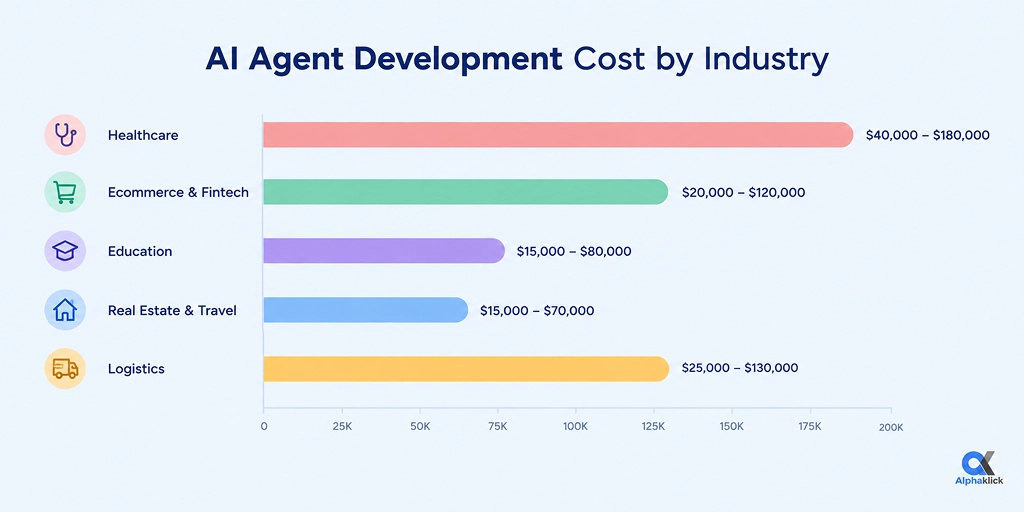
| Industry | Typical Cost Range | Common Use Case |
|---|---|---|
| Healthcare | $40,000 – $180,000 | Patient triage, appointment agents (HIPAA compliance adds cost) |
| Ecommerce & Fintech | $20,000 – $120,000 | Personalized shopping agents, fraud-check assistants |
| Education | $15,000 – $80,000 | Tutoring agents, student support bots |
| Real Estate & Travel | $15,000 – $70,000 | Listing search agents, booking assistants |
| Logistics | $25,000 – $130,000 | Route optimization, inventory agents |
- Healthcare: sits at the top of the range mainly because of HIPAA compliance; every agent touching patient data needs encryption, access controls, and audit trails built in from day one, which adds weeks of extra engineering and legal review before launch.For a detailed look at healthcare AI agents, including use cases, compliance requirements, and development costs, see our guide to AI healthcare agent development.
- Ecommerce & Fintech: costs vary widely depending on whether the agent handles payments or fraud detection (higher cost, PCI-DSS considerations) versus simple product recommendations (lower cost, minimal compliance overhead).
- Education: tends to be more affordable because tutoring and student-support agents usually work with lower-stakes data and simpler integrations, mainly an LMS or student database rather than financial or medical systems.
- Real Estate & Travel: agents are often listing-search or booking assistants that connect to a handful of APIs (MLS data, booking engines), which keeps development relatively contained compared to compliance-heavy industries.
- Logistics: costs climb when agents need to plug into route-optimization engines, inventory systems, and real-time tracking data across multiple warehouses or carriers, which is more integration-heavy than most other sectors.
This is a useful enterprise AI agent pricing breakdown view if you’re comparing your project against your specific sector rather than a generic average.
One-Time Build Cost vs. Ongoing Costs
| Cost Type | What It Covers | Typical Range |
|---|---|---|
| One-time development | Design, build, testing, deployment | $3,000 – $250,000+ (see tiers above) |
| LLM/API usage (monthly) | Token consumption based on volume | $50 – $5,000+/month |
| Hosting & infrastructure | Servers, vector database, storage | $50 – $1,500/month |
| Monitoring & maintenance | Bug fixes, performance checks, retraining | $500 – $5,000/month |
- One-time development: covers discovery, design, build, testing, and go-live, the number most businesses negotiate upfront, but only half the total investment.
- LLM/API usage is billed by the token, scaling with how many conversations your agent handles, from $50/month for low traffic to thousands for high-volume, customer-facing use.
- Hosting & infrastructure covers servers, vector database, and storage. Usually predictable, unlike token costs, which can spike with usage.
- Monitoring & maintenance keeps the agent accurate over time, retraining, fixing edge cases, and watching for performance drift. Skipping this is the top reason agents degrade after launch.
The build cost is only half the picture. AI agent monthly operating and token costs scale directly with usage; the more conversations or tasks your agent handles, the higher your monthly LLM bill climbs. Budget for ongoing costs from day one, not as an afterthought.
In-House vs. Freelancer vs. Agency: Cost Comparison
| Option | Cost | Speed | Quality Control | Scalability Risk |
|---|---|---|---|---|
| In-house team | Highest (salaries + benefits) | Slower to start | High (if skilled) | Low |
| Freelancer | Lowest upfront | Fast, but inconsistent | Variable | High |
| Agency | Mid-range | Balanced | Structured process | Low |
- In-house team: This is the most expensive route once you factor in salaries, benefits, and the time it takes to hire the right AI talent. The payoff is long-term control, your team understands the business deeply and can iterate on the agent continuously without renegotiating scope each time.
- Freelancer: The cheapest upfront option and often the fastest way to get a prototype working, since you’re paying for hours rather than overhead. The risk is consistency, quality varies a lot between freelancers, and if the person becomes unavailable mid-project, you can lose momentum and institutional knowledge overnight.
- Agency: Sits in the middle on cost, above a freelancer but below hiring in-house, while offering a structured development process, a full team (not just one person), and accountability through contracts and milestones. This is usually the best fit for businesses that want reliability without the overhead of building an internal AI team.
There’s also a build-approach decision layered on top: a low-code vs custom AI agent cost comparison typically shows low-code platforms costing $0–$5,000/month in subscription fees but hitting a ceiling fast on customization. Custom development costs more upfront but scales with your business logic instead of fighting the platform’s limits.
Case Study: What a Real Project Looked Like
Client demand: An event photography business wanted to stop manually sorting thousands of photos after every event and instead let guests find their own photos automatically.
What we built: SooraApp, an AI-powered event photo-sharing platform where an agent automatically matches faces across uploaded images and delivers a personalized gallery to each guest.
Tech stack used: AI-based facial recognition and image-matching models, a custom matching agent layer, cloud storage for high-volume images, and a guest-facing web app.
How to Reduce AI Agent Development Costs Without Cutting Corners
- Start with an MVP: Build the single-task version first, prove it works, then expand into a multi-agent system later instead of building everything at once.
- Use existing frameworks: LangChain, AutoGen, and similar tools cut weeks off development compared to building orchestration from scratch.
- Match the model to the task: Not every function needs your most expensive LLM; routing simple queries to a cheaper model can cut token costs significantly.
- Phase your integrations. Connect the one or two systems that matter most first; add the rest after launch.
ROI: What Businesses Get Back
Roughly 51% of enterprises already have AI agents in production, largely because the payback shows up fast in reduced manual labor. Don’t just look at the build price; calculate AI agent ROI and total cost of ownership using this formula:
ROI (%) = [(Total Value Gained − Total Cost of Ownership) / Total Cost of Ownership] × 100
Total Cost of Ownership = One-time build cost + (Monthly operating cost × 12)
Total Value Gained = Labor hours saved + Faster conversion revenue + Error-reduction savings
Example: a $30,000 agent with $500/month operating cost has a year-one TCO of $36,000. If it saves $60,000 in labor and adds $10,000 in faster-converted leads, that’s $70,000 in value — roughly 94% ROI. Most task-specific agents break even within 6–12 months.
Conclusion
AI agent development costs in 2026 range from a few thousand dollars for a basic chatbot to well over $200,000 for an enterprise multi-agent system, and the real number for your business depends on agent type, complexity, industry compliance needs, and whether you go in-house, freelance, or agency.
The mistake most businesses make isn’t picking the wrong price tier; it’s forgetting to budget for ongoing token, hosting, and maintenance costs after launch.
At AlphaKlick AI Solutions, we help businesses scope AI agent projects the right way from the start, matching complexity to actual business need instead of overbuilding or underbuilding.
The best next step is to scope your specific use case- one task, one integration, one workflow- and get a quote based on that, rather than a generic “AI agent” estimate.
Book a Free Consultation with our AI team to get a cost estimate tailored to your project.
FAQs
Question: How much does a simple AI agent cost?
Answer: A basic rule-based or single-task agent typically costs $3,000–$15,000, depending on how many integrations it needs and whether it requires custom UI. Simple FAQ bots and query routers sit at the lower end, while agents that connect to a CRM or booking system land closer to $15,000.
Question: What’s the cheapest way to build an AI agent?
Answer: Low-code platforms and pre-built agent tools are the cheapest entry point, often available for a monthly subscription instead of a large upfront build cost. The trade-off is customization; you’re working within the platform’s limits, which can become restrictive as your use case grows more specific.
Question: Do AI agents have ongoing costs after launch?
Answer: Yes, expect monthly LLM/API usage, hosting, and maintenance costs on top of the one-time build cost. These can range from under $100/month for a low-traffic internal tool to several thousand dollars monthly for a high-volume, customer-facing agent, so it’s worth budgeting for usage growth from the start.
Question: How long does an AI agent take to build?
Answer: Anywhere from 2 weeks for a basic agent to 6–9 months for an enterprise multi-agent system. Timeline mostly depends on the number of integrations, compliance requirements, and how much testing is needed before the agent can safely handle real user interactions.
Question: Is it cheaper to use ChatGPT/Claude APIs or build custom?
Answer: Using APIs directly is cheaper upfront since you skip most development work, but custom development gives you agent behavior, memory, integrations, and business logic that off-the-shelf chat tools can’t match. For most businesses, a hybrid approach- a custom agent built on top of an existing LLM API- offers the best balance of cost and capability.