Video has become the default way people learn online, easier to follow, retain, and revisit than plain text, whether it’s a student catching up on a lecture or an employee finishing a compliance module between meetings.
This shift has pushed ed-tech founders, institutions, and corporate L&D teams toward video-based learning platform development as a serious business opportunity rather than a side project.
If you’re exploring how to build a video learning platform for your own audience, this guide covers the features, technology, process, and cost involved, explained in a way that’s technically accurate but still easy to follow, even if you’re not a developer.
What Is a Video-Based Learning Platform?
A video-based learning platform is a digital product where video is the primary teaching format, not just an add-on. Unlike a basic LMS that mainly tracks documents and quizzes, a video-first platform is architected around streaming, structured courses, and interactivity from the ground up.
As an experienced Education Software Development Company, we understand that these platforms require a purpose-built technology architecture designed around seamless video delivery and learner engagement.
This is the key difference between an LMS with video integration, where video is one resource among many, and a true video-based platform, where adaptive playback, offline access, and content protection are core, not optional.
Market Growth & Why Businesses Are Investing in Video Learning
Corporate training budgets are shifting from in-person workshops toward on-demand video modules, fueling steady growth in corporate training video platform development. The numbers back this up:
| Market Segment | Current Size | Projected Size | CAGR | Source |
|---|---|---|---|---|
| Global E-Learning Services Market | $352.98B (2025) | $1,485.00B by 2033 | 19.90% | Grand View Research |
| Corporate E-Learning Market | $104.32B (2024) | $334.96B by 2030 | 21.70% | Grand View Research |
| Global Video Streaming Market | $191.1B (2026) | $416.8B by 2030 | 21.50% | Grand View Research |
For businesses, the appeal is simple: video content scales. A recorded module can be delivered to ten learners or ten thousand without extra instructor time, making video-based platforms far more cost-effective in the long term than live-only training.
Who Can Benefit from a Video-Based Learning Platform?
Ed-tech startups building subscription-based course libraries from scratch
Corporate L&D teams rolling out onboarding, upskilling, and compliance training at scale
Universities and coaching institutes digitizing lecture delivery for hybrid or fully remote classrooms
Independent creators and subject-matter experts monetizing structured video courses
Enterprises needing internal knowledge-sharing platforms for distributed teams
Each of these use cases shares a common need: reliable video streaming for e-learning platforms, paired with tools to organize, track, and monetize content effectively as the learner base grows.
Educational institutions can also combine video learning with AI automation for educational institutions to streamline administrative workflows, learner support, assessments, and other repetitive processes.
Types of Video-Based Learning Platforms
| Platform Type | Best For | Key Characteristic |
|---|---|---|
| On-Demand Course Platforms | Course creators, ed-tech startups | Pre-recorded lessons, self-paced learning |
| Live + Recorded Hybrid | Coaching institutes, universities | Real-time classes with recorded backups |
| Microlearning / Short-Video | Corporate training | Bite-sized videos, high completion rates |
| Corporate Training / LMS-Integrated | Enterprises | Compliance tracking, certification, reporting |
How Top Platforms Compare: Udemy vs Coursera vs MasterClass
| Feature | Udemy | Coursera | MasterClass |
|---|---|---|---|
| Content Model | Open marketplace | University & company partnerships | Curated celebrity-led courses |
| Pricing | Pay-per-course | Subscription + certificates | Flat annual subscription |
| Certification | Limited/basic | Strong (university-backed) | None |
The takeaway: there’s no single “correct” model. Deciding your positioning- marketplace, academic, or premium- should happen before development starts, since it directly shapes your feature list and cost.
Must-Have Features of a Video-Based Learning Platform
A strong list of e-learning video platform features includes:
Adaptive video streaming & player: auto-adjusts quality based on internet speed, switching resolutions in real time to prevent buffering
Course & content management system (CMS): lets instructors organize lessons into modules, chapters, and prerequisites without needing developer support
User roles: separate, purpose-built dashboards for learners, instructors, and admins
Interactive elements: quizzes, downloadable notes, and in-video questions that convert passive watching into active learning
Progress tracking & certification: completion percentages, milestone badges, and downloadable certificates
Offline viewing & DRM protection: encrypted downloads for access without a stable internet connection
Discussion forums: comment threads under each lesson that reduce learner drop-off caused by getting stuck
Payment gateway & subscriptions: one-time purchases, recurring billing, and regional payment support
These features form the baseline expected by users familiar with platforms like Udemy or Coursera, and skipping any of them tends to show up quickly in poor retention.
For platforms focused on personalized learning, AI skills assessment platform development can help evaluate learner abilities, identify knowledge gaps, and recommend suitable learning paths.
Advanced Features That Set a Platform Apart
AI-based content recommendations: suggest the next relevant course based on watch history and quiz scores
Auto-generated subtitles & transcripts: improve accessibility and content discoverability
Video analytics & engagement heatmaps: show exactly where learners drop off, guiding content improvements
Gamification: points, streaks, and leaderboards that boost completion rates
Multi-language support: full localization to widen your addressable audience
AI-powered features can go beyond recommendations. An AI tutoring chatbot for EdTech apps can answer learner questions, explain concepts, provide personalized guidance, and keep students engaged between lessons.
How Video Streaming & Content Delivery Actually Work
When a video is uploaded, it’s encoded into multiple resolutions and split into chunks using HLS or MPEG-DASH. The player then automatically switches between resolutions based on the learner’s internet speed; this is adaptive bitrate streaming, and it’s what prevents constant buffering. Content is distributed through a CDN, a network of servers close to users geographically, so videos load fast anywhere.
For offline downloads, videos are encrypted with DRM, tying playback to a licensed device and preventing unauthorized sharing, a core piece of any solid educational video platform architecture.
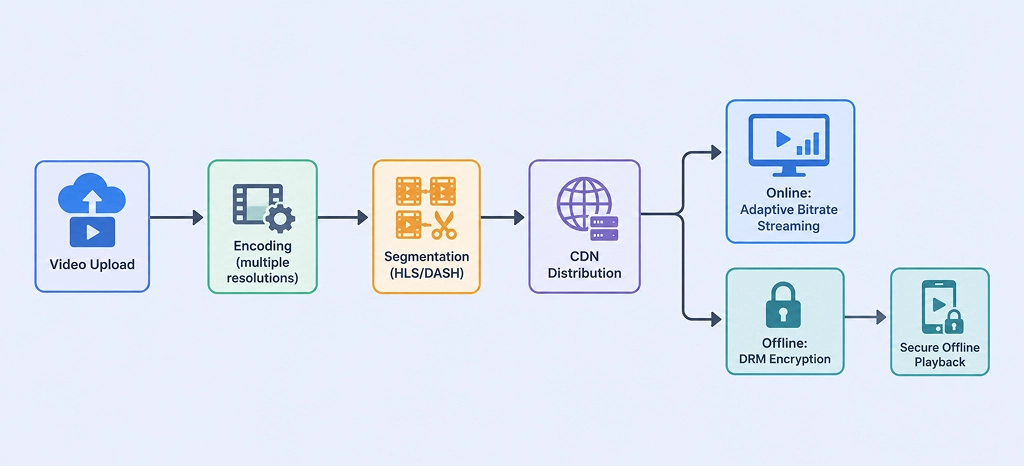
A weak link anywhere in this chain- poor encoding, a badly configured CDN, or missing DRM- shows up immediately to the learner as buffering, slow loading, or failed downloads, which is why getting this pipeline right early matters so much.
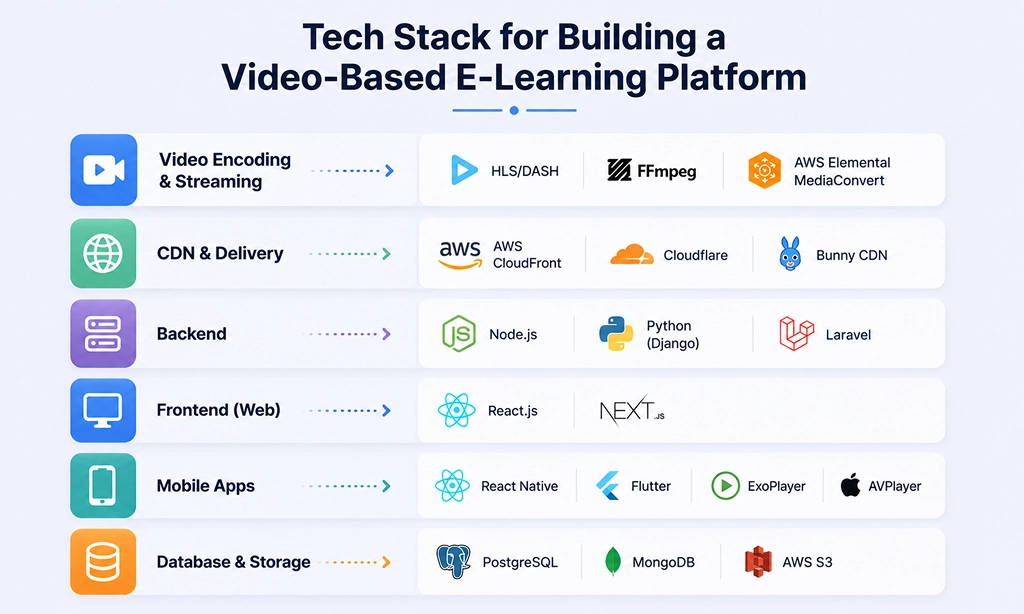
Tech Stack for Building a Video-Based Learning Platform
| Layer | Common Technologies |
|---|---|
| Video Encoding & Streaming | HLS/DASH, FFmpeg, AWS Elemental MediaConvert |
| CDN & Delivery | AWS CloudFront, Cloudflare, Bunny CDN |
| Backend | Node.js, Python (Django), Laravel |
| Frontend (Web) | React.js, Next.js |
| Mobile Apps | React Native, Flutter, ExoPlayer, AVPlayer |
| Database & Storage | PostgreSQL, MongoDB, AWS S3 |
This online learning platform tech stack directly affects performance, scalability, and hosting costs, which is why it should be finalized before development begins.
Step-by-Step Video-Based Learning Platform Development Process
Building a video-based learning platform follows a structured path, with the right technology applied at each stage:
1. Discovery & Requirement Analysis
This is where the platform type, target audience, monetization model, and must-have features get defined. Decisions made here, like whether to support live streaming or go on-demand only, directly shape the architecture and cost of everything that follows.
2. UI/UX Design
Wireframes and interactive prototypes, typically built in Figma, map out the learner journey from sign-up to course completion. For a video-first platform, special attention goes into the video player layout, offline download flow, and how progress and certificates are displayed.
3. Streaming Infrastructure Setup
This is the technical backbone of the platform: setting up the video encoding pipeline (FFmpeg), configuring CDN delivery (AWS CloudFront or Cloudflare), and implementing DRM for offline protection. The backend itself is typically built using Node.js, Django, or Laravel, with a database like PostgreSQL or MongoDB handling user data, course structures, and progress tracking.
4. App Development
The web platform is built using React.js or Next.js for a fast, responsive interface, while mobile apps are developed in React Native or Flutter to cover both Android and iOS from a shared codebase. Native video players like ExoPlayer (Android) and AVPlayer (iOS) are integrated at this stage to ensure smooth, adaptive playback on mobile devices.
5. Testing & QA
Beyond standard functional testing, video platforms need specific checks: playback across different devices and network speeds, offline download and DRM license validation, and load testing to simulate concurrent-user traffic during peak hours, such as exam season or a course launch.
6. Deployment & Launch
The platform goes live on cloud infrastructure (AWS S3 for storage, CloudFront for delivery), with monitoring tools set up to track streaming performance, server load, and error rates from day one, so issues can be caught and fixed before they affect a large number of learners.
This process is what turns a feature list into a working video-based learning platform development project, with each phase tied directly to the tech stack that supports it.
Skipping steps, particularly load testing or DRM configuration, is one of the most common reasons platforms struggle to scale after launch.
If you’re considering a broader e-learning mobile app development project rather than a video-first platform, the development process, features, costs, and technology choices can vary significantly.
Cost Breakdown for Video-Based Learning Platform Development
| Platform Tier | Typical Scope | Estimated Cost Range |
|---|---|---|
| Basic | Web-only, on-demand videos, basic CMS | $15,000 – $30,000 |
| Mid-Level | Web + mobile apps, offline download, payments | $30,000 – $60,000 |
| Enterprise | Live streaming, AI recommendations, DRM, analytics | $60,000 – $120,000+ |
Costs also depend on development team location; rates in India are typically lower than the US or UK for comparable quality, plus ongoing expenses like CDN bandwidth, cloud storage, and maintenance after launch.
Case Study: Video Learning Platform for a Multi-Batch Education Institute
Client Requirement: An education institute running multiple student batches needed a platform supporting live and recorded lecture delivery, offline downloads for students with unreliable internet, secure document exchange between instructors and students, and fee payment processing, all without slowdowns during peak exam-season traffic when hundreds of students logged in around the same time.
What We Delivered: Simultaneous login support for 200+ concurrent students, fast video downloads and recordings, secure document exchange between instructors and students, and smooth payment processing, built on a scalable backend with CDN-backed video delivery and a cross-platform mobile app covering both Android and iOS from a single codebase.
Result: The platform handled 200+ simultaneous logins without performance dips, delivered quick downloads and recordings even during peak usage, and processed transactions and document exchange smoothly throughout, turning a previously fragmented, manual setup into one reliable, scalable system the institute could depend on every exam season.
How Alphaklick Helps You Build a Video-Based Learning Platform
Alphaklick Solutions is a mobile app development company in India with hands-on experience across education technology and AI-powered platforms. For video-based learning platform development, the team brings:
End-to-end development, discovery, UI/UX, backend infrastructure, and post-launch support
Proven education-sector experience, including LMS and student portal development
AI integration for recommendations, chatbots, and content tagging
Scalable architecture built to handle concurrent users and high video traffic
Cross-platform development using React Native, Flutter, and React.js/Next.js
With offices in Jaipur, Bangalore, and New York, Alphaklick combines the cost advantages of an India-based team with responsive US-facing support.
If you’re ready to discuss your requirements, timeline, and budget, you can book a free consultation, no commitment required.
FAQs
Question: How long does it take to build a video-based learning platform?
Answer: A basic platform typically takes 3–4 months, while an enterprise-level platform with live streaming and AI features can take 6–9 months.
Question: Can I add offline download later instead of at launch?
Answer: Yes, but it’s more cost-effective to plan DRM and offline architecture from the start, since retrofitting it later often requires backend changes.
Question: Is React Native good enough for a video learning mobile app?
Answer: Yes, paired with native players like ExoPlayer and AVPlayer, it handles video-heavy apps well while keeping cost and development time lower than fully native builds.
Question: What’s the difference between an LMS and a video-based learning platform?
Answer: An LMS is broader and document/quiz-focused; a video-based learning platform is architected specifically around video delivery and video-first engagement tools.