What if every student, in every school, had access to a tutor who never got tired, never ran out of patience, and was available at 11 PM before an exam?
That’s the question I keep coming back to whenever a school, university, or EdTech founder reaches out asking about AI tutoring chatbot development.
It’s not a hypothetical anymore. From doubt-solving mobile apps to full-scale virtual tutors, AI tutors have moved from “interesting idea” to one of the most requested features in modern EdTech products.
But turning “we want an AI tutor” into a working, safe, and scalable product needs the right architecture, the right tech stack, and a realistic budget, not just a chatbot bolted onto a mobile app.
This guide breaks down exactly how an AI tutor chatbot for education is built in 2026, from core features to system architecture, tech stack choices, and AI tutoring chatbot cost, in plain, non-technical language.
What is an AI Tutoring Chatbot?
An AI tutoring chatbot is very different from a basic FAQ bot or a static quiz tool inside an LMS. A true AI tutor chatbot for education understands a student’s question, explains concepts in multiple ways, adjusts to their pace, and tracks progress over time, much like a human tutor would.
Institutions are exploring this technology under a few common names, all pointing to the same core idea:
- AI Teacher: acts as a classroom co-pilot, explaining concepts, answering “why” questions, and reinforcing what was taught in class. Unlike a textbook, it can rephrase the same concept three different ways until it actually clicks for that specific student.
- AI Homework Assistant: helps students work through assignments step-by-step instead of just giving final answers. It nudges students toward the reasoning process, catching mistakes in logic rather than just marking an answer wrong.
- AI Learning Assistant: an always-available study companion for revision, doubt-clearing, and practice, especially useful outside school hours when a human teacher or tutor isn’t reachable.
- AI Exam Preparation: generates mock tests, identifies weak topics, and builds a targeted revision plan based on actual performance data rather than a generic syllabus checklist.
- Personalized Learning: the outcome all of the above are working toward: every student getting a learning path suited to their own pace, strengths, and gaps, instead of a one-size-fits-all curriculum.
If you’re exploring how adaptive algorithms improve student outcomes beyond chatbots, read our guide on AI-powered personalized learning experiences in mobile apps.
Whether it’s branded as a smart AI tutor chatbot or an AI learning assistant mobile app, the underlying goal is the same: using AI to make learning more responsive and personal at a scale no human tutor team could match.
Core Features of a Production-Grade AI Tutoring Chatbot
Before jumping into architecture, it helps to know what a real, classroom-ready edtech mobile app AI chatbot actually needs to do well:
- Adaptive explanations: rephrasing the same concept in simpler terms if a student doesn’t understand it the first time, and gradually increasing complexity as the student shows mastery, instead of repeating the same explanation on a loop
- Voice tutoring: letting students ask questions out loud and hear spoken responses back, which is especially useful for younger learners who aren’t confident typing yet, and for students with reading or visual difficulties
- Multi-modal input: accepting typed questions, photos of handwritten math problems, diagrams, or even screenshots of a textbook page, so students aren’t limited to typing out complex equations
- Progress dashboards: giving students, parents, and teachers visibility into what’s been learned, what needs work, and how consistently a student is engaging with the platform week over week
These features are what separate a genuine AI chatbot for learning mobile apps from a chatbot that simply answers questions without understanding the learner behind them.
AI tutoring chatbots are just one part of a modern EdTech platform. Our complete eLearning app development guide explains the features, development process, and costs of building a scalable learning solution.
System Architecture: How an AI Tutoring Chatbot Actually Works
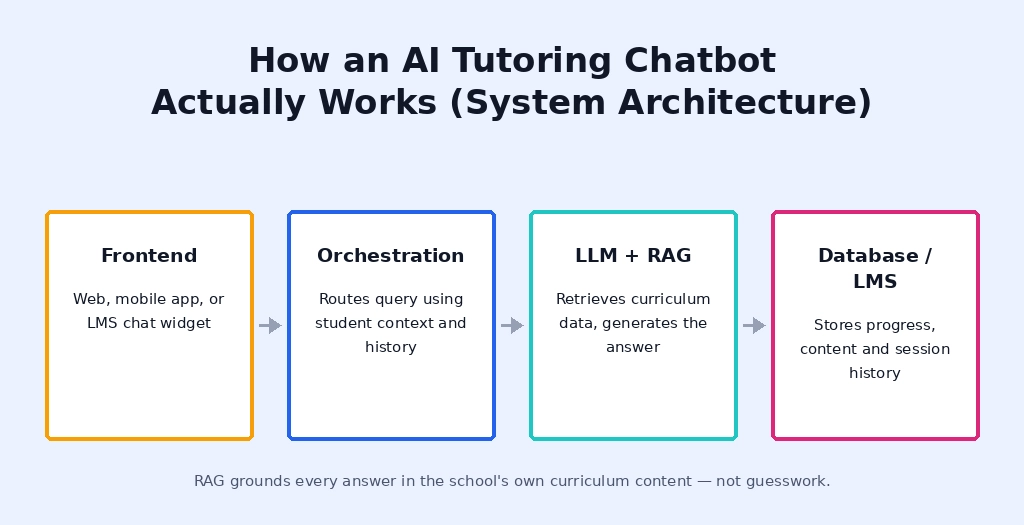
At a high level, every AI tutoring chatbot has four connected layers:
- Frontend: the chat interface students interact with, whether that’s a web app, a mobile app, or a chat widget embedded directly inside an existing LMS. This layer also handles voice input/output and image uploads for handwritten questions.
- Orchestration layer: the “brain” that decides how to respond. It pulls in the student’s history, current session context, and grade level, then routes the request to the right retrieval and generation steps before a response goes back to the student.
- LLM + RAG layer: the AI model that generates the actual answer, but only after retrieving relevant, verified content so the response stays grounded in curriculum rather than the model’s general knowledge.
- Database/LMS layer: stores student progress, curriculum content, session history, and analytics data, and syncs back with the school’s or platform’s existing LMS or student information system so nothing lives in a silo.
The most important piece here is RAG (Retrieval-Augmented Generation). Instead of letting the AI model answer purely from its general training, RAG connects it to your school’s or platform’s own textbooks, syllabus, and approved study material.
When a student asks a question, the system first retrieves the most relevant content from this trusted source, then uses the AI model to turn it into a clear, conversational answer.
This is what keeps responses accurate and aligned with what’s actually being taught, a core requirement in any serious AI tutoring chatbot development project.
AI tutoring can be combined with video-based learning platform development to create engaging learning experiences with video lessons, interactive content, and real-time AI support.
The Adaptive Learning Engine: Powering Real Personalization
Adaptive learning is what turns a chatbot into a genuine personalized learning chatbot. Here’s how it works in simple terms:
- The system tracks how a student performs on each topic: right answers, wrong answers, time taken, and questions asked
- This performance data feeds back into the model, adjusting difficulty and explanation style for the next interaction
- Combined with RAG, the chatbot doesn’t just answer questions — it notices patterns, like a student repeatedly struggling with fractions, and proactively offers extra practice
This feedback loop is what makes an AI tutor feel personal instead of generic, and it’s usually the single biggest differentiator between a basic chatbot and a genuinely effective learning assistant.
Tech Stack Breakdown
The right stack depends on your budget, scale, and existing systems, but most modern platforms follow a similar pattern:
| Layer | Common Tools | Purpose |
|---|---|---|
| LLM / AI model | OpenAI GPT models, Claude, or fine-tuned open-source models | Generates explanations and answers (GPT integration is common here) |
| Voice stack | Speech-to-text and text-to-speech APIs | Powers voice tutoring and accessibility features |
| Orchestration & RAG | LangChain, LangGraph, vector databases (Pinecone, Weaviate) | Connects the AI model to curriculum content |
| Backend | FastAPI, Node.js | Handles logic, APIs, and integrations |
| Frontend | React, React Native | Student-facing chat interface, web or mobile |
| Infrastructure | AWS, GCP | Hosting, scaling, and data storage |
Choosing between a general-purpose model with GPT integration versus a fine-tuned open-source model is one of the highest cost and performance decisions in any build AI tutoring chatbot project. General models are faster to launch, while fine-tuned models offer more control over tone and accuracy for younger learners.
Student Analytics: Turning Interactions into Actionable Insight
A tutoring chatbot generates a huge amount of data, and that data is only useful if it’s turned into insight. A good analytics layer tracks:
- Topic-level mastery (which concepts a student has actually understood)
- Engagement patterns (time spent, questions asked, drop-off points)
- Early warning signs, like a sudden dip in activity or repeated wrong answers
This data isn’t just for reporting; it feeds back into the adaptive learning engine, helping the chatbot keep improving its own responses over time, and gives teachers a dashboard that’s actually useful for intervention rather than just a vanity metric.
Institutions looking to modernize operations can also explore how AI automates educational institutions, covering admissions, administration, learning management, and student support.
AI Safety, Bias & Hallucination Prevention
Because this technology talks directly to students — often minors — safety cannot be an afterthought. A responsible AI tutoring chatbot development process includes:
- Hallucination prevention through RAG, so answers are grounded in verified curriculum content instead of the model’s own guesses
- Human-in-the-loop review, where educators periodically audit chatbot responses for accuracy and tone
- Age-appropriate response tuning, adjusting language complexity and content filters based on the student’s grade level
- Bias auditing, checking that explanations and examples are fair and inclusive across subjects and demographics
Getting this right is what separates a trustworthy smart AI tutor chatbot from one that risks giving students confidently wrong information.
Data Privacy & Compliance
Because AI tutors handle student data, compliance isn’t optional. Depending on your target market, this typically includes:
- COPPA: for platforms used by children under 13 in the US
- FERPA: protecting US student education records
- GDPR: for platforms serving users in the EU, covering consent and data rights
Compliance needs to be built in from day one, not added later. Retrofitting privacy controls into an existing system is far more expensive than designing for it upfront.
Development Process: From MVP to Full Platform
Building an AI tutoring chatbot isn’t a single build-and-launch project; it’s a phased process, and skipping phases is usually where budgets and timelines go wrong. Here’s how a technically sound rollout typically looks:
1. Discovery & content mapping
Before any code is written, the curriculum needs to be structured into a format the AI model can retrieve from.
This means breaking down textbooks and syllabus content into indexed chunks, defining the subjects and grade levels in scope, and choosing which AI model (GPT-based, Claude, or a fine-tuned open-source model) fits the budget and accuracy needs.
2. RAG pipeline setup
The curriculum content is converted into vector embeddings and stored in a vector database, so the system can retrieve the most relevant material for any given student question.
This step also includes setting up the orchestration logic that decides when to retrieve content versus when to rely on conversational context.
3. MVP build
A single-subject chatbot goes live first, with core chat functionality, basic adaptive difficulty, and a simple progress tracker.
This is intentionally narrow in scope so the RAG accuracy and response quality can be tested and refined with real students before expanding further.
For organizations planning to build a complete AI-powered education platform, partnering with experienced mobile app development companies in India can help transform the MVP into a scalable mobile learning solution with advanced features like AI tutoring, analytics, and personalized learning paths.
4. Testing & educator review
Before wider rollout, educators review a sample of chatbot responses for accuracy, tone, and age-appropriateness. This human-in-the-loop step catches issues that automated testing alone would miss.
5. Scaling phase
Once the MVP proves reliable, the platform expands to multiple subjects, adds voice tutoring, builds out the full analytics dashboard, and integrates with the institution’s existing LMS or student information system.
6. Continuous improvement
After launch, the adaptive learning engine and RAG content keep getting refined based on real usage data, flagged responses, and curriculum updates, so the chatbot’s accuracy improves over time rather than staying static.
This phased approach keeps early costs manageable while proving the concept technically and pedagogically before a full institutional rollout.
AI Tutoring Chatbot Cost in 2026
One of the first questions every EdTech founder or school asks is: what does this actually cost?
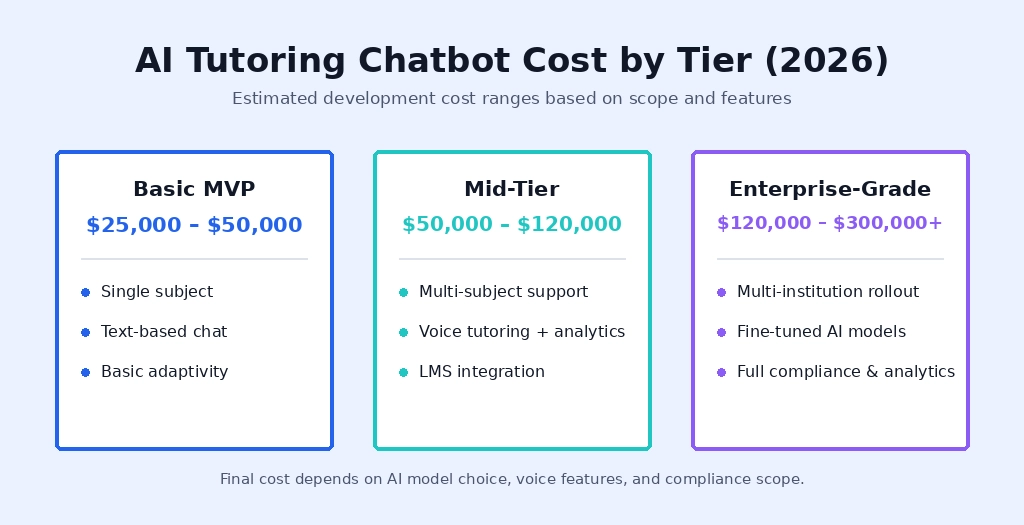
Here’s a realistic breakdown of AI tutor mobile app development cost by tier:
| Tier | Cost Range | What’s Included |
|---|---|---|
| Basic MVP | $25,000 – $50,000 | Single subject, text-based chat, basic adaptivity |
| Mid-tier | $50,000 – $120,000 | Multi-subject, voice tutoring, analytics dashboard, LMS integration |
| Enterprise-grade | $120,000 – $300,000+ | Multi-institution deployment, fine-tuned models, full compliance, advanced analytics |
The biggest cost drivers are LLM API usage, RAG infrastructure (vector databases), voice stack integration, and compliance requirements.
Any credible edtech chatbot development guide should walk you through these trade-offs rather than quoting a single flat number, since the right AI tutoring chatbot cost genuinely depends on scope.
If you’re comparing AI-powered application budgets, our guide on AI personal assistant app development cost explains the key factors that influence pricing across different AI applications.
Why Choose AlphaKlick for AI Tutoring Chatbot Development
Building an AI tutor isn’t just a coding exercise; it requires understanding curriculum design, student data privacy, and how to keep an AI model accurate and safe for young learners.
AlphaKlick works as an education chatbot development company with hands-on experience across AI-powered learning platforms, skills assessment tools, and adaptive mobile learning apps, and is recognized as one of the trusted mobile app development company in India for EdTech and AI-driven products.
We have helped EdTech businesses turn ideas like a personalized learning chatbot or a full AI learning assistant mobile app into real, working products, built on secure architecture, transparent cost estimates, and models that are actually accurate for the classroom.
If you’re planning to build an AI tutoring chatbot for your school, university, or EdTech platform, book a free consultation with AlphaKlick and let’s map out the right architecture and budget for your project.
FAQs
Question: How much does AI tutoring chatbot development cost?
Answer: Costs typically range from $25,000 for a basic MVP to $300,000+ for an enterprise-grade platform, depending on features like voice tutoring, analytics, and compliance requirements.
Question: What’s the difference between an AI teacher and an AI homework assistant?
Answer: An AI teacher explains concepts and reinforces classroom learning, while an AI homework assistant focuses on helping students work through specific assignments step-by-step.
Question: Does RAG really reduce hallucinations in AI tutors?
Answer: Yes. RAG grounds the AI model’s answers in your actual curriculum and study material instead of letting it guess, which significantly reduces incorrect or made-up responses.
Question: Can an AI tutoring chatbot integrate with our existing LMS?
Answer: Yes, most modern chatbots are built to integrate with existing LMS and school management systems through APIs, so student data and progress stay in sync.
Question: Is student data safe with an AI tutoring chatbot?
Answer: It should be, as long as the platform is built with COPPA, FERPA, or GDPR compliance from the start, including encrypted data storage and clear parental consent controls.