Most companies think they have a hiring problem. What they actually have is a measurement problem. Resumes tell you history. Interviews test confidence. Neither tells you whether someone can actually do the job.
According to LinkedIn’s 2024 Workplace Learning Report, 89% of L&D professionals say proactive skills-building is critical to navigating the future of work, yet most companies still rely on static tests and gut instinct.
A well-built AI skills assessment platform fixes this by measuring what candidates can actually do, not just what they say they can.
This guide covers everything you need to build one, including features, compliance, tech stack, and realistic costs.
What is an AI Skills Assessment Platform?
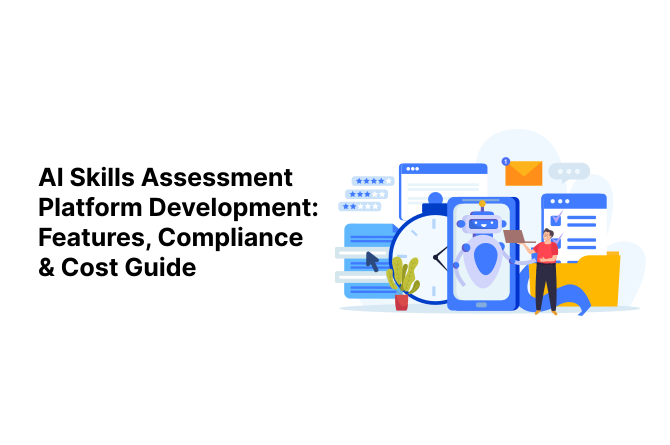
An AI skills assessment platform uses machine learning, NLP, and behavioural data to evaluate candidates and employees with precision. Unlike static tests that ask everyone the same questions, a real AI talent assessment platform adapts in real time, reads more than answers, and predicts future performance, not just current knowledge.
The difference between a standard quiz tool and a skills intelligence platform is the difference between a speedometer and a GPS. One tells you where you are. The other tells you where you are going.
When building a custom AI agent, businesses can connect AI with assessment workflows, databases, APIs, and reporting systems.
Core Features to Build Into Your Platform
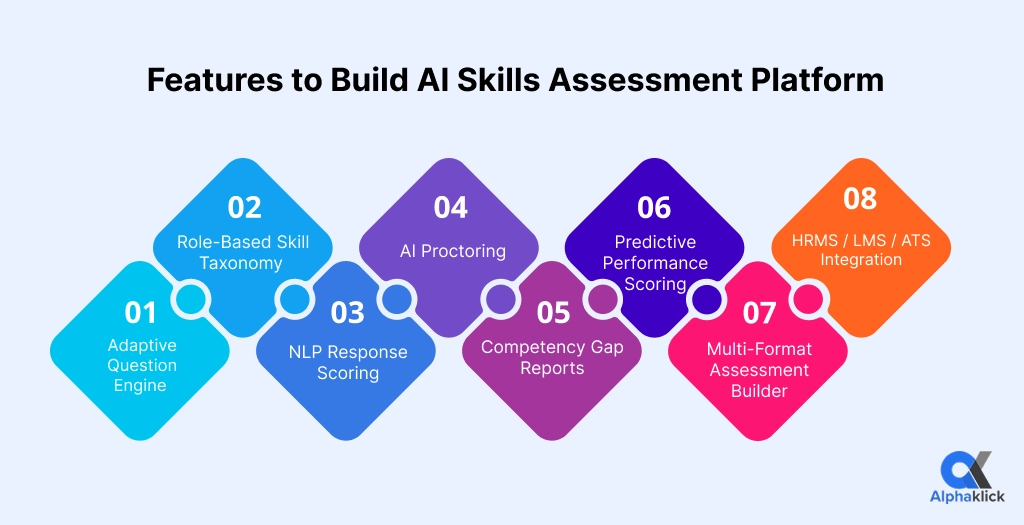
When it comes to skill assessment software development, the feature set you choose at the start determines how useful the platform is two years from now.
Here are the 8 must-have modules, and why each one earns its place:
| Feature | What It Does | Why It Matters |
| Adaptive Question Engine | Adjusts difficulty in real time based on each response | Shows true skill depth, not just pass or fail |
| Role-Based Skill Taxonomy | Maps questions to specific job roles and competencies | No generic aptitude tests — assessments stay relevant |
| NLP Response Scoring | AI reads and scores written and spoken answers | Enables situational and behavioural assessments |
| AI Proctoring | Monitors video, audio, and screen for integrity violations | Protects credibility of remote hiring |
| Competency Gap Reports | Shows individual and team-level skill gaps vs role benchmarks | L&D teams get a training roadmap, not just scores |
| Predictive Performance Scoring | ML models forecast on-the-job performance using historical data | Makes assessments forward-looking, not just knowledge-based |
| Multi-Format Assessment Builder | Supports coding, video responses, scenarios, and MCQs | Works for technical, managerial, and creative roles alike |
| HRMS / LMS / ATS Integration | Plugs into Workday, SAP SuccessFactors, Greenhouse via REST APIs | No data silos — the platform works inside your HR ecosystem |
Most off-the-shelf tools cover two or three of these. A custom-built technical skills assessment platform covers all eight, tuned to your roles, industries, and benchmarks.
Many of these assessment capabilities are part of a broader trend of how AI can automate educational institutions, helping schools and universities make data-driven decisions at scale.
AI and ML Capabilities That Separate Good Platforms from Great Ones
Not all AI talent evaluation software is built the same. These are the capabilities that create a genuine edge:
- Adaptive scoring logic: difficulty adjusts question-by-question based on live response patterns, not a preset sequence
- NLP for open-ended answers: AI evaluates how a candidate explains their thinking, ideal for leadership, consulting, and product roles
- Predictive performance models: trained on your historical hiring data to forecast on-the-job success, not just assessment scores
- Bias detection layer: flags assessment questions and scoring patterns that disproportionately disadvantage protected groups
- Continuous model retraining: the platform improves with every assessment cycle, not just at launch
These capabilities are what make a true AI hiring assessment tool different from a quiz with a dashboard bolted on.
Once a learner’s skill gaps are identified, video-based learning platforms can deliver targeted lessons that help turn assessment results into measurable progress.
Recommended Tech Stack
If you are building an AI skills assessment platform, these are the technology layers we recommend based on production deployments:
- Frontend: React.js or Angular for fast, responsive interfaces
- Backend: Python (FastAPI) or Node.js, both handle high-concurrency sessions reliably
- AI / ML: TensorFlow or PyTorch for custom models; Hugging Face for NLP scoring; OpenAI APIs for question variation
- Real-time scoring: Redis for live state management during assessments
- Database: PostgreSQL for structured data; MongoDB for flexible question bank storage
- Cloud: AWS (SageMaker, Lambda, S3) or GCP with autoscaling for peak hiring periods
- MLOps: MLflow for model versioning; Kubeflow for pipeline orchestration
This stack gives your AI recruitment assessment software the speed, accuracy, and scalability to serve enterprise clients without breaking under load.
Compliance, Data Privacy, and Ethical AI Considerations
This is where enterprise deals get blocked or approved. Building an AI-based candidate assessment platform without proper compliance architecture is a legal and commercial liability.
Here is what matters and why:
- GDPR: Candidates in Europe must be told what data is collected, how long it is stored, and how to request deletion. Fines reach 4% of global turnover. This requires consent flows, retention policies, and delete-on-request functionality built into the database architecture from day one, not added later.
- SOC 2 Type II: Enterprise buyers will ask for this before signing. It covers security, availability, confidentiality, and processing integrity, audited over time, not just at a single point. It means access controls, encrypted data at rest and in transit, full action logging, and a documented incident response process.
- EEOC and Disparate Impact Testing (US): Any assessment used in US hiring must comply with the Uniform Guidelines on Employee Selection Procedures. AI models can silently inherit bias from historical data. If past hires were skewed, the model learns that skew. A bias audit layer, tested before launch and periodically thereafter, is not optional for platforms used in US hiring.
- AI Audit Trails: When a candidate is rejected by an AI-generated score, they are increasingly entitled to know why. The EU AI Act requires explainability for high-risk AI systems. Audit logs that record what the model scored, what drove that score, and which model version was active are becoming a regulatory expectation, not a nice-to-have.
- Data Residency: Enterprise clients in healthcare, finance, and government often require data stored within specific geographic boundaries. Without data residency controls built into the architecture, you cannot serve these clients. Retrofitting it later is expensive and disruptive.
The bottom line: compliance is a software architecture problem. It must be built in from day one, not treated as a legal checkbox at the end of the project.
A well-built AI skills testing platform that cannot pass an enterprise security review will not close enterprise deals, regardless of how good the assessment engine is.
Development Timeline and Cost Estimate
One of the most common questions during planning for AI talent evaluation software is what it actually costs.
The answer depends on feature scope, integration depth, and whether the platform is built for internal use or as a commercial SaaS product.
Here is a realistic breakdown:
| Phase | What Gets Built | Timeline | Approx. Cost |
| 1. Discovery & Architecture | Requirements, system design, data model | 2–4 weeks | $3K – $6K |
| 2. MVP Build | Assessment engine, taxonomy, dashboard, auth | 8–12 weeks | $15K – $30K |
| 3. AI & ML Integration | Adaptive engine, NLP scoring, predictive model, proctoring | 6–10 weeks | $12K – $25K |
| 4. Integrations & Compliance | HRMS/ATS APIs, GDPR audit trails, data residency | 3–5 weeks | $6K – $12K |
| 5. QA & Launch | Load testing, bias audit, security pen test, rollout | 2–4 weeks | $4K – $8K |
| Total | End-to-end production platform | ~5–6 months | $40K – $81K |
Multi-language support, white-labelling, advanced server-side video proctoring, and large AI-generated question banks will push costs toward the higher end.
An AI skills testing platform built for one organisation costs less than one built to serve multiple clients at scale.
Organizations investing in assessment technology often expand into broader digital learning ecosystems, making e-learning app development a natural next step for workforce training and upskilling.
Why Choose Alphaklick for AI Skills Assessment Platform Development
An AI skills assessment platform is not a standard web application. It combines real-time scoring, AI and ML models, compliance requirements, and an assessment experience that must feel instant while processing complex evaluations in the background.
At Alphaklick, a leading AI development company, we build AI-powered platforms across healthcare, education, and enterprise domains.
From AI skills assessment platforms, online exam software, LMS development, and e-learning platforms to enterprise AI solutions, we develop secure, scalable, and production-ready systems using technologies like TensorFlow, FastAPI, AWS SageMaker, and LangChain.
Our solutions integrate seamlessly with HR, recruitment, and learning ecosystems, helping organizations measure skills, track performance, and make better decisions.
We understand the difference between a platform that looks impressive in a demo and one that delivers reliable results at scale.
Build Smarter Hiring with AI
Turn candidate evaluation into a faster, fairer, and data-driven process. Partner with Alphaklick to build an AI skills assessment platform that scales with your hiring goals.
FAQs
Question: How is this different from an LMS or ATS?
Answer: An LMS manages learning. An ATS manages applications. An AI recruitment assessment software evaluates actual skill depth and generates insights that neither platform is designed to provide.
If you’re planning to build a learning platform, check out our guide on How Much Does Custom LMS Development Cost in 2026? to understand the investment, features, and development timeline.
Question: Can the platform be trained on our own data?
Answer: Yes. Custom ML models can be trained on your historical hiring and performance data, making predictions specific to what success looks like within your organisation rather than relying on industry averages.
Question: How do you prevent AI bias?
Answer: Through diverse training data, disparate impact testing before launch, regular model audits, and human review of edge cases. An AI-powered skills assessment platform without a bias audit process can become a compliance risk.
Question: Can it be white-labelled?
Answer: Yes. We build multi-tenant SaaS architectures that support custom branding, role-based configurations, and separate data environments for each client.