
Key highlights
- Medical billing software helps hospitals and clinics automate insurance claims, patient invoices, payment tracking, and revenue management workflows.
- Modern healthcare billing software includes AI-powered claim processing, EHR/EMR integration, analytics dashboards, and HIPAA-compliant security features.
- Custom medical billing software development improves billing accuracy, reduces claim rejection rates, and streamlines healthcare financial operations.
- Billing software for hospitals and clinics can significantly reduce administrative workload while improving patient payment experience and operational efficiency.
Managing insurance claims, patient invoices, and healthcare payments manually can slow down operations and increase billing errors. Modern healthcare providers now rely on advanced medical billing platforms to streamline financial workflows and improve reimbursement cycles.
As a trusted medical billing software development company, Alphaklick develops secure, scalable, and HIPAA-compliant healthcare billing software tailored for hospitals, clinics, and healthcare startups. From AI-powered claims processing to custom patient billing systems, the right software can significantly improve operational efficiency and revenue management.
In this guide, we will explain the medical billing software development process, key features, benefits, development cost, and the latest technologies used in modern healthcare billing solutions.
Medical billing software market insights
According to Grand View Research, the global medical billing software market is growing rapidly due to increasing adoption of digital healthcare systems and automated billing workflows.
| Market insights | Data |
| 2023 market size | USD 16.34 Billion |
| 2030 projected market size | USD 32.18 Billion |
| CAGR (2024–2030) | 10.20% |
What is medical billing software?
Medical billing software is a digital platform used by healthcare providers to manage billing, patient invoices, insurance claims, reimbursements, and payment tracking.
A modern patient billing system simplifies the complete revenue cycle, from patient registration to final payment collection. It also reduces manual paperwork and improves billing accuracy.
Healthcare providers commonly use:
- Billing software for clinics for appointment billing and outpatient services
- Billing software for hospitals for managing multi-department financial operations
- Insurance claims management software for faster claim submission and approvals
- Claims processing software to automate insurance workflows
Why healthcare providers need it
Healthcare providers deal with strict insurance regulations, coding systems, and financial documentation. Manual billing processes often increase claim rejection rates and operational costs.
With advanced medical billing solutions, healthcare organizations can:
- Automate insurance claim submissions
- Reduce billing errors
- Improve reimbursement cycles
- Manage patient invoices efficiently
- Track outstanding payments in real time
- Improve operational efficiency
Types of medical billing software
Different healthcare organizations require different billing systems depending on their workflows.
| Software type | Best for | Main purpose |
| Standalone billing software | Small clinics | Basic billing and invoicing |
| Integrated hospital billing software | Hospitals | Department-wide billing management |
| Cloud-based billing platforms | Multi-location healthcare providers | Remote access and scalability |
| AI-based claims processing software | Large healthcare networks | Automated claim verification |
Custom vs ready-made solutions
| Feature | Custom software | Ready-made software |
| Customization | High | Limited |
| Scalability | Flexible | Restricted |
| Integration capability | Advanced | Depends on vendor |
| Long-term cost | Better ROI | Recurring license cost |
| Workflow control | Fully customizable | Standard workflows |
Many healthcare businesses now prefer custom healthcare software development because it allows better integration with existing hospital systems and billing processes.
Key features of medical billing software
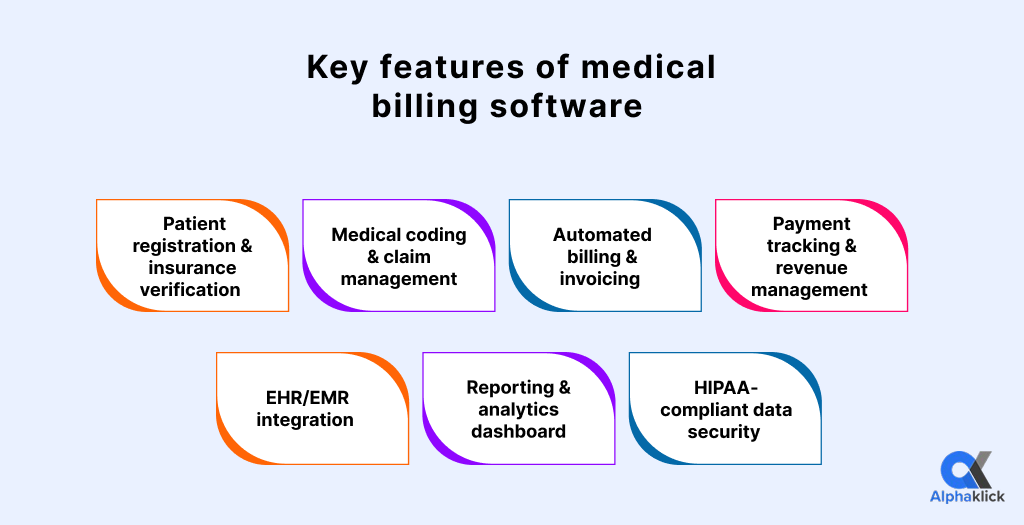
Modern healthcare providers need more than simple billing tools. Today’s medical billing software features focus on automation, faster insurance processing, secure patient data management, and better financial tracking.
1. Patient registration & insurance verification
The software stores patient details digitally and verifies insurance eligibility during registration. This helps reduce manual paperwork, billing mistakes, and claim rejection caused by incorrect insurance information.
2. Medical coding & claim management
Built-in ICD and CPT coding support helps healthcare staff generate accurate insurance claims quickly. Advanced insurance claims management software also tracks claim status, denied claims, and reimbursement updates in one dashboard.
This feature improves billing accuracy and speeds up insurance approvals.
3. Automated billing & invoicing
The system automatically creates invoices, payment reminders, recurring bills, and billing summaries. This reduces administrative workload and helps healthcare providers manage payments more efficiently.
4. Payment tracking & revenue management
Real-time financial dashboards allow hospitals and clinics to monitor:
- Pending payments
- Completed transactions
- Denied insurance claims
- Revenue performance
- Outstanding invoices
This helps improve overall financial visibility and cash flow management.
5. EHR/EMR integration
Modern healthcare billing software should integrate smoothly with EHR and EMR systems. This allows billing teams to access patient records, prescriptions, treatment details, and invoices without entering the same data multiple times.
6. Reporting & analytics dashboard
Advanced reporting tools help healthcare organizations analyze billing and financial performance using detailed reports and visual dashboards.
Healthcare providers can track:
- Claim approval rates
- Insurance settlement cycles
- Revenue trends
- Billing efficiency
- Department-wise financial reports
7. HIPAA-compliant data security
Medical billing systems manage highly sensitive patient and financial information. Strong security features help protect healthcare data from unauthorized access and cyber threats.
Important security measures include:
- Encrypted databases
- Role-based access control
- Audit logs
- Secure APIs
- Multi-factor authentication
- HIPAA-compliant infrastructure
Medical billing software development process
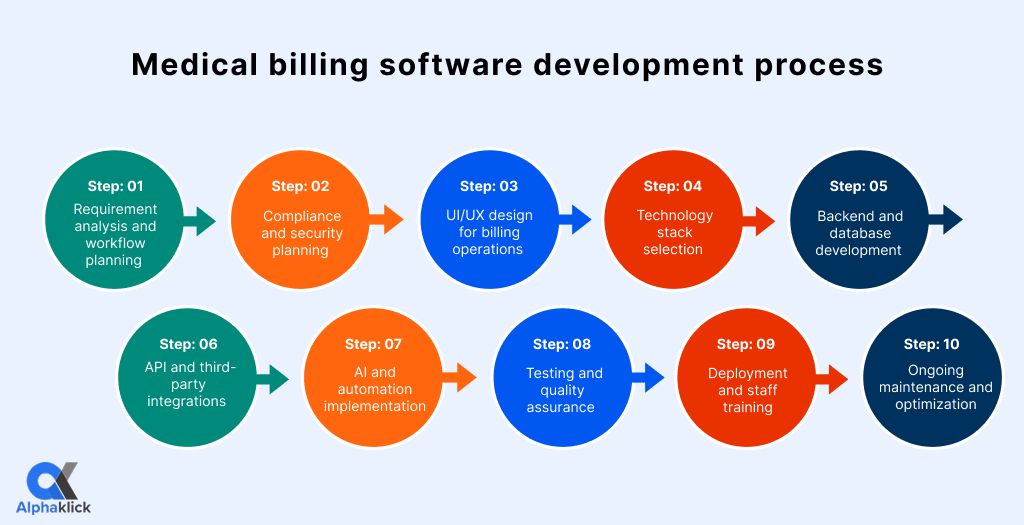
Successful medical billing software development follows a structured workflow focused on billing automation, compliance, security, and smooth healthcare operations. A well-planned process helps hospitals and clinics reduce billing errors, improve reimbursements, and manage payments more efficiently.
Step 1: Requirement analysis and workflow planning
The process starts with understanding the hospital or clinic’s billing workflow, insurance claim process, payment handling system, reporting needs, and existing EHR/EMR setup.
This stage helps define the right features, integrations, and automation requirements for scalable healthcare billing software and customized medical billing solutions.
Step 2: Compliance and security planning
Before development begins, the system architecture is planned according to healthcare security and compliance standards. Since billing software for hospitals handles sensitive patient and financial data, security implementation becomes a critical part of the process.
| Compliance standard | Purpose |
| HIPAA | Protects patient healthcare data |
| HL7 | Standardizes healthcare data exchange |
| FHIR | Supports EHR/EMR interoperability |
| GDPR | Data privacy and protection |
| PCI DSS | Secure payment processing |
At this stage, developers also plan encrypted databases, role-based access control, audit logs, secure APIs, and authentication systems.
Security and compliance are critical when building HIPAA-compliant healthcare apps with AI-powered automation.
Step 3: UI/UX design for billing operations
Once the workflows are finalized, the design team creates user-friendly dashboards for billing staff, hospital administrators, finance teams, and healthcare providers.
The focus is on building clean and easy-to-use interfaces that simplify invoice creation, claim tracking, payment monitoring, and report generation. A well-designed patient billing system reduces staff training time and improves operational efficiency.
Step 4: Technology stack selection
The next step involves selecting the right technologies based on scalability, security, integrations, and long-term performance requirements for the healthcare software development process.
| Development area | Technologies |
| Frontend | React.js, Angular |
| Backend | Node.js, Laravel, .NET |
| Database | PostgreSQL, MongoDB |
| Cloud hosting | AWS, Azure, Google Cloud |
| Security | JWT, SSL, OAuth 2.0 |
You can also read our healthcare software development guide to understand modern healthcare platforms and technologies.
Step 5: Backend and database development
In this stage, developers build the core backend system to manage patient records, billing workflows, insurance claims, payment transactions, and financial reports.
A strong backend architecture is important for secure and scalable billing software for clinics and hospitals.
Step 6: API and third-party integrations
Modern healthcare platforms require integrations with external systems to automate billing operations and reduce manual work.
Common integrations include EHR/EMR systems, insurance provider APIs, payment gateways, accounting software, CRM platforms, and hospital management systems. This improves the efficiency of the claims processing software.
Many healthcare providers integrate their billing platforms with custom hospital management systems to streamline healthcare operations.
Step 7: AI and automation implementation
After the core system is ready, AI and automation features are added to improve billing accuracy and reduce manual tasks in the insurance claims management software.
AI-powered systems can detect coding errors, predict claim rejection risks, automate invoices, identify unusual billing activity, and improve revenue forecasting.
Many healthcare providers now use AI tools and automation platforms such as:
| AI & automation tools | Main use case |
| AWS HealthLake | Healthcare data management |
| OpenAI | AI-powered automation and analysis |
| Google Cloud Vertex AI | Predictive analytics and AI models |
| Qventus | Healthcare workflow optimization |
| UiPath | Billing process automation |
| Zapier | Workflow automation |
| Power Automate | Administrative task automation |
Step 8: Testing and quality assurance
Before launch, the software is tested for billing accuracy, security, integrations, payment workflows, and overall system performance. This step ensures stable and reliable medical billing software features before deployment.
Step 9: Deployment and staff training
After testing, the platform is deployed on the selected server or cloud infrastructure. The process includes system setup, data migration, user configuration, and staff training for daily billing operations using the new medical billing solutions platform.
Step 10: Ongoing maintenance and optimization
Regular maintenance helps keep the platform secure, updated, and optimized. Continuous support improves performance, maintains compliance, and maximizes long-term medical billing software benefits for hospitals and clinics.
Cost of medical billing software development
The cost of medical billing software development depends on features, integrations, compliance requirements, AI automation, and platform complexity. Custom solutions for hospitals usually cost more than basic systems for small clinics.
| Software type | Estimated cost |
| Basic billing software for clinics | $15,000 – $30,000 |
| Mid-level healthcare billing software | $30,000 – $70,000 |
| Enterprise hospital billing software | $70,000 – $200,000+ |
Major cost factors include EHR/EMR integration, insurance claim automation, cloud infrastructure, AI features, security compliance, and custom reporting dashboards.
Many businesses now prefer healthcare mobile app developers in India for AI and IoT-based healthcare platforms.
Why choose Alphaklick for medical billing software development
Healthcare billing is not just about invoices and claims; it is about speed, accuracy, compliance, and uninterrupted financial operations.
As a specialized medical billing software development company, Alphaklick builds custom healthcare billing platforms that help hospitals and clinics simplify complex billing workflows and improve revenue management.
Whether you need a secure patient billing system, AI-powered claim automation, or scalable hospital billing software, our team develops solutions tailored to real healthcare operations.
If you are planning to build or upgrade a healthcare billing platform, book a free consultation with Alphaklick to discuss your requirements, integrations, compliance goals, and development strategy.
Frequently asked questions
Question: How long does medical billing software development take?
Answer: The development timeline usually ranges from 3 to 9 months, depending on the software complexity, integrations, AI features, compliance requirements, and customization needs.
Question: What are the most important medical billing software features?
Answer: Important medical billing software features include insurance verification, claim management, invoice automation, payment tracking, EHR/EMR integration, analytics dashboards, and HIPAA-compliant security.
Question: Can medical billing software integrate with existing hospital systems?
Answer: Yes, modern healthcare billing software can integrate with EHR/EMR systems, payment gateways, insurance provider APIs, accounting software, CRM platforms, and hospital management systems.
Question: Why do hospitals and clinics invest in custom medical billing solutions?
Answer: Custom medical billing solutions help healthcare providers automate billing workflows, reduce claim rejection rates, improve reimbursement speed, increase billing accuracy, and manage patient payments more efficiently.