“Can people buy my products straight from ChatGPT?”
Our Shopify team keeps hearing this question from Shopify store owners, usually right after they notice an AI chatbot showing up as a referral source in their analytics. The honest answer is yes, as long as the Shopify store is set up the right way.
The feature behind that answer is called Shopify agentic storefronts. Here is how we explain it to our own clients, in plain words, with the parts that actually affect your sales.
What Are Shopify Agentic Storefronts?
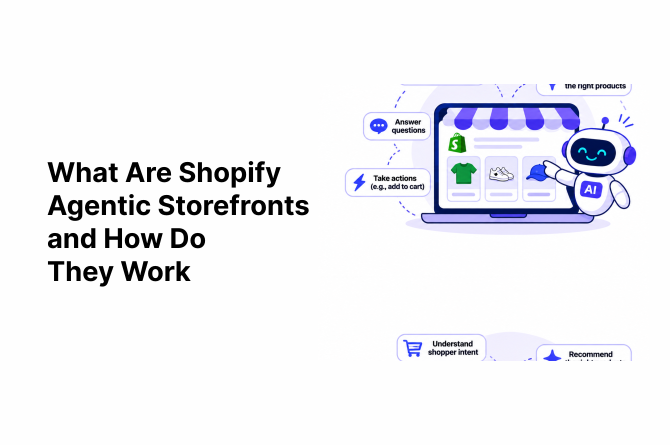
Inside the Shopify admin, there is a sales channel called Agentic Storefronts. It connects your products to AI shopping platforms such as ChatGPT, Microsoft Copilot, Google AI Mode, Gemini and Meta AI. Once it is active, these AI assistants can read your product data, show your products to shoppers during a conversation and, on many platforms, let the shopper buy without leaving the chat.
I usually describe it to Shopify store owners like this. Your website is still your main shop, but now you also have a small counter inside every AI chat your customers use.
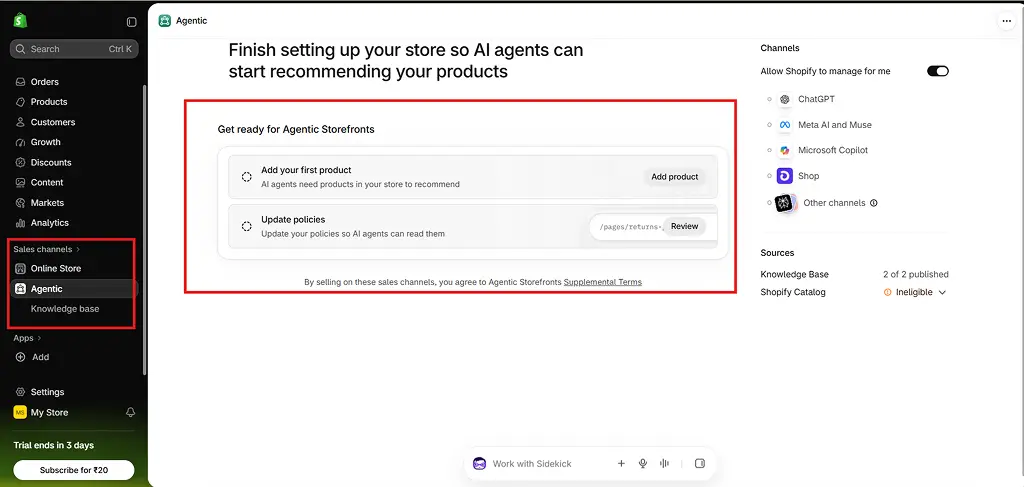
You run all of those counters from one place, under Sales channels > Agentic in your Shopify admin, instead of building a separate integration for each AI platform.
What Is Agentic Commerce and Why It Matters for Shopify Stores
The word “agentic” comes from “agent.” In agentic commerce, an AI agent does part of the shopping work for the buyer. The shopper explains what they need, and the agent searches product catalogs, compares options, answers follow-up questions, and guides the buyer to checkout.
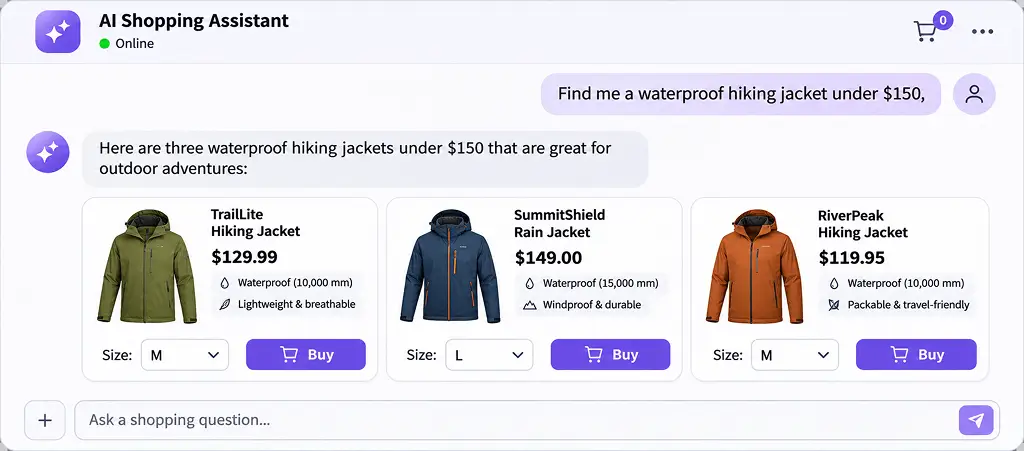
When Shopify store owners ask us what is agentic commerce in day-to-day terms, we use a simple example. A shopper types, “Find me a waterproof hiking jacket under $150 that can reach me by Friday.” Instead of a page of links, the AI assistant shows three jackets with prices, sizes and delivery times, and the shopper can pick one right there.
The shift is already visible in real numbers. According to Shopify’s own data, AI-driven traffic to Shopify stores grew 8 times year over year in Q1 2026, and orders from AI-powered searches grew nearly 13 times.
For a Shopify store owner, Shopify agentic commerce is not a separate business. It is a new place where your existing products get sold.
Agentic Commerce vs Traditional E-commerce
On client calls, we explain this shift with a simple side-by-side comparison.
| Factor | Traditional E-commerce | Agentic Commerce |
|---|---|---|
| Starting point | Shopper types keywords into Google or your Shopify store search | Shopper describes a need in plain language to an AI assistant |
| Product discovery | Shopper browses category pages and filters | AI agent picks a short list of matching products |
| Comparing options | Shopper opens many tabs and reads reviews | AI agent compares price, features and delivery in one reply |
| Who reads your product page first | A human visitor | An AI agent reading structured product data |
| Checkout | On your Shopify store website | On your website or directly inside the AI chat |
| What decides visibility | SEO, ads and site design | Product data quality, relevance, pricing and availability |
The biggest point in the agentic commerce vs traditional e-commerce comparison is the fourth row. Your first visitor is now often a machine, and it judges your product by its data, not by your banner design.
Not every AI chat tool can take action for the user, though. Our guide on AI agents vs AI assistants breaks down that difference if you want a deeper look.
How Shopify Agentic Storefronts Work: The Technology Behind It
When our Shopify developers set up agentic storefronts for a Shopify store, the work touches four layers: the product data, the AI agent that reads it, the shared protocol that carries it and the checkout that completes the sale. A weak spot in any one of them means fewer of your products reach AI shoppers, which is why we review all four together.
Shopify Catalog: The Product Data Layer
Shopify Catalog takes product information from your eligible products and turns it into a structured format that AI platforms can read. Qualifying products are added and updated automatically. AI agents do not look at your product page the way a person does. They read titles, descriptions, images, prices, inventory and shipping details, and decide what to recommend from that data.
One detail many Shopify store owners miss: Google AI Mode and Gemini use a separate Google Merchant Center feed, and errors there can hurt your Google visibility even when the Catalog looks fine.
How AI Agents Pick and Show Products
Each AI platform has its own ranking logic. Shopify notes that ranking can depend on data quality, relevance, availability, pricing and engagement signals. Being in the Catalog does not guarantee a spot in the answer, and each platform decides what to show.
We treat this a lot like early SEO, where complete and specific product data wins. If you are curious about how these agents are built, our post on custom AI agent development explains the main building blocks.
Universal Commerce Protocol (UCP)
The Universal Commerce Protocol is a shared standard co-developed by Shopify and Google. It defines how product, checkout and order information moves between AI platforms and merchants. In practice, it keeps your checkout rules, discounts and terms consistent, no matter which AI agent starts the purchase. When a new AI platform adopts UCP, Shopify merchants are ready to sell there without another integration.
Checkout, Payments and Fulfillment
Checkout works differently on each platform. On ChatGPT, the shopper completes the order on your website, either in ChatGPT’s built-in browser or in a new tab. Microsoft Copilot and Google AI Mode offer direct checkout inside the chat for eligible Shopify stores in supported regions. In every case, Shopify takes care of payment processing, tax calculation, fraud checks and order fulfillment, and it checks inventory again at checkout in case a product sold out after the AI recommended it.
Knowledge Base: The Store Information Layer
Product data tells an AI agent what you sell, but shoppers in a chat also ask about your Shopify store itself. Questions like “Who pays for return shipping?” or “How long does delivery take?” need answers from your policies and FAQs, not from a product title. Shopify gives merchants a Knowledge Base inside the admin under Sales channels > Agentic > Sources, where you can review the facts AI agents use about your business, fix outdated details and add answers your customers need. On our client projects, we check this area right after the product data, because a wrong return policy in an AI reply can cost a sale just as much as a wrong price.
The FAQ content on your website matters too, since shoppers on ChatGPT finish their order on your Shopify store, and many read your help pages before paying. A Shopify app like BetterDocs FAQ Knowledge Base helps you build FAQ pages, product FAQs and a searchable help center, and it adds FAQ schema that gives search engines a structured version of each question and answer.
Which AI Platforms Support Shopify Agentic Storefronts?
Shopify store owners always ask us this next, because it decides where their products can actually sell. Here is the current picture from Shopify’s documentation.
| AI Platform | How Products Get Found | Checkout Type | Buyer Regions |
|---|---|---|---|
| ChatGPT | Shopify Catalog, on by default | On your website (built-in browser or new tab) | US buyers |
| Microsoft Copilot | Shopify Catalog | Direct checkout inside Copilot, on by default | US buyers |
| Google AI Mode and Gemini | Google Merchant Center feed | Direct checkout rolling out, otherwise on your website | Direct checkout in the US, Canada and Australia |
| Meta AI | Shopify Catalog | Direct checkout, on by default | 11 countries, including the US, Canada and Mexico |
| Shop | Shop sales channel | Managed in the Shop channel settings | Depends on Shop channel setup |
The list of agentic commerce platforms will keep growing as more AI companies adopt shared standards, and new agentic commerce platforms show up first in the Agentic channel of your Shopify admin.
How to Get Your Shopify Store Ready for Agentic Storefronts
Whenever our team reviews a Shopify store for AI readiness, we start with product data before touching anything else. Many Shopify stores qualify on paper, but their product information is too thin for an AI agent to recommend with confidence. Agentic AI e-commerce rewards detail, and a missing size chart or a vague title can quietly keep a product out of AI answers.
Here is the checklist we use.
| Area | What to Check | Why It Matters |
|---|---|---|
| Product titles | Clear name, type and key attribute (for example, “Women’s Waterproof Hiking Jacket”) | AI agents match titles to the shopper’s exact request |
| Descriptions | Materials, use cases, sizing and care details in simple sentences | Agents answer follow-up questions from this text |
| Variants and attributes | Size, color and material filled in for every variant | Missing attributes can drop products from filtered results |
| Inventory | Stock levels synced and accurate | Out-of-stock items lose trust and get skipped |
| Store policies | Terms of service, privacy policy and refund policy published | Required for eligibility |
| Google Merchant Center | Feed approved with no product errors | Needed for Google AI Mode and Gemini |
| Checkout setup | Bundles, custom products and subscriptions reviewed | These are excluded from direct checkout on some platforms |
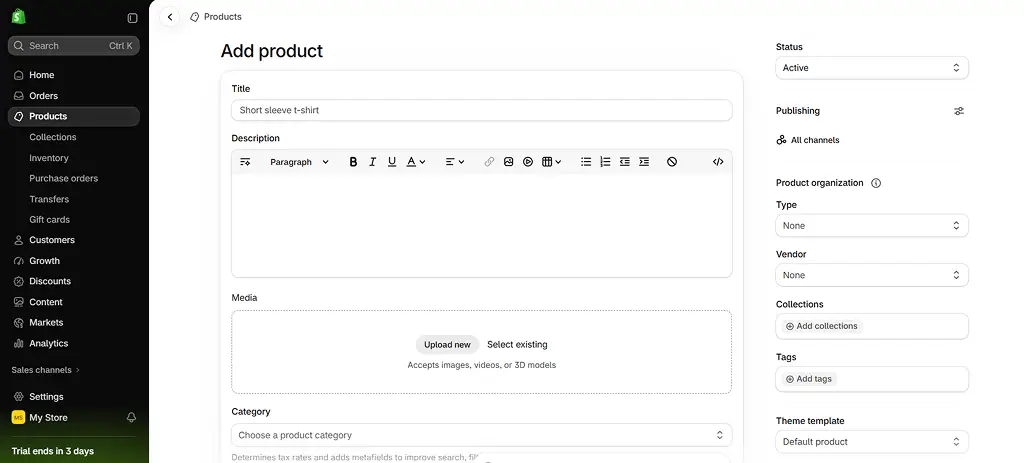
Shopify’s Sidekick can help you draft better descriptions. For larger catalogs or checkout changes, you can Hire Shopify Developers in Jaipur from our team to handle the technical setup. Getting this groundwork right is what turns agentic AI e-commerce into real orders.
Benefits of Shopify Agentic Storefronts for Shopify Merchants
The first benefit our clients notice is reach without extra work. One setup in the Shopify admin covers several AI channels, with no separate feeds or contracts for each platform. The second is timing, because AI shoppers usually arrive with a clear need and budget, ready to decide.
Accuracy matters too. Without a proper feed, AI tools may rely on outdated scraped data. With Shopify Catalog sharing your real prices, stock and policies, shoppers see correct information about your Shopify store.
Finally, Shopify still handles payments, tax, fraud checks and refunds, and reports under Sales channels > Agentic show sales by channel. Some brands consider building their own AI shopping assistant instead, but our breakdown of AI agent development cost shows why most Shopify store owners are better off starting with what Shopify already provides.
Limitations and Things to Watch Out For
We always share these limits with clients before they turn the channel on.
Direct checkout on Google, Copilot and Meta does not support bundles, customizable products or subscription-only purchases. If your Shopify store depends on these, you can turn off direct checkout for that channel and send shoppers to your website.
Location is another limit. ChatGPT and Copilot currently require sales to US buyers, and direct checkout on Google and Meta is limited to certain countries. Headless Shopify stores also do not get the agentic performance reports. On top of that, removing a product from Shopify Catalog does not stop it from being found through web crawling or other sources.
If you are unsure how ready your business data is, a quick AI readiness assessment can show you the gaps first.
How AlphaKlick Helps Shopify Stores Prepare for Agentic Commerce
Our Shopify team in Jaipur works on Shopify development and AI projects every day, and agentic commerce sits right where those two meet. We help Shopify store owners clean up and enrich product data, fix Catalog and Merchant Center eligibility issues, adjust checkout setups that do not fit direct checkout and build a custom Shopify app when the default tools are not enough.
If you are looking for Shopify Experts in Jaipur who understand both the store side and the AI side, our developers can review your Shopify store and give you a clear list of what to fix first. Many brands choose to Hire Shopify Developers in Jaipur from AlphaKlick on a monthly basis, which lets them keep their product data AI ready as the catalog grows.
FAQs
Question: Are Shopify agentic storefronts free for Shopify merchants?
Answer: Shopify does not list a separate fee for Agentic Storefronts in its documentation. Your regular Shopify plan and payment processing fees still apply. Pricing can change, and Shopify’s help center has the latest details.
Question: Do I need a Shopify app to use agentic storefronts?
Answer: No. Agentic Storefronts is a sales channel already built into the Shopify admin. A Shopify app can help with product data, but it is not required.
Question: Can non-Shopify brands sell through agentic storefronts?
Answer: Yes. Shopify offers an Agentic Plan for brands on other platforms, such as custom ERP systems, that want to sell through AI channels without moving their whole website. It has no monthly subscription, and US online card rates start at 2.9% + 30¢.
Question: How is Shopify agentic commerce different from regular AI product recommendations?
Answer: Regular AI recommendations only suggest products and send the shopper elsewhere. Shopify agentic commerce connects your real product data and checkout to the AI platform, which lets the shopper complete the purchase with accurate prices and stock.
Question: Does my Shopify store need custom Shopify development for agentic storefronts?
Answer: Not always. Simple Shopify stores with clean product data can enable the channel on their own. Shopify stores with large catalogs, bundles, subscriptions or headless setups usually benefit from working with Shopify Experts in Jaipur or another experienced development team.