Key highlights
- Healthcare CRM software helps hospitals and clinics streamline patient communication, appointment scheduling, billing coordination, and healthcare workflow automation.
- Modern medical CRM software includes advanced healthcare CRM software features such as EHR integration, patient engagement software, secure patient data management, and AI-powered automation tools.
- A scalable healthcare CRM for hospitals and healthcare CRM for clinics improves operational efficiency, reduces manual tasks, and delivers a better patient experience.
1xKXDzSHVWf9j5TvmTDyolZElAntp1RDtG9WA-XeaLo8
This is why many hospitals and clinics are now investing in healthcare CRM software to centralize patient communication, improve workflow management, and automate repetitive administrative tasks.
As a healthcare software development company, we develops custom healthcare CRM solutions for hospitals, clinics, diagnostic centers, and healthcare startups. From patient engagement software and appointment scheduling software to secure patient data management and healthcare workflow automation, CRM platforms are becoming an important part of modern healthcare operations.
This guide explains the most important healthcare CRM software features, how healthcare CRM for hospitals and clinics works, and the development costs before choosing a CRM solution.
What is healthcare CRM software for hospitals & clinics?
Healthcare CRM software is a platform designed for hospitals, clinics, and healthcare providers to manage patient communication, appointments, follow-ups, and operational workflows from a centralized system.
Unlike traditional CRM platforms, medical crm software focuses on patient engagement software, healthcare workflow automation, appointment coordination, and secure patient data management.
A modern hospital CRM system helps healthcare organizations:
- Manage patient records securely
- Automate appointment reminders
- Improve doctor-patient communication
- Track treatment history
- Coordinate billing and insurance workflows
- Improve patient retention and satisfaction
Similarly, clinic CRM software helps smaller healthcare practices reduce administrative workload and improve daily operational efficiency.
You can also read our detailed guide on healthcare software development solutions to understand development costs, features, integrations, and healthcare platform types in detail.
Healthcare CRM vs traditional CRM
| Feature | Traditional CRM | Healthcare CRM Software |
| Customer Management | General customers | Patients |
| Compliance Support | Limited | HIPAA/GDPR-focused |
| Appointment Management | Basic | Advanced scheduling |
| EHR Integration | Rare | Common |
| Patient Engagement | Limited | Personalized communication |
| Healthcare Workflow Automation | Minimal | Advanced |
Top features of healthcare crm software for hospitals & clinics
Modern hospitals and clinics use healthcare CRM software to manage appointments, patient communication, billing coordination, and operational workflows in a single system.
The right CRM platform also improves patient data management, scheduling efficiency, and overall patient experience.
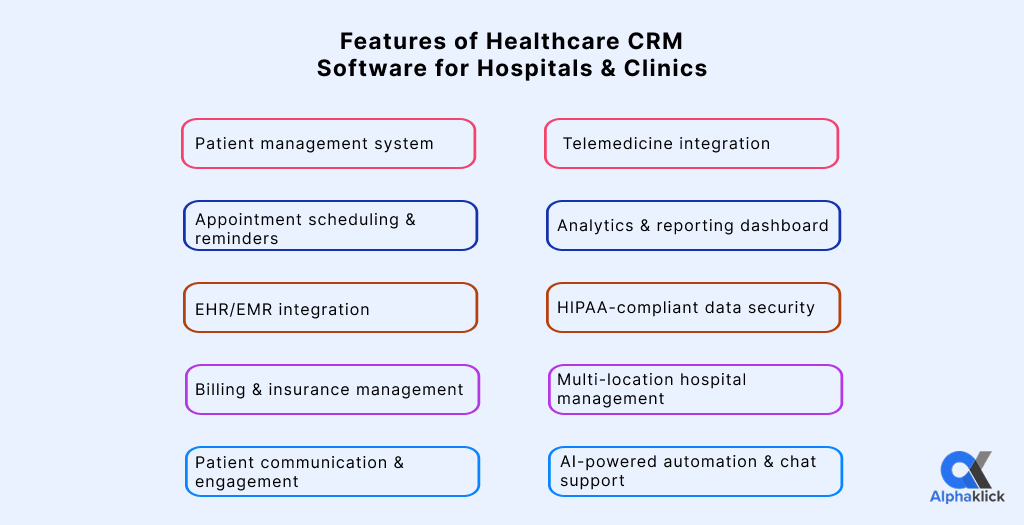
1. Patient management system
A centralized patient management system helps hospitals and clinics organize consultation history, prescriptions, medical reports, insurance details, and treatment records from one platform.
This improves patient data management and allows doctors, reception teams, and billing staff to access patient information quickly during consultations and follow-ups.
2. Appointment scheduling & reminders
Modern appointment scheduling software helps healthcare providers manage online bookings, doctor availability, automated reminders, and appointment rescheduling more efficiently.
This reduces missed appointments, improves scheduling accuracy, and helps front-desk teams manage patient flow more smoothly.
Benefits of appointment scheduling software
| Feature | Benefit |
| Online Booking | Faster appointment process |
| Automated Reminders | Reduced missed appointments |
| Doctor Availability Tracking | Better schedule management |
| Multi-Location Scheduling | Centralized appointment handling |
3. EHR/EMR integration
Many healthcare crm software platforms integrate directly with EHR and EMR systems to sync patient records, prescriptions, lab reports, and consultation history automatically.
This improves treatment coordination, reduces duplicate data entry, and helps healthcare providers access patient information without switching between multiple systems.
4. Billing & insurance management
A modern hospital crm system helps automate invoice generation, insurance verification, payment tracking, claims processing, and billing reminders through a centralized workflow.
This minimizes billing errors, speeds up administrative processes, and improves overall financial management for hospitals and clinics.
You can also read our guide on medical billing software development to understand billing automation, insurance claim workflows, and modern healthcare billing software features.
5. Patient communication & engagement
Effective communication is one of the most important healthcare crm software features for hospitals and clinics. Using patient engagement software, healthcare providers can send appointment reminders, prescription alerts, follow-up notifications, and personalized care updates through SMS or email.
This improves patient communication consistency, retention, and overall patient experience.
6. Telemedicine integration
Modern medical crm software platforms often include telemedicine features such as video consultations, virtual appointments, remote patient monitoring, and online prescription sharing.
This helps healthcare providers manage digital consultations efficiently while improving accessibility for patients in remote or busy locations.
7. Analytics & reporting dashboard
A centralized healthcare crm software dashboard helps healthcare organizations monitor appointments, revenue, staff productivity, patient engagement, and operational performance in real time.
These reports help management teams identify workflow gaps, track performance, and make faster operational decisions.
8. HIPAA-compliant data security
Security is a critical part of every hospital crm system and clinic crm software because healthcare organizations manage sensitive patient information daily.
Most healthcare CRM platforms include data encryption, role-based access controls, audit logs, multi-factor authentication, and HIPAA/GDPR compliance features to improve secure patient data management.
9. Multi-location hospital management
Large healthcare organizations often manage multiple clinics, departments, or hospital branches from different locations. A centralized healthcare crm for hospitals helps manage patient records, appointments, billing operations, and reporting across all facilities from one platform.
This improves coordination, operational consistency, and centralized workflow management.
10. AI-powered automation & chat support
Modern healthcare workflow automation systems now include AI-powered chatbots, automated follow-up workflows, predictive analytics, smart appointment reminders, and patient support automation.
These features reduce repetitive administrative work, improve response management, and help healthcare providers deliver faster patient support.
Many healthcare providers are now shifting toward AI-powered healthcare platforms to automate patient communication, workflow management, and operational processes more efficiently.
Benefits of healthcare CRM software for hospitals and clinics
Using healthcare crm software helps hospitals and clinics improve patient communication, automate workflows, and manage daily operations more efficiently.
A centralized CRM platform also improves appointment handling, follow-ups, and patient data management.
| Benefit | Impact |
| Faster Patient Communication | Improved patient experience |
| Automated Workflows | Reduced manual work |
| Better Patient Engagement | Higher patient retention |
| Centralized Patient Data Management | Faster record access |
| Improved Appointment Scheduling | Fewer missed appointments |
| Better Workflow Coordination | Improved operational efficiency |
Both healthcare CRM for hospitals and healthcare CRM for clinics help healthcare providers streamline operations and improve overall patient experience.
Healthcare CRM software development cost
The cost of developing healthcare crm software depends on the platform’s features, integrations, security requirements, and workflow complexity.
A basic clinic crm software with appointment management and patient communication features costs much less than an enterprise-level hospital crm system with AI automation, EHR integration, and multi-location management.
Development cost is mainly affected by:
- Custom healthcare crm software features
- EHR/EMR integrations
- AI-powered healthcare workflow automation
- Telemedicine functionality
- HIPAA/GDPR compliance
- Mobile application support
- Billing and insurance modules
- Multi-location management
Estimated healthcare CRM software development cost
| CRM Type | Estimated Cost |
| Basic clinic crm software | $15,000 – $30,000 |
| Mid-level hospital crm system | $30,000 – $70,000 |
| AI-powered healthcare crm software | $70,000 – $150,000+ |
The final cost depends on customization level, integration complexity, security implementation, and scalability requirements.
If you are also planning to build a mobile healthcare platform, you can explore leading healthcare mobile app developers in India focused on AI-powered healthcare and IoT-based solutions.
Why choose Alphaklick as your healthcare crm software development company
Alphaklick is a healthcare CRM software development company building custom CRM solutions for hospitals, clinics, and healthcare startups. We develop scalable healthcare crm software focused on patient communication, workflow management, appointment handling, and secure patient data management.
Our expertise includes:
- HIPAA-compliant healthcare CRM systems
- AI-powered healthcare workflow automation
- Custom hospital crm system development
- Scalable clinic crm software solutions
- Patient engagement software integration
- EHR/EMR and telemedicine integrations
Whether you need a custom healthcare CRM for hospitals or a modern CRM platform for clinics, our team can help you plan, design, and develop the right healthcare solution based on your operational requirements.
If you are running a hospital, clinic, diagnostic center, or healthcare startup and planning to build or upgrade your CRM platform, you can book a free consultation with our team to discuss your requirements, integrations, workflow challenges, and development roadmap.
FAQs about healthcare CRM software
Question: What is healthcare crm software for hospitals and clinics?
Answer: Healthcare crm software helps hospitals and clinics manage patient communication, appointment scheduling, follow-ups, billing coordination, and secure patient records from a centralized platform.
Question: What are the top healthcare crm software features?
Answer: The most important healthcare crm software features include patient management systems, appointment scheduling software, EHR/EMR integration, patient engagement software, billing management, analytics dashboards, and healthcare workflow automation.
Question: How does healthcare crm for hospitals improve patient management?
Answer: Healthcare crm for hospitals helps healthcare providers centralize patient records, automate appointment reminders, improve patient communication, reduce manual administrative work, and streamline operational workflows.
Question: What is the average healthcare crm software development cost?
Answer: The development cost of healthcare crm software typically ranges between $15,000 and $150,000+, depending on custom features, integrations, security requirements, AI automation, and platform scalability.
Question: Why do clinics need patient engagement software?
Answer: Patient engagement software helps clinics improve communication through automated reminders, follow-up notifications, personalized health updates, and faster appointment coordination, improving patient retention and overall experience.