Key highlights
- A centralized hospital information system helps hospitals manage patients, billing, pharmacy, and appointments with better operational control.
- Modern hospital management system features now support AI-driven workflows, cloud accessibility, and secure EMR and EHR integration.
- Smart hospital software solutions reduce manual workload, improve patient coordination, and simplify daily hospital operations.
Managing hospital operations through disconnected systems often creates challenges in patient records, appointments, billing, pharmacy tracking, and internal coordination. Modern hospital management software helps healthcare organizations centralize operations, improve workflow efficiency, and manage healthcare data more accurately.
Today, hospitals are increasingly adopting AI-enabled and cloud-based hospital software solutions with secure EMR and EHR integration to streamline daily operations and improve patient management.
This guide covers the key features, modules, benefits, technologies, and development costs involved in modern hospital management system development.
Hospital management software market demand & analysis
The demand for modern hospital management software is increasing as hospitals, clinics, and healthcare organizations continue investing in digital healthcare infrastructure, AI-enabled workflows, and centralized patient management systems.
According to Market Research Future, the global market is expected to grow steadily over the next decade.
| Market Insights | Details |
| 2024 Market Size | USD 29.33 Billion |
| 2035 Projected Market Size | USD 57.64 Billion |
| CAGR (2025–2035) | 6.33% |
| Major End Users | Hospitals, Clinics, Nursing Homes, Pharmacies |
| Deployment Types | On-Premise, Cloud-Based, Hybrid |
What is a hospital management system (HMS)?
A Hospital Management System (HMS) is a centralized software platform used to manage hospital operations such as patient records, appointments, billing, pharmacy, laboratory workflows, inventory, and staff management.
Modern hospital management software helps healthcare organizations improve operational efficiency, reduce manual work, and maintain better coordination across departments.
Today, many healthcare providers are investing in advanced hospital software solutions with AI automation, cloud accessibility, and secure EMR and EHR integration to improve patient care and daily operations.
You can also read our healthcare software development guide to understand healthcare platforms, integrations, features, costs, and development trends in detail.
Why modern hospitals need hospital management software
Traditional hospital workflows often create delays in appointments, billing errors, disconnected patient records, and inefficient communication between departments. A modern hospital information system helps healthcare providers centralize operations, automate repetitive tasks, and improve patient management through real-time data access.
An advanced patient management system and appointment scheduling system also help hospitals reduce waiting time, improve doctor availability management, and streamline patient workflows.
Modern hospital management systems increasingly integrate AI-powered patient no-show reduction features such as predictive analytics, smart reminders, and automated rescheduling to improve resource utilization.
Types of hospital management systems
| HMS Type | Best For |
| Cloud-Based HMS | Multi-location hospitals & remote accessibility |
| On-Premise HMS | Large hospitals require infrastructure control |
| Hybrid HMS | Organizations needing both cloud and local systems |
| AI-Powered HMS | Smart automation & predictive healthcare analytics |
Key benefits of hospital management system development
Modern hospital management system development helps healthcare organizations manage daily operations more efficiently while improving patient handling, reporting, and internal coordination.
Instead of using disconnected systems for appointments, billing, pharmacy, and records, hospitals can manage everything through one centralized platform.
1. Faster hospital operations
Manual paperwork and repetitive administrative tasks often slow down hospital workflows. A centralized hospital management software helps automate registrations, appointments, staff coordination, and report management, making daily operations faster and more organized.
2. Better patient care management
A connected patient management system allows doctors and hospital staff to quickly access medical history, prescriptions, diagnostic reports, and treatment records without searching through multiple systems.
3. Improved billing accuracy
An integrated billing and invoice management module helps hospitals reduce billing errors, simplify insurance processing, and maintain accurate financial records.
4. Centralized data accessibility
Modern hospital information system platforms keep patient records, laboratory reports, prescriptions, billing details, and operational data in one secure location for easier access and management.
5. Better inventory and pharmacy control
A smart pharmacy management system helps hospitals monitor medicine stock, expiry dates, supplier tracking, and prescription management while reducing inventory-related issues.
6. Real-time analytics and reporting
Modern dashboards provide hospitals with real-time operational reports, patient statistics, billing insights, and performance tracking for better decision-making.
Essential modules in a hospital management system
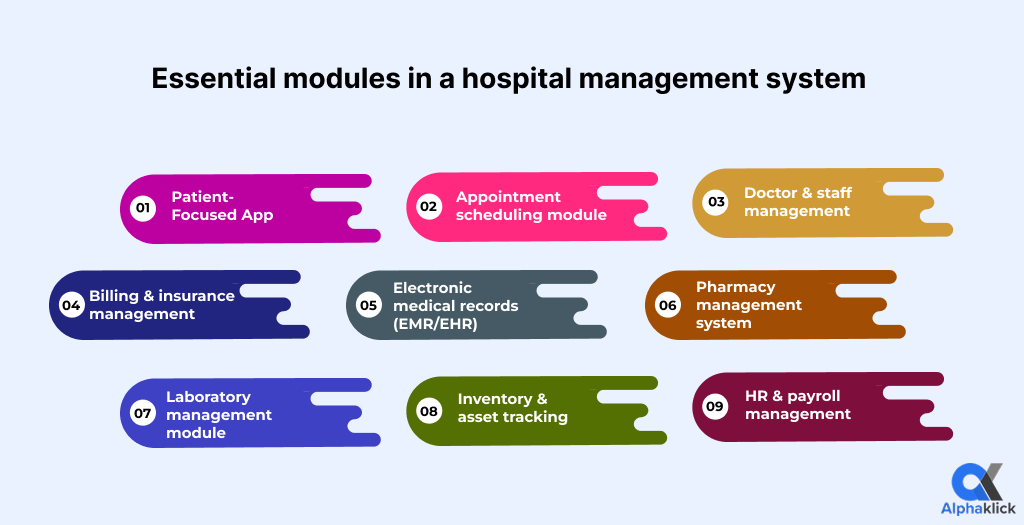
The efficiency of any hospital management software depends on how well different modules work together. Instead of managing appointments, records, billing, pharmacy, and reports separately, hospitals can streamline everything through one centralized platform.
Modern hospital management system development helps healthcare organizations improve coordination, reduce administrative workload, and manage daily operations more efficiently.
1. Patient registration & management
A centralized patient management system helps hospitals securely manage patient profiles, medical history, prescriptions, insurance details, admission records, and treatment history for faster access across departments.
2. Appointment scheduling module
An advanced appointment scheduling system helps hospitals manage bookings, doctor availability, follow-ups, reminders, rescheduling, and patient queues more efficiently.
3. Doctor & staff management
This module helps hospitals manage doctor schedules, attendance records, payroll processing, staff availability, and departmental coordination.
4. Billing & insurance management
Integrated billing and invoice management helps automate invoices, payment tracking, insurance claims, and financial reporting while reducing manual billing errors.
5. Electronic medical records (EMR/EHR)
Secure EMR and EHR integration allows hospitals to maintain centralized digital records for prescriptions, diagnostics, laboratory reports, and treatment history with easier accessibility.
6. Pharmacy management system
A smart pharmacy management system helps hospitals monitor medicine inventory, expiry dates, supplier records, stock alerts, and prescription handling workflows.
7. Laboratory management module
This module manages sample collection, diagnostic tracking, pathology reports, test scheduling, and patient result management to improve laboratory efficiency.
8. Inventory & asset tracking
Hospitals can track medical equipment, consumables, stock movement, and inventory availability in real time to improve operational control.
9. HR & payroll management
This module helps healthcare organizations manage employee records, attendance, shift scheduling, payroll processing, and staff administration through one centralized system.
A modern hospital CRM system also helps hospitals improve patient engagement, automate follow-ups, and centralize communication across departments.
Advanced features in modern hospital management software
Advanced hospital management system features now help hospitals automate workflows, improve accessibility, and manage healthcare operations through more connected digital infrastructure.
1. AI-based patient insights
AI-powered systems can analyze patient history, diagnostic records, treatment patterns, and clinical data to help healthcare providers identify risks, improve treatment planning, and support faster medical decision-making.
2. Telemedicine integration
Modern hospitals are integrating virtual consultation capabilities directly into their hospital information systems, allowing doctors to manage online appointments, patient records, prescriptions, and follow-ups from a single platform.
3. ePrescription system
Digital prescription management helps doctors generate and share prescriptions electronically while connecting directly to the pharmacy management system, enabling faster medication processing and reducing prescription errors.
4. Mobile accessibility
Modern hospital software solutions now allow patients, doctors, and hospital staff to access appointments, reports, notifications, and medical records securely through mobile applications from anywhere.
5. Role-based access control
Advanced security systems use permission-based access to control who can view, edit, or manage sensitive healthcare information, helping hospitals improve data protection and operational security.
6. Multi-hospital management
Healthcare groups and hospital chains can manage multiple branches, departments, staff records, billing systems, and patient data through one centralized dashboard with real-time visibility across locations.
7. Cloud-based healthcare infrastructure
Modern healthcare software development focuses heavily on cloud infrastructure to support remote accessibility, centralized data storage, automatic backups, and better scalability for growing healthcare organizations.
8. AI-powered workflow automation
Advanced hospital software development now includes automation for appointment reminders, patient notifications, report generation, billing workflows, and operational reporting to reduce manual administrative work.
Many hospitals are now shifting toward AI-enabled systems for automation and analytics. You can also compare AI healthcare software vs traditional software to understand the key operational differences.
AI tools & technologies used in hospital management system development
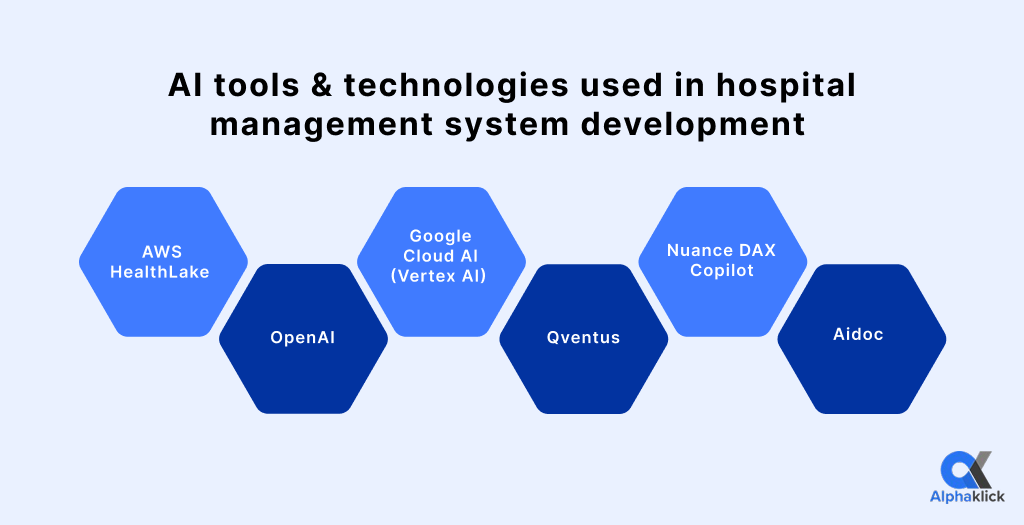
Modern healthcare software development now includes AI-powered tools that help hospitals automate workflows, manage healthcare data more efficiently, and improve operational decision-making.
| AI Tool | Why It Is Useful in HMS |
| AWS HealthLake | Helps hospitals securely manage and organize healthcare data in one centralized system |
| OpenAI | Supports AI chatbots, patient communication, and workflow automation |
| Google Cloud AI (Vertex AI) | Helps analyze healthcare data for predictive insights and reporting |
| Qventus | Improves hospital workflows and patient flow management |
| Nuance DAX Copilot | Assists doctors with AI-generated clinical documentation |
| Aidoc | Supports AI-powered diagnostic and medical imaging analysis |
These AI tools help modern hospital management software improve automation, reporting, patient management, and operational efficiency.
Compliance & security standards in hospital management software
Security and compliance are essential in modern hospital management software because healthcare organizations handle highly sensitive patient and operational data.
A secure hospital information system helps hospitals protect healthcare records, reduce cyber risks, and maintain regulatory compliance.
1. Healthcare compliance standards
HIPAA compliance: Protects patient health information and ensures secure handling of healthcare data.
GDPR compliance: Supports secure patient data management and privacy protection for global healthcare operations.
HL7 & FHIR standards: These standards support secure healthcare interoperability and smooth EMR and EHR integration between healthcare systems.
Healthcare organizations implementing AI-enabled healthcare platforms should also understand the importance of building HIPAA-compliant AI healthcare apps for secure patient data management.
2. Access control & data security
Role-based access control (RBAC): Restricts access to sensitive healthcare information based on user roles and permissions.
Data protection & encryption: Secure APIs, encrypted communication, and protected systems help safeguard healthcare data.
Database encryption: Encrypts patient records, billing details, prescriptions, and operational data from unauthorized access.
3. Risk management & threat prevention
Regular risk assessments & penetration testing: Helps identify vulnerabilities and improve overall system security.
AI-powered threat detection: AI-based systems monitor unusual activities and potential cyber threats in real time.
Data backup & disaster recovery: Automated backup systems help hospitals recover critical healthcare data during failures or security incidents.
4. Staff security & cybersecurity awareness
Staff training: Helps employees follow secure healthcare data handling and operational practices.
Cybersecurity training: Improves awareness around phishing attacks, password security, and cyber risk prevention.
Hospital management system development cost in 2026
The cost of hospital management system development depends on system complexity, modules, integrations, security requirements, and infrastructure.
Basic platforms cost less, while enterprise-level hospital management software with AI automation, cloud systems, telemedicine, and advanced EMR and EHR integration requires a higher investment.
| HMS Type | Estimated Cost |
| Basic hospital management software | $15,000 – $30,000 |
| Mid-level HMS platform | $30,000 – $80,000 |
| Enterprise hospital management system | $80,000 – $250,000+ |
Advanced custom hospital software development projects with AI-powered workflows and enterprise integrations generally require higher development investment.
You can also explore some of the top healthcare app development companies in India working on AI-powered and IoT-enabled healthcare solutions.
Real case study of hospital management system development
A multi-specialty healthcare provider invested in custom hospital management system development to centralize appointments, billing, diagnostics, pharmacy, inventory, and patient management into one connected platform.
| Project Overview | Details |
| Client Requirement | Centralized management for appointments, billing, diagnostics, pharmacy, inventory, and patient records |
| Technologies Used | React.js, Node.js, MongoDB, AWS |
| Key Modules Implemented | Patient management, billing, appointment scheduling, pharmacy, diagnostics, and inventory tracking |
| Major Challenges | Manual workflows, disconnected departments, billing inefficiencies, and inventory visibility |
| Results Achieved | 40–50% reduction in manual work, faster patient handling, improved billing accuracy, and better department coordination |
Why choose Alphaklick for hospital management system development
Modern healthcare organizations require systems that can manage patient records, appointments, billing, diagnostics, pharmacy operations, and internal workflows without operational complexity.
At Alphaklick, we provide specialized Healthcare Software Development Services focused on building scalable and connected healthcare platforms for hospitals, clinics, and healthcare businesses.
If you are planning to build a new hospital management software platform or upgrade your existing system, you can connect with me or book a free consultation with our team to discuss your project requirements, integrations, and healthcare development roadmap.
Frequently asked questions (FAQs)
Question: How long does it take to develop hospital management software?
Answer: The development timeline depends on the number of modules, integrations, and system complexity. A mid-level hospital management system usually takes 3–6 months to develop.
Question: Is cloud-based hospital management software secure?
Answer: Yes, modern cloud-based hospital systems use encrypted databases, secure APIs, role-based access control, backups, and compliance standards like HIPAA and GDPR for data security.
Question: How much does hospital management system development cost?
Answer: The cost depends on modules, integrations, security requirements, and system complexity. Basic platforms usually start from $15,000, while enterprise healthcare systems can exceed $250,000.
Question: Why is EMR and EHR integration important in hospitals?
Answer: EMR and EHR integration helps hospitals maintain centralized patient records, improve data accessibility, reduce duplication, and support better coordination between departments.
Question: Can hospital management software support multi-hospital operations?
Answer: Yes, modern hospital management software can manage multiple hospital branches, departments, billing systems, staff records, and patient data through one centralized platform.