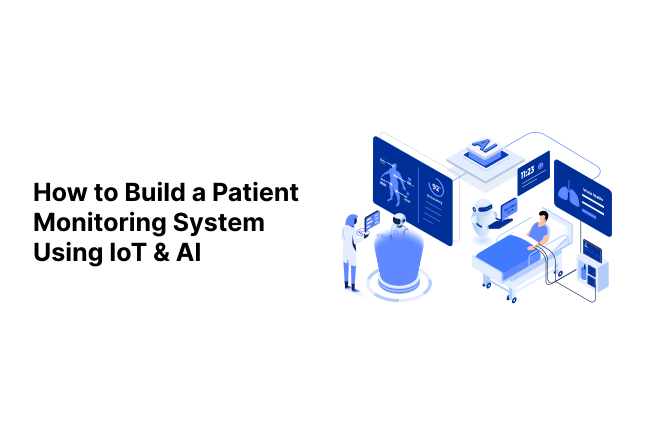
Healthcare is moving beyond hospital walls with the rise of the patient monitoring system using IoT and AI.
As part of modern healthcare software development, hospitals and healthcare providers are now using smart wearables, AI-driven alerts, and connected healthcare platforms to monitor patient health in real time and improve emergency response remotely.
Today, remote patient monitoring systems are helping hospitals, clinics, and healthcare startups track patient vitals more accurately through IoT sensors, cloud infrastructure, and AI-powered healthcare monitoring solutions.
In this guide, we will cover how to build a patient monitoring system using AI, including core technologies, essential features, development steps, and estimated costs.
What is a patient monitoring system?
A patient monitoring system is a healthcare software and device ecosystem that continuously tracks patient health data such as heart rate, oxygen level, blood pressure, glucose level, temperature, ECG, and respiratory activity.
A modern remote health monitoring system collects data from wearable devices, IoT sensors, and medical equipment, then sends that information to doctors or healthcare providers in real time.
The use of IoT in healthcare monitoring allows healthcare teams to monitor patients remotely without requiring constant hospital visits.
Unlike traditional systems, modern AI-powered healthcare software can deliver real-time monitoring, predictive alerts, and automated healthcare insights.
Types of patient monitoring systems
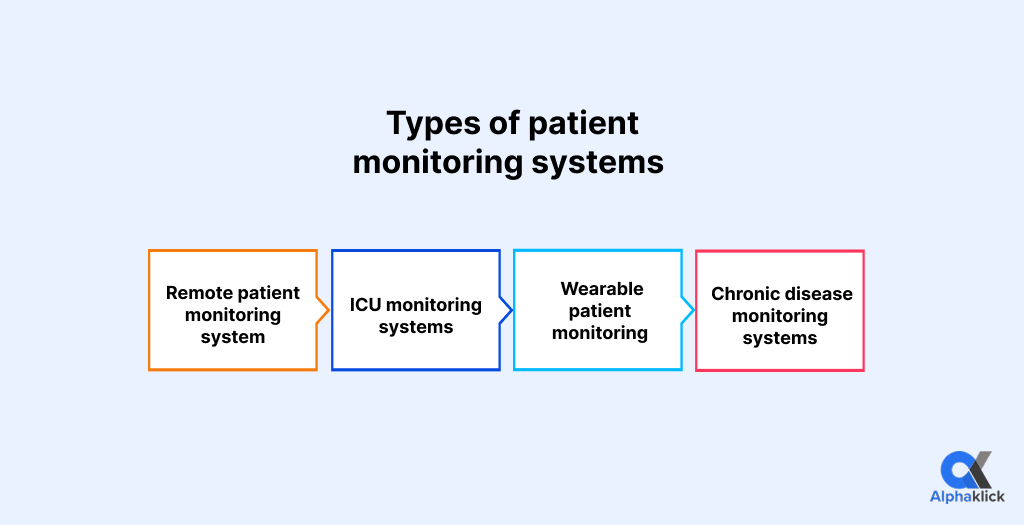
1. Remote patient monitoring system: A remote patient monitoring system helps doctors monitor patient health remotely using wearable devices, IoT sensors, and mobile apps.
2. ICU monitoring systems: ICU monitoring systems continuously track critical patient vitals such as heart rate, oxygen level, and blood pressure in hospitals.
3. Wearable patient monitoring: Wearable patient monitoring includes smartwatches, ECG patches, glucose monitors, and fitness trackers for real-time health tracking.
4. Chronic disease monitoring systems: These systems help monitor diabetes, cardiac conditions, blood pressure, and respiratory diseases through continuous health tracking.
The growing use of wearable patient monitoring and real-time patient monitoring solutions is improving preventive healthcare and faster medical response.
Core technologies used in modern patient monitoring systems
Building a patient monitoring system using IoT requires advanced technologies that work together to enable secure and real-time patient monitoring.
1. IoT sensors & medical devices
IoT-enabled healthcare devices continuously collect patient vitals and send data to healthcare platforms in real time.
Common devices include:
- ECG sensors – Monitor heart activity and irregular heartbeat patterns
- Pulse oximeters – Measure oxygen levels and pulse rate
- Blood pressure monitors – Track blood pressure changes
- Glucose monitoring sensors – Help monitor diabetes continuously
- Smart thermometers – Detect temperature fluctuations
- Wearable fitness trackers – Track activity, sleep, and heart rate
These devices are widely used in IoT in healthcare monitoring and remote healthcare systems.
2. Artificial intelligence & predictive analytics
The use of AI in patient monitoring helps healthcare providers analyze patient data, predict health risks, and generate instant alerts.
Machine learning (ML): ML algorithms study patient health patterns and help detect abnormal activities such as heart irregularities or oxygen drops.
Predictive analytics: Predictive analytics helps identify potential medical risks before conditions become critical.
NLP & AI assistants: Natural language processing (NLP) helps process patient reports, doctor notes, and AI chatbot interactions more efficiently.
These technologies improve the accuracy of AI-powered healthcare monitoring systems.
3. Cloud computing & real-time data processing
Cloud platforms like AWS, Azure, and Google Cloud securely store healthcare data and support:
- Real-time patient monitoring
- Remote doctor access
- Health report management
- Multi-device synchronization
4. Mobile applications & dashboards
A patient monitoring app helps doctors and patients access live vitals, alerts, reports, and medication reminders directly from mobile devices.
5. APIs, EHR integrations & healthcare security
Healthcare APIs help integrate monitoring systems with EHR, EMR, telemedicine, and hospital software using standards like HL7 and FHIR.
Healthcare security technologies include:
- HIPAA compliance – Protects patient health data
- End-to-end encryption – Secures healthcare information during transfer
- Multi-factor authentication (MFA) – Adds secure login protection
- Role-based access control (RBAC) – Restricts unauthorized access to patient records
These technologies help build secure and scalable healthcare IoT solutions.
Patient monitoring platforms must follow security standards similar to HIPAA-compliant healthcare apps to protect sensitive medical data.
Essential features of an IoT & AI patient monitoring system
1. Real-time patient monitoring
The system continuously tracks patient vitals such as ECG, oxygen saturation (SpO2), heart rate, blood pressure, temperature, and glucose levels through connected IoT devices.
2. AI-powered alerts & predictive analytics
The use of AI in patient monitoring helps identify abnormal health conditions, predict medical risks, and trigger instant alerts for doctors and caregivers.
3. Wearable device integration
Wearable patient monitoring supports integration with smartwatches, ECG patches, pulse oximeters, glucose monitors, and other connected healthcare devices.
4. Patient monitoring app & doctor dashboard
A patient monitoring app allows patients to view reports, medication reminders, and health updates, while doctor dashboards provide centralized access to live patient data and alerts.
5. Cloud-based healthcare data management
Cloud infrastructure enables secure storage, real-time synchronization, and faster access to patient records across hospitals and healthcare systems.
6. EHR & telemedicine integration
The platform integrates with EHR, EMR, telemedicine, and hospital management software using standards like HL7 and FHIR.
7. Healthcare security & compliance
Security features such as HIPAA compliance, end-to-end encryption, multi-factor authentication (MFA), and role-based access control (RBAC) help protect sensitive healthcare data.
8. Remote access & emergency support
A remote patient monitoring system allows healthcare providers to monitor patients remotely and receive emergency alerts during critical health situations.
The rapid growth of AI and connected healthcare platforms is transforming modern healthcare software development across hospitals and clinics.
Step-by-step process to build a patient monitoring system using IoT & AI
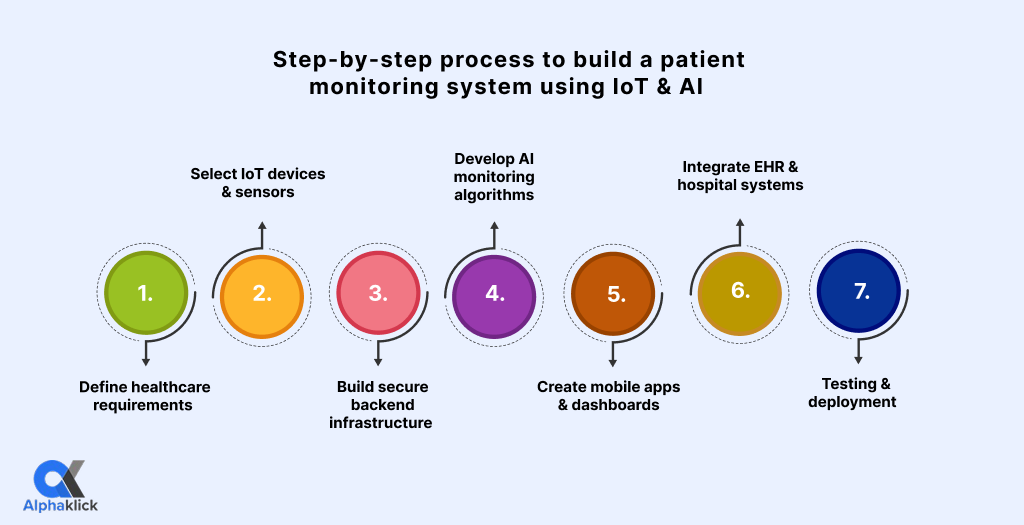
Developing a patient monitoring system using AI requires healthcare planning, IoT integration, secure infrastructure, and compliance-focused development.
Step 1: Define healthcare requirements
Start by identifying the core healthcare objectives of the platform, including:
- Target patient groups
- Remote monitoring goals
- Chronic disease management requirements
- Emergency alert workflows
- HIPAA and healthcare compliance needs
This stage helps define the overall architecture of the remote patient monitoring system.
Step 2: Select IoT devices & sensors
Choose healthcare devices based on the type of patient monitoring required.
Common IoT devices include:
- ECG monitors
- Pulse oximeters
- Blood pressure monitors
- Glucose monitoring devices
- Smartwatches and wearable trackers
These devices play a key role in real-time patient monitoring and health data collection.
Step 3: Build secure backend infrastructure
Develop a cloud-based backend using platforms like AWS, Azure, or Google Cloud to manage healthcare data securely and support real-time synchronization across devices.
The infrastructure should support:
- Real-time data processing
- Secure patient record storage
- API integrations
- Scalable healthcare operations
Step 4: Develop AI monitoring algorithms
The use of AI in patient monitoring helps automate health analysis and risk prediction.
AI models can analyze:
- Heart rate fluctuations
- Oxygen level changes
- Sleep patterns
- Glucose trends
- Abnormal health conditions
This improves the efficiency of AI-powered healthcare monitoring systems.
Step 5: Create mobile apps & dashboards
Develop a healthcare-focused patient monitoring app for patients and a centralized dashboard for doctors and hospital staff.
The platform should support:
- Live patient monitoring
- Health reports and alerts
- Medication reminders
- Emergency notifications
- Secure login access
Step 6: Integrate EHR & hospital systems
Integrate the monitoring platform with EHR, EMR, telemedicine, and hospital systems using healthcare standards like HL7 and FHIR for smooth data exchange.
Step 7: Testing & deployment
Before deployment, the platform must undergo:
- Performance testing
- Device connectivity testing
- Security testing
- HIPAA compliance testing
Proper testing ensures the smart patient monitoring system works securely and reliably in real healthcare environments.
Many healthcare businesses work with experienced AI & IoT healthcare app developers to build scalable and connected patient monitoring solutions.
IoT devices are commonly used in patient monitoring systems
The success of healthcare IoT solutions depends on accurate sensors, reliable connectivity, and real-time health data tracking. These IoT-enabled devices help healthcare providers improve real-time patient monitoring and remote care management.
| IoT Device | Monitoring Purpose |
| Smart ECG monitors | Heart rhythm and cardiac monitoring |
| Pulse oximeters | Oxygen saturation (SpO2) tracking |
| Blood pressure monitors | Blood pressure and hypertension monitoring |
| Glucose monitoring devices | Continuous diabetes monitoring |
| Smart thermometers | Body temperature tracking |
| Smart wearables | Heart rate, sleep, and activity tracking |
| Respiratory monitoring devices | Breathing and respiratory monitoring |
The growing adoption of iot in healthcare monitoring and wearable patient monitoring devices is helping hospitals and clinics deliver smarter and more connected healthcare services.
Before building a new solution, it’s important to know whether your hospital actually needs one. Read Top 7 Signs Your Hospital Needs a Custom Patient Monitoring System to identify the key indicators.
Cost to build a patient monitoring system using IoT & AI
The cost of developing a patient monitoring system using IoT depends on AI features, device integrations, cloud infrastructure, and healthcare compliance requirements.
| Development Component | Estimated Cost |
| UI/UX design | $5,000 – $15,000 |
| Mobile & web development | $20,000 – $60,000 |
| AI development | $15,000 – $50,000 |
| IoT device integration | $10,000 – $40,000 |
| Cloud & security infrastructure | $8,000 – $25,000 |
| Testing & compliance | $5,000 – $15,000 |
A basic remote patient monitoring system may cost less, while enterprise-level AI-powered healthcare monitoring platforms require larger investments.
Factors affecting cost
- Number of connected devices
- AI complexity
- Real-time analytics
- HIPAA compliance
- Cloud infrastructure
- Third-party integrations
Why choose Alphaklick for patient monitoring system development
Alphaklick is a specialized patient monitoring system development company helping healthcare businesses build connected, AI-driven monitoring platforms for modern patient care.
We create custom remote patient monitoring systems, wearable device integrations, live doctor dashboards, and secure patient monitoring apps that support real-time health tracking and faster clinical response.
Our focus is not just software development; we build healthcare ecosystems that combine IoT connectivity, AI-powered insights, cloud infrastructure, and healthcare compliance into one scalable platform.
If you are planning to launch a smarter healthcare monitoring solution, book a free consultation with the Alphaklick healthcare team.
Frequently asked questions
Question: What is a patient monitoring system using IoT?
Answer: A patient monitoring system using IoT uses connected healthcare devices and sensors to collect patient health data in real time and share it with doctors or hospitals remotely.
Question: How does AI help in patient monitoring systems?
Answer: The use of AI in patient monitoring helps detect abnormal health conditions, generate instant alerts, analyze patient patterns, and improve medical decision-making through predictive analytics.
Question: Which devices are commonly used in wearable patient monitoring?
Answer: Common wearable patient monitoring devices include smartwatches, ECG monitors, pulse oximeters, glucose monitoring devices, blood pressure monitors, and fitness trackers.
Question: How much does it cost to develop a remote patient monitoring system?
Answer: The cost of a remote patient monitoring system depends on features, AI capabilities, IoT device integrations, cloud infrastructure, healthcare compliance, and platform complexity.
Question: Is patient monitoring software secure for healthcare data?
Answer: Yes, modern AI-powered healthcare monitoring platforms use security technologies like HIPAA compliance, encrypted data transfer, MFA authentication, and secure cloud storage to protect patient information.