Dr. Kavya has been a practicing dietitian for over a decade. In her clinic, the pattern repeats with almost every new client: they arrive with months of tracker entries and the same frustrated line, “I logged everything, and I still don’t know what to eat.”
She isn’t guessing what people need. She’s watching it play out, consultation after consultation.
That’s what led her to ask us a simple question: could an app replicate what happens in her consultation room, not the logging, but the guidance, at a scale no single dietitian could ever offer one client at a time?
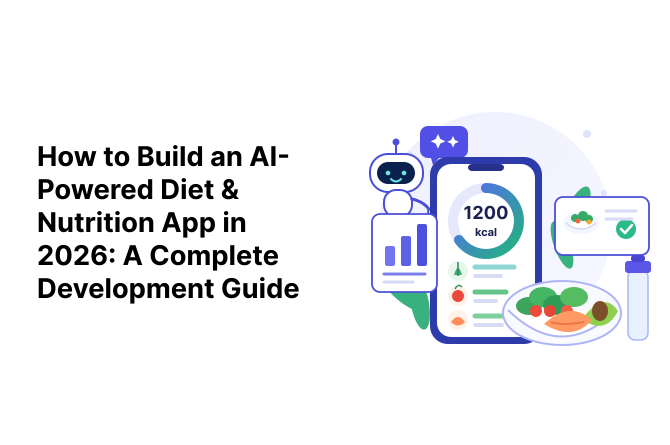
That question is the heart of this AI-powered diet and nutrition planning app development guide. Below, we cover features, market demand, tech stack, accuracy challenges, compliance, cost, and monetization- everything you need to actually plan how to build an AI meal planner app.
What is an AI-Powered Nutrition Mobile App?
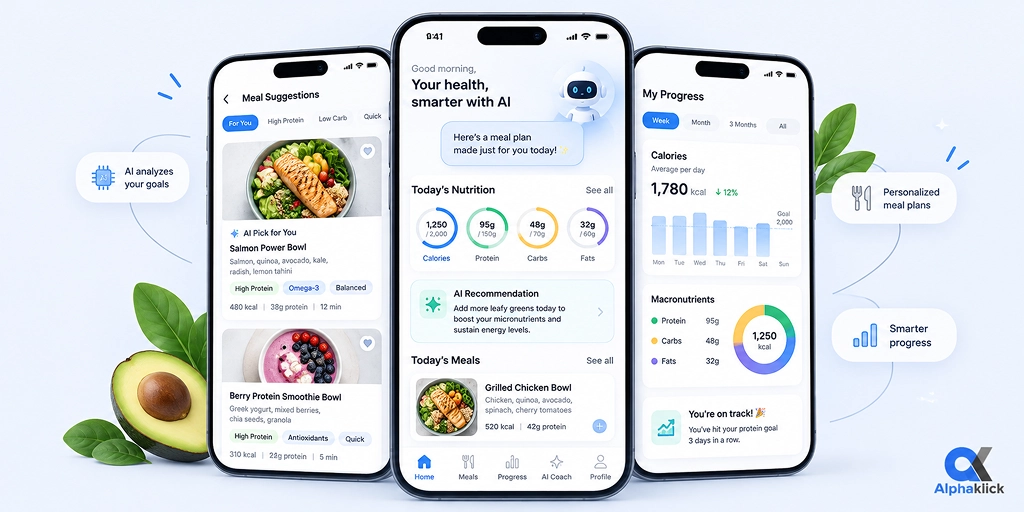
A lot of apps marketed as “AI-powered” are really just automation with a nicer label. A true AI nutrition mobile app uses machine learning to learn from what a user eats, how their body responds, what they skip, and adjusts its guidance accordingly.
Here’s the simplest way to see the difference:
- A regular tracker tells you that you ate 1,800 calories today.
- An AI-powered mobile app notices you’re consistently low on protein by dinner, and quietly nudges your next meal suggestion to fix it.
That distinction shapes every decision that follows: features, architecture, and cost.
Market Demand: Why Now Is the Right Time to Build
| Market Signal | Data Point |
|---|---|
| Diet & nutrition apps market size (2026) | USD 6.94 billion, growing to USD 27.73 billion by 2035 (16.64% CAGR) [source] |
| AI personalized nutrition market size (2026) | USD 2.01 billion, growing to USD 17.59 billion by 2035 (27.25% CAGR) [source] |
| User preference for AI platforms | 52%+ of nutrition app users now prefer AI-powered platforms for daily planning |
| Wearable data integration growth | Metabolic wearable integration (CGMs, biosensors) up 44% YoY |
The short version: this market is growing fast, users increasingly expect AI-level personalization by default, and the infrastructure (APIs, wearables, LLMs) needed to build it is now affordable and production-ready.
Key Features of an AI Diet & Nutrition App (MVP vs. Advanced)
When Dr. Kavya asked us where to start, we didn’t hand her a 40-feature wishlist. We asked her a clinician’s question instead: “In a first consultation, what do you actually do first?”
Her answer- listen, learn restrictions, give a simple starting plan- became the MVP blueprint.
MVP Features (Build First)
| Feature | What It Does | Why It’s Non-Negotiable |
|---|---|---|
| AI food image recognition calorie tracking app | Snap a photo, get calorie/macro estimates | Removes the #1 friction point — manual entry |
| Basic personalized meal plans | Suggests meals based on goals and preferences | Delivers real value from the first session |
| Macro/calorie dashboard | Visual daily/weekly nutrition summary | Core utility every user expects |
| Barcode scanning | Instant packaged-food logging | Fast alternative when a photo isn’t practical |
| Water & habit tracking | Simple daily wellness logging | Cheap to build, keeps daily engagement up |
| Onboarding questionnaire | Captures goals, allergies, restrictions | Seeds the AI model before real usage data exists |
Advanced / Phase 2 Features (Deepen Retention)
| Feature | What It Does | Why It Matters Later |
|---|---|---|
| LLM chatbot nutrition coach conversational AI | Answers real-time “what should I eat” questions | Turns the app into a daily habit, not just a log |
| Wearable integration: Apple Health, Fitbit, Google Fit | Syncs activity, sleep, and heart-rate data | Connects nutrition to the full health picture |
| Predictive health insights | Flags patterns before users notice them | Builds the “this app actually knows me” moment |
| Grocery list & recipe generation | Auto-builds shopping lists from meal plans | Reduces daily decision fatigue |
| Social/community features | Progress sharing, challenges, accountability groups | Improves long-term retention |
| Clinician/coach dashboard | Lets professionals monitor client progress | Opens B2B2C revenue (clinics, gyms, wellness programs) |
Build the MVP tight. Prove it holds attention the way a real consultation does. Then layer in AI depth, not the other way around.
How a User Moves Through the App
| New User Signs Up | v Onboarding Questionnaire (goals, allergies, biometrics) | v AI Seeds Initial Meal Plan (cold-start recommendation) | v User Logs Food (photo/barcode/manual) | v AI Analyzes Pattern (protein gaps, calorie trends, timing) | v AI Adjusts Next Recommendation —> Chatbot Coach Available | v Weekly Insight Report Sent to User | v Loop Repeats (model gets smarter with each cycle) |
This loop- log, learn, adjust, repeat- is the engine behind every AI nutrition app that retains users past the 30-day mark.
AI Food Recognition Technology: How Accurate Is Photo-Based Food Logging?
In Dr. Kavya’s consultation room, a client describes their plate, and she estimates it instantly, from years of trained eye. Software has to earn that same instinct, and it’s harder than it looks.
A few reasons why:
- A barcode is clean, printed data. A plate of food is chaos: mixed ingredients, inconsistent portions, different lighting and angles.
- Regional cuisines make it worse. A bowl of dal looks nothing like a bowl of ramen to a model trained mostly on Western food datasets.
- Industry-wide accuracy for photo-based food recognition sits around 70–85%, depending on the dish and how cleanly the items are separated on the plate.
What matters most isn’t chasing the last few points of accuracy. It’s how you handle the 15–30% the AI gets wrong. The fix is simple: show the AI’s guess (“Chicken biryani, ~650 kcal — is this right?”), let the user confirm or correct it in one tap.
That single UX decision does more for trust than extra model training ever will. People don’t expect AI to be perfect; they expect it to be honest about its limits.
Example: Apps like Cal AI and MyFitnessPal’s AI Meal Scan use exactly this confirm-or-correct flow: the AI estimates the dish and calories, then lets the user tap “adjust portion” or pick a closer match if the guess looks off.
That one extra tap is what keeps users trusting the feature instead of abandoning it after the first wrong guess.
How AI Personalizes Meal Plans and Nutrition Recommendations
This is where “AI-powered” stops being a buzzword and becomes the actual product.
Take two of Dr. Kavya’s real client types, both chasing the same goal, “lose 5kg”:
- A night-shift nurse who eats dinner at midnight
- A marathon runner carb-loading before races
A generic meal plan serves neither well. A good dietitian knows that instinctively, and a personalized meal recommendation engine machine learning model has to learn it the same way, from real signals:
- Stated goals (weight loss, muscle gain, diabetes management)
- Biometrics (age, weight, activity level)
- Allergies and dietary restrictions
- Actual eating behavior over time, not just what a user says they’ll do
The hard part is the “cold start” problem: what does the app recommend before it has any usage history? Most apps solve this with a short, smart onboarding questionnaire that seeds a reasonable first guess, then lets real logging refine it.
One rule we never bend: personalization should never cross into medical advice. For products that do handle symptom-related interactions, AI symptom checker mobile app development requires an even clearer boundary between AI guidance and medical diagnosis.
Tech Stack for AI Nutrition Apps: Frameworks, APIs & Integrations
Here’s a realistic breakdown of what goes into building an AI meal planner app, features and tech stack included.
| Layer | Common Choices | Purpose |
|---|---|---|
| Frontend | React Native/Flutter cross-platform nutrition app | One codebase, iOS + Android from day one |
| AI/ML | TensorFlow, PyTorch, custom CV models | Food recognition, personalization engine |
| Nutrition Data | Nutrition API integration: Edamam, USDA, Nutritionix | Verified nutrition and ingredient databases |
| Conversational Layer | LLM-based chat (fine-tuned or API-based) | Nutrition coach chatbot |
| Wearables | HealthKit, Fitbit SDK, Google Fit API | Activity and sleep data sync |
| Backend | Node.js / Python, cloud infra (AWS/GCP) | Scalable data processing and storage |
Most teams don’t need to build food-recognition AI or nutrition databases from scratch. Using APIs like Edamam or Nutritionix for the data layer, while investing custom work in the personalization engine, is usually the smarter build-vs-buy call.
Is Your Nutrition App HIPAA Compliant? Data Privacy Requirements Explained
A nutrition mobile app collects health data the moment it asks about allergies, medical conditions, or weight goals. That means HIPAA and GDPR compliance health data privacy nutrition app requirements aren’t optional extras; they’re foundational, especially if you ever want to partner with clinics, gyms, or insurers.
Before writing production code, map out:
- What health data is being collected
- Where it’s stored
- Who can access it
- How consent is captured
Retrofitting compliance after launch is far more expensive than designing for it from day one. A health insurance claim processing app also requires careful handling of sensitive healthcare and insurance data.
AI Nutrition Mobile App Development Cost: 2026 Pricing Breakdown
| Build Scope | Approx. Cost Range | Timeline |
|---|---|---|
| Basic MVP (logging + meal plans) | $15,000 – $30,000 | 8–10 weeks |
| Mid-tier (+ AI food recognition, wearables) | $35,000 – $65,000 | 12–16 weeks |
| Full AI-powered product (+ LLM coach, predictive insights) | $70,000 – $120,000+ | 20–28 weeks |
Hidden costs founders often miss: AI training data acquisition, third-party API rate limits at scale, and compliance review cycles.
How Do Nutrition Mobile Apps Make Money? Monetization Models Explained
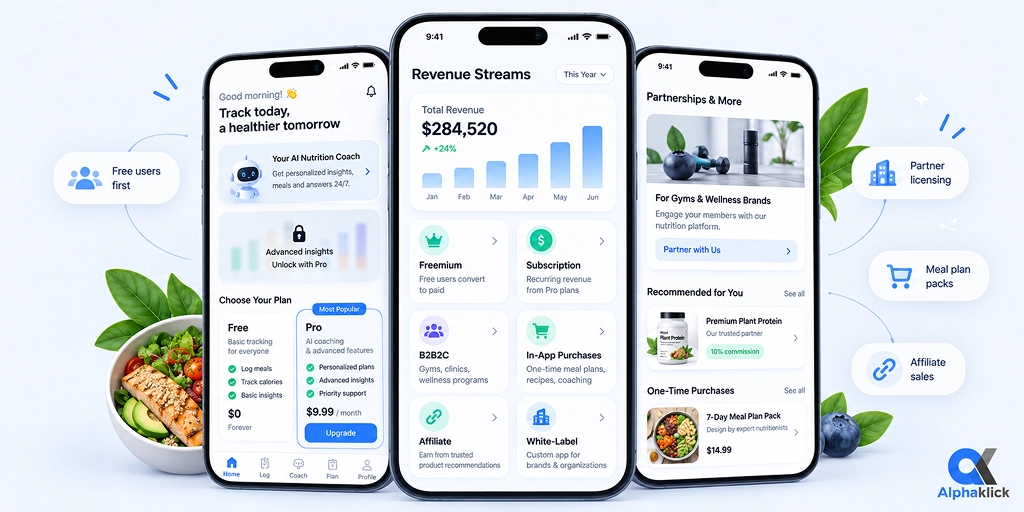
Subscription is the dominant model, but the more resilient apps combine two or three revenue streams:
- Freemium: free basic tracking, AI coaching, and insights behind a paywall
- Subscription (B2C): monthly or annual plans, the primary driver once retention is proven
- B2B2C partnerships: licensing to gyms, clinics, corporate wellness programs, or insurers
- In-app purchases: one-time meal plan packs, specialized programs
- Affiliate/commerce integration: grocery delivery, supplement recommendations
- White-label licensing: selling the AI engine to other health/fitness brands
The mistake we see most often: paywalling every AI feature before users feel its value. Let free users experience the AI first; monetize the depth, not the entry point.
How We Approach These Builds at AlphaKlick
Every AI nutrition mobile app we scope follows a similar arc:
Pattern 1: The lean MVP that earns its next round
A founder has a strong instinct about a gap but a limited budget. We scope a tight MVP: food logging, basic personalization, clean onboarding, built to prove the core retention loop. That proof point is what founders take to investors or early enterprise partners.
Pattern 2: AI depth after real usage data exists
Once an app has even a few hundred active users, the personalization engine has something real to learn from. We hold off on the LLM coaching chatbot and predictive insights until this stage; they perform noticeably better built against real behavior than against assumptions.
This conversational layer can eventually become more sophisticated as the product grows. For broader healthcare use cases, AI healthcare agent development can extend beyond nutrition coaching into patient support, workflow automation, and other healthcare interactions.
Pattern 3: Compliance-first architecture for B2B2C ambitions
For founders who know they’ll eventually sell into clinics or corporate wellness programs, we build HIPAA/GDPR-ready data architecture from the first sprint; retrofitting it later is slower and more expensive.
If you’re comparing healthcare mobile app developers in India, experience with AI, mobile development, and health-data architecture is particularly important for this type of product.
Why Choose AlphaKlick to Build an AI-Powered Diet & Nutrition App
This category punishes shortcuts. Getting food recognition, personalization logic, and compliance architecture right the first time saves months of rework.
About AlphaKlick: a mobile app development company in India, also building web and AI-powered products where AI is engineered in, not bolted on. We work across React Native/Flutter, custom ML integration, and compliant health-data architecture, exactly what an AI nutrition app needs.
- We scope features around what actually improves retention
- We build compliance in from sprint one, not as a pre-launch scramble
- We sequence MVP first, AI depth second, so budget goes where it matters
- We stay hands-on through discovery, design, development, and post-launch iteration
Book a free consultation with AlphaKlick →
AI Nutrition App FAQs
Question: How much does it cost to build an AI nutrition app?
Answer: $15,000–$30,000 for a lean MVP, $35,000–$65,000 for a mid-tier build with food recognition and wearables, and $70,000–$120,000+ for a full AI-powered product with coaching and predictive insights.
Question: Is a diet app required to be HIPAA compliant?
Answer: Yes, if it collects health-related data like allergies, conditions, or biometrics. This becomes essential if you plan to partner with clinics, gyms, or insurers later.
Question: How accurate is AI food recognition?
Answer: Around 70–85% industry-wide. A quick confirmation step in the UX closes the trust gap better than chasing marginal accuracy gains.
Question: How long does it take to build one?
Answer: 8–10 weeks for an MVP, 12–16 weeks with food recognition and wearables, 20–28 weeks for a full AI-powered build.
Question: Do I need to build my own AI models, or can I use existing APIs?
Answer: Most teams use APIs like Edamam, USDA, or Nutritionix for the nutrition database, and invest custom development in the personalization engine and food recognition, the parts that actually differentiate the app.