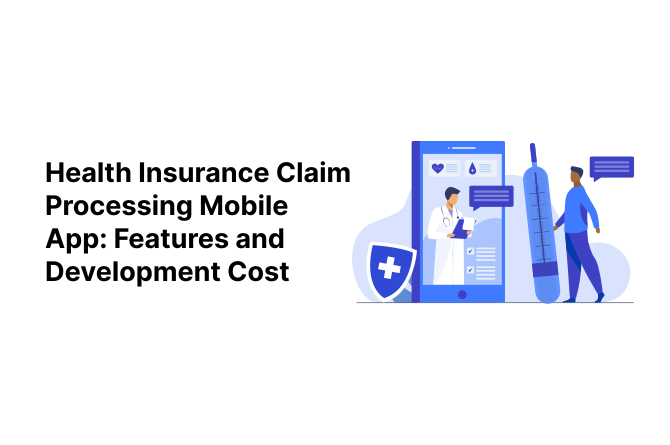
Filing a health insurance claim shouldn’t feel like a second job. Yet for millions of people, it still means chasing paperwork, waiting weeks for updates, and hoping nothing gets rejected on a technicality.
Insurers and hospitals feel it too, drowning in manual claim files, human errors, and slow approvals.
This is why a health insurance claim processing mobile app has become one of the smartest investments in healthcare technology today.
In this guide, we’ll cover the must-have health insurance claim processing mobile app features, break down the health insurance claim mobile app development cost, and walk through compliance and integrations too.
What is Health Insurance Claim Processing (How It Works)
At its core, health insurance claim processing is the journey a claim takes from treatment to payout. It sounds simple, but involves a lot of moving parts.
Manual vs. automated workflow
In the manual process, a patient or hospital submits paper forms, someone keys in the data, an adjuster reviews it, and the claim moves through several desks before approval. This can take weeks, and mistakes creep in from re-entering the same data repeatedly.
An automated claim processing mobile app removes most of this friction. Documents are uploaded digitally, AI checks for errors instantly, and the claim moves through a set workflow with real-time updates. What used to take weeks can now take hours.
Key stakeholders
Every claim touches four main players:
- the policyholder (patient),
- the provider (hospital/clinic),
- the insurer/TPA managing payout,
- and the adjuster (human or AI) who reviews and approves it.
A good claim management mobile app connects all four on one platform, so nobody’s left waiting on a phone call or an email that never comes.
Market Insight & Growth of Health Insurance Claim Mobile Apps
Here’s why this isn’t a “nice to have” anymore; it’s becoming the standard.
| Market Insight | Data | Source |
|---|---|---|
| Global healthcare claims management market (2026) | ~$65.25 billion, growing at 24.70% CAGR through 2034 | Fortune Business Insights |
| AI in insurance claims processing market | $0.46B (2025) → $0.97B by 2030, 16.2% CAGR | GlobeNewswire |
The takeaway: rising claim volumes, AI adoption, and regulatory pressure are all pushing insurers and hospitals toward digital-first claim systems, fast.
Why Businesses Need a Claim Processing Mobile App
Let’s talk about the actual pain points this solves:
- delays (manual approvals take weeks,
- automation cuts this to hours),
- fraud (fake claims and duplicate billing cost insurers heavily),
- paperwork overload (documents get lost or misfiled),
- and manual errors (re-typing data across systems always introduces mistakes).
Benefits by stakeholder:
| Stakeholder | What They Gain |
|---|---|
| Insurer | Faster processing, lower operational cost, better fraud detection |
| Hospital/Provider | Quicker reimbursements, less paperwork, smoother cash flow |
| Patient | Real-time tracking, faster payouts, less stress |
This is really the whole point of building a claim processing mobile app; it turns a painful process into something almost boring, in a good way.
Types of Health Insurance Claim Processing Mobile Apps
Not every claim app is built the same way. Depending on who you’re building for, the app usually falls into one of these categories:
| App Type | Built For | What It Does |
|---|---|---|
| Insurer-side claim management system | Insurance companies | Reviews, adjudicates, and approves incoming claims internally |
| Patient/policyholder self-service app | End users/patients | Lets people file, upload documents, and track their own claims |
| TPA platform | Third-party administrators | Manages claims on behalf of insurers or self-funded employers |
| Provider-facing claim submission tool | Hospitals and clinics | Submits claims directly and requests cashless pre-authorization |
Most successful platforms actually combine two or three of these into one connected ecosystem.
Core Features of a Health Insurance Claim Processing Mobile App
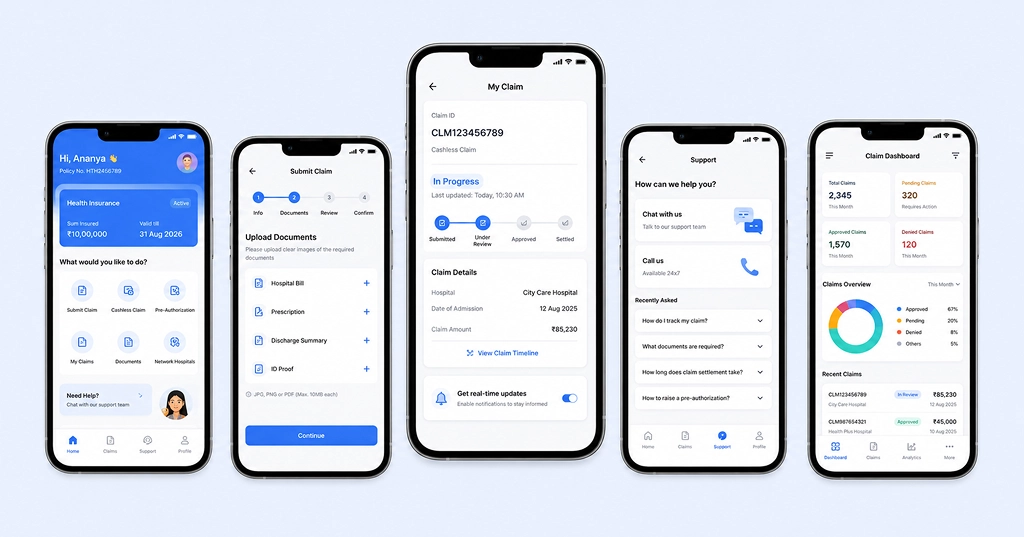
This is the heart of the blog, so let’s slow down here. The right mix of health insurance claim processing app features decides whether your mobile app actually gets used or gets uninstalled after one bad experience.
Patient/Policyholder Features
- Easy claim submission with photo/document upload
- Real-time claim status tracking
- Digital e-KYC verification
- Push notifications and alerts at every claim stage
- In-app chat or support with a live agent
Admin/Insurer Features
- Claim adjudication dashboard with prioritized queues
- Configurable rules engine for auto-approvals and escalations
- Fraud detection alerts flagged in real time
- Analytics and reporting on claim volume, turnaround time, and denial rates
- Role-based access control for different internal teams
Provider Features
- Cashless claim requests submitted directly from the hospital system
- Pre-authorization workflows for planned treatments
- Billing and EHR system integration to avoid duplicate data entry
AI & Automation Features
- OCR to scan and read bills/documents automatically
- Fraud anomaly detection using machine learning
- Predictive claim risk scoring before a claim even reaches an adjuster
- Chatbot-assisted claim filing that guides users step by step
- Auto-adjudication for simple, low-risk claims
All these features cover the full journey, from the moment a patient uploads a bill to the moment the claim is settled.
Choosing the right features can make a major difference in usability, automation, and scalability. See our guide to the top features to include in a modern health insurance software platform.
Health Insurance Claim Processing Mobile App Development Cost
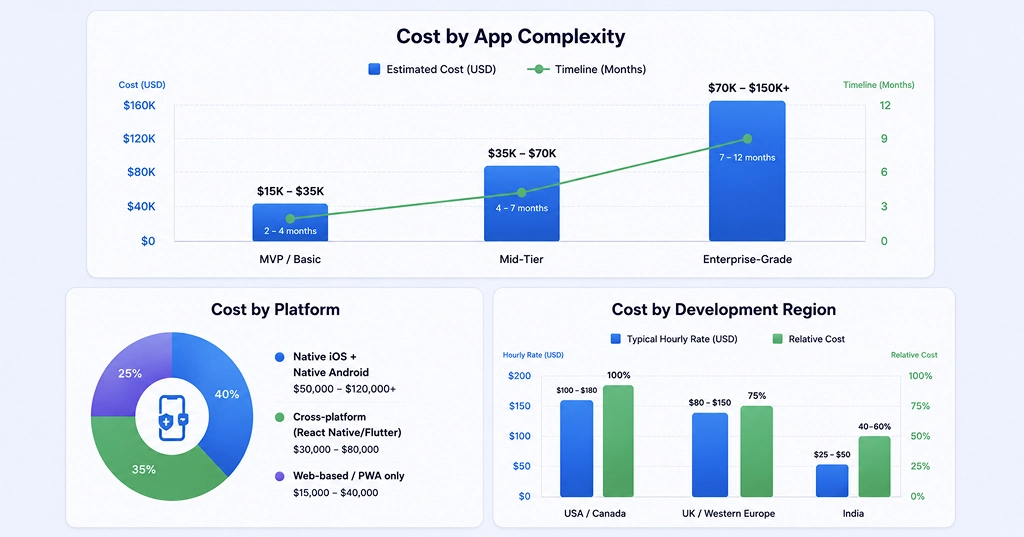
Now for the question everyone actually clicks on this blog for: how much does this cost?
The honest answer is “it depends,” but let’s make that answer useful.
Cost by app complexity
| App Type | Features Included | Estimated Cost (USD) | Timeline |
|---|---|---|---|
| MVP / Basic | Claim submission, tracking, basic dashboard | $15,000 – $35,000 | 2–4 months |
| Mid-Tier | + OCR, notifications, provider portal, analytics | $35,000 – $70,000 | 4–7 months |
| Enterprise-Grade | + AI fraud detection, auto-adjudication, multi-role systems, full compliance stack | $70,000 – $150,000+ | 7–12 months |
Cost by platform
| Platform Approach | Estimated Cost (USD) | Best For |
|---|---|---|
| Native iOS + Native Android | $50,000 – $120,000+ | Large enterprises wanting platform-specific performance |
| Cross-platform (React Native/Flutter) | $30,000 – $80,000 | Most MVPs and mid-tier apps needing faster time-to-market |
| Web-based/PWA only | $15,000 – $40,000 | Insurer-side admin panels or internal tools |
Cost by development region
| Region | Typical Hourly Rate (USD) | Relative Cost |
|---|---|---|
| USA/Canada | $100 – $180 | Highest |
| UK/Western Europe | $80 – $150 | High |
| India | $25 – $50 | 40–60% lower than the West |
Hiring a mobile app development company in India typically delivers the same expertise at a fraction of Western rates, without compromising quality.
Hidden or ongoing costs to plan for: compliance audits and certifications, cloud hosting and storage, third-party API fees (payment gateways, EHR systems, OCR tools), and ongoing maintenance (usually 15–20% of build cost, annually).
A solid mid-tier build with the essentials plus a bit of AI usually lands somewhere between $40,000 and $80,000, but always get a custom quote once your feature list is finalized.
AI can add powerful automation and personalization to healthcare apps, but it also affects the overall development budget. Learn more in our guide to AI mobile app development costs in 2026.
Compliance & Regulatory Requirements
If there’s one section you can’t skip while planning a compliant insurance app, it’s this one. Health data is some of the most sensitive information out there, and regulators don’t take it lightly.
Key requirements include:
- HIPAA (US): protects patient health information, mandatory for any US-facing app
- GDPR (EU): governs personal data collection and storage for European users
- Regional data laws: many countries now have their own local data protection rules
- Data encryption: both at rest and in transit, non-negotiable for medical records
- Audit trails: every claim action should be logged and traceable
- Consent management: users must clearly agree to how their data is used
Skipping compliance doesn’t just risk fines, it destroys the one thing your mobile app needs most: trust.
Key Integrations This Mobile App Depends On
No claim processing mobile app works in isolation. It needs to talk to a handful of external systems to actually be useful:
| Integration | Why It’s Needed |
|---|---|
| EHR/EMR systems | Pulls patient treatment records automatically |
| Payment gateways | Handles reimbursements and premium payments |
| Insurance/claims APIs | Connects with clearinghouses for claim validation |
| OCR/document processing tools | Reads and digitizes scanned bills and reports |
| SMS/email/push notifications | Keeps users updated in real time |
| Fraud detection & KYC APIs | Verifies identity and flags suspicious activity |
Getting these right early saves a lot of rework later.
Tech Stack Used to Build These Features
The technology choices behind a claim processing app directly affect its speed, security, and ability to scale under load. Here’s a quick technical breakdown:
- Frontend: React Native or Flutter for cross-platform mobile apps; React.js for insurer/admin web dashboards
- Backend: Node.js (NestJS) or Python (Django/FastAPI) for APIs handling claim submission and adjudication logic; Java (Spring Boot) for large enterprise systems needing strict transaction handling
- Database: PostgreSQL for structured claim and policy data; MongoDB for flexible claim metadata and scanned documents
- Cloud: AWS or Microsoft Azure, both offering HIPAA-eligible services for secure, compliant hosting
- AI/ML: Python-based models for fraud detection and risk scoring; AWS Textract or Google Cloud Vision for OCR
- Security: OAuth 2.0/JWT authentication, AES-256 encryption at rest, TLS 1.2+ in transit
This kind of stack keeps the app fast under real claim-processing load, secure enough to meet compliance audits, and flexible enough to add new AI capabilities later without a full rebuild.
Building a connected healthcare solution involves more than just choosing the right technology. Our healthcare software development guide covers essential features, solutions, development costs, and key considerations.
Challenges in Development and How to Solve Them
Building this kind of mobile app isn’t all smooth sailing. Here are the real challenges teams face, and how experienced developers solve them:
- Data security and compliance complexity: Work with mobile app developers who specialize in HIPAA/GDPR builds from day one.
- Integrating with legacy insurer systems: Use middleware and well-documented APIs to bridge old and new systems smoothly.
- Processing claims in real time at scale: Use cloud-based auto-scaling infrastructure to handle traffic spikes.
- Keeping fraud detection accurate: Continuously retrain AI models with fresh claim data.
- Getting users to adopt the app: Keep the UI simple, add a chatbot for hand-holding, and offer clear onboarding.
Every one of these is solvable with the right team, one that’s dealt with them before.
The right development partner can help balance healthcare compliance, AI capabilities, and scalability. See our guide to the best healthcare mobile app developers in India in 2026.
Real-World Case Study: How Alphaklick Builds Claim-Ready Healthcare Systems
We’re not just writing about this from the sidelines; we’ve built the kind of connected, compliance-ready healthcare systems this blog is talking about.
Client Requirement: A multi-specialty hospital came to us with patient management, billing, diagnostics, and inventory all running on disconnected systems, with no single source of truth for records.
What We Provided: A custom Hospital Management System that unified these functions into one platform: patient records, billing, diagnostics, and inventory, all connected through a single, secure backend.
What We Did: Mapped existing manual workflows, built role-based dashboards for admin and clinical staff, integrated billing directly with patient and diagnostic records, and set up secure, auditable data flows in line with healthcare data protection standards.
The result: information moved between departments instantly instead of getting stuck in paperwork — the same principle that makes a strong claim processing mobile app work.
Why Choose Alphaklick for Your Health Insurance Claim Mobile App Development
When you’re picking a partner to build something this sensitive, a few things matter more than a nice portfolio: real healthcare domain expertise, fluency in HIPAA and data security, and support that doesn’t disappear after launch.
As a mobile app development company in India, Alphaklick brings hands-on experience across healthcare software, AI automation, and global product delivery, including hospital management systems, medical billing platforms, and healthcare CRMs.
If you’re ready to turn your idea into a working, compliant claim processing app, book a free consultation with our team.
We’ll walk through your requirements, suggest the right features and tech stack, and give you a clear cost estimate, no obligation, no jargon.
FAQs
Question: How much does it cost to build a health insurance claim mobile app?
Answer: Typically $15,000 for a basic MVP to $150,000+ for a full enterprise platform with AI features, depending on complexity and region of development.
Question: How long does it take to build one?
Answer: Anywhere from 2 months for an MVP to 12 months for a fully-loaded enterprise system with AI and compliance built in.
Question: Is HIPAA compliance mandatory?
Answer: Yes, if your app handles health data for US users, HIPAA compliance is legally required, not optional.
Question: Can AI actually reduce claim processing time?
Answer: Yes. AI-based auto-adjudication and OCR can cut simple claim processing time from days down to minutes, while improving fraud detection accuracy.
Question: Should I hire locally or outsource development?
Answer: Many companies now partner with a mobile app development company in India for significant cost savings without sacrificing quality, especially for healthcare apps where experienced teams already understand compliance requirements.