Key Highlights
- A modern health insurance software platform combines claims, billing, underwriting, and member support into one connected system instead of scattered tools.
- Must-have health insurance software features include automated claims processing, real-time eligibility checks, policy administration, and a self-service member portal.
- Any platform handling member health data must be built as HIPAA compliant insurance software, with security and compliance designed in from day one, not added later.
Health insurance companies are under more pressure than ever. Members want fast answers, providers want quick approvals, and regulators want airtight compliance. An outdated system can’t keep up.
This is why more insurers are investing in a modern health insurance software platform that can handle claims, policies, payments, and member communication in one place.
In this blog, we will break down the must-have health insurance software features, why they matter, and why AlphaKlick is the right team to build them.
Why Health Insurance Companies Need Modern Software Platforms
Manual processes slow everything down. Paper-based claims, spreadsheet-based policy tracking, and disconnected systems lead to delays, errors, and frustrated members.
A modern health insurance software setup fixes this by connecting every department- claims, billing, underwriting, and support- into one digital ecosystem.
This kind of healthcare software development helps insurers cut costs, stay compliant, and build connected digital ecosystems for providers, insurers, and patients alike.
Core Features Every Health Insurance Software Platform Should Have
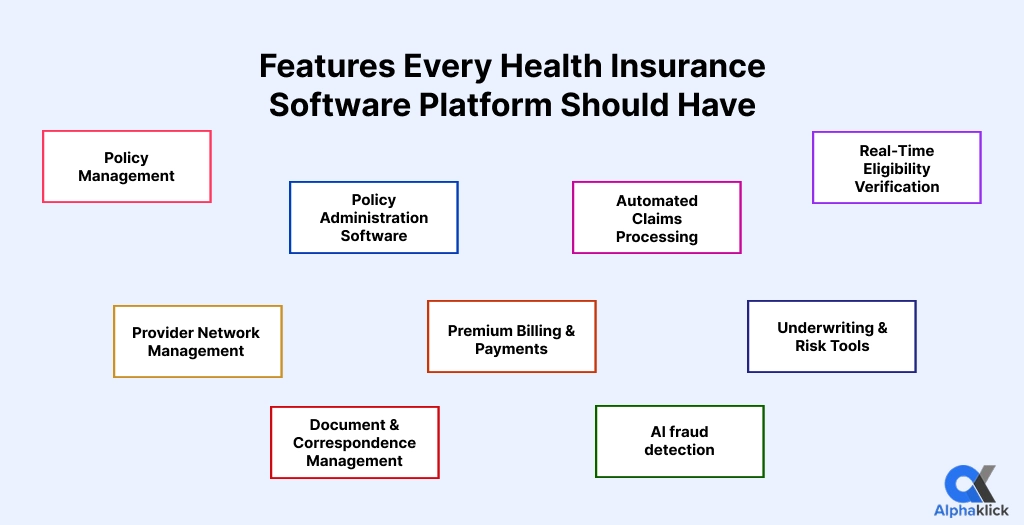
Every strong platform needs a solid foundation. Here are the core health insurance software features insurers should prioritize:
- Policy Management: stores member details, plan history, and coverage data in one place, so staff aren’t switching between systems mid-call
- Policy Administration Software: handles plan documents, renewals, and endorsements without manual paperwork
- Automated Claims Processing: reviews and approves claims using pre-set rules, so straightforward claims clear without waiting in a review queue
- Real-Time Eligibility Verification: confirms coverage instantly at the point of care, so fewer claims get rejected later over a coverage mismatch
- Provider Network Management: keeps in-network doctors, hospitals, and clinics accurate, so referrals don’t send members out-of-network
- Premium Billing & Payments: automates invoicing and payment collection, reducing missed payments and manual reconciliation
- Underwriting & Risk Tools: evaluates applicant risk using data models, supporting fairer, faster pricing
- Document & Correspondence Management: centralizes policy letters and claim notices so nothing gets lost in email threads
Reliable insurance claims management software ensures claims move from submission to settlement without unnecessary back-and-forth.
Behind the scenes, dependable claims processing software applies the rules, checks documents, and flags exceptions for human review. Most insurers start here, since these modules have the biggest impact on cost and member satisfaction.
For a deeper look at digital claim workflows, key features, and development costs, see our guide to Health Insurance Claim Processing Mobile App: Features and Development Cost.
Advanced Features That Make an Insurance Platform Future-Ready
AI and Automation Features
Artificial intelligence is no longer a “nice to have” add-on. It’s becoming central to how insurers detect fraud, price risk, and support members. Some of the most useful health insurance automation features include:
- AI fraud detection – flags suspicious claims before payout
- Predictive risk scoring – helps underwriters price policies more accurately
- Chatbots and virtual assistants – answer member questions instantly, day or night
These tools don’t replace human teams; they remove repetitive work so staff can focus on complex cases that actually need a human decision. Insurers that adopt these health insurance automation features early usually see faster turnaround times within the first few months of going live.
Many insurers are now adopting AI healthcare agents to automate member support, streamline claims processing, detect fraud, and assist care teams. Learn more in our guide on AI Healthcare Agent Development: Use Cases, Compliance & Cost.
Integration & Interoperability Features
A health insurance platform cannot work in isolation. It needs to talk to hospitals, labs, pharmacies, and other healthcare systems in real time. This is where solid health insurance app development matters most:
- HL7 FHIR standards connect directly with EHR/EMR systems
- Open APIs link pharmacy networks and third-party verification tools
- Mobile-first architecture ensures the app gets the same attention as the backend
Strong health insurance app development reduces paperwork for members and speeds up approvals for providers, without either side chasing information manually.
If you’re planning healthcare integrations, read our detailed FHIR Integration Guide: Connecting EHR, EMR & Healthcare Systems.
Compliance, Security & Data Privacy Features
Health data is sensitive, and insurers are legally required to protect it. Any platform handling member records must be built as HIPAA compliant insurance software from day one, not patched in later. Key security measures should include:
- End-to-end encryption for stored and transmitted data
- Role-based access controls so staff only see what they need
- Detailed audit trails for every claim and policy change
Skipping these steps doesn’t just risk fines; it risks member trust, which is far harder to rebuild than a compliance report.
Building secure healthcare applications requires compliance from the start. Our guide on How to Develop a HIPAA-Compliant AI-Powered Healthcare App in 2026 explains the security, privacy, and regulatory requirements in detail.
Member Experience & Self-Service Features
Members today expect the same convenience from their insurer as they get from any banking or shopping app. A well-designed health insurance customer portal should let members:
- Check claim status in real time
- Download digital ID cards instantly
- Compare and switch between plans
- Message support without picking up the phone
Insurers that invest early in a strong health insurance customer portal usually see fewer support calls, simply because members can find answers themselves.
Analytics & Reporting Capabilities
Real-time dashboards showing claim volumes and cost trends help leadership make faster decisions.
Predictive analytics can flag rising costs in specific member groups early, and custom reporting makes compliance audits less stressful since the data is already organized.
Scalability & Cloud Infrastructure Considerations
Insurance platforms face heavy traffic spikes during open enrollment season.
Cloud-native infrastructure, built on services like AWS or Azure Health Data Services, lets the system scale up during peak load and back down afterward, keeping costs predictable.
Cost Factors in Building a Health Insurance Software Platform
Budgeting for health insurance platform development depends on several moving parts, not just the number of screens in the app.
| Cost Factor | Impact on Overall Cost |
| Number of integrations (EHR, payment gateways, provider APIs) | Medium to High |
| AI features (fraud detection, risk scoring) | High |
| Compliance and security implementation | High |
| Cloud infrastructure and hosting | Medium |
| Mobile app development (iOS + Android) | Medium |
| Team location and experience level | Variable |
Most insurers find that starting with a focused set of core modules, and expanding gradually, keeps costs manageable while still delivering real value early on.
What Health Insurance Companies Say After Switching to Modern Software
Insurers that have moved away from legacy systems consistently share similar feedback about the shift:
“Claims that used to sit in a manual review queue for days now clear in hours. Our team barely touches the simple cases anymore.” — Operations Head, regional health insurer
“The number one complaint we used to get was ‘my paperwork got lost.’ Since moving everything into a digital record, that complaint has basically disappeared.” — Member Support Lead, mid-size insurance provider
“Once our data moved into one system instead of five, leadership stopped asking ‘can someone pull that report’ and started actually seeing it in real time.” — COO, health insurance startup
The common theme across this feedback isn’t just speed. It’s confidence, in compliance, in accuracy, and in the member experience.
Still deciding between modern AI-powered platforms and legacy systems? Read Custom AI Healthcare Software vs Traditional Software: Which Is Better? to understand which approach delivers better scalability, automation, and long-term ROI.
Why Choose AlphaKlick to Build Your Insurance Software
Not every insurance software development company understands healthcare data, compliance, and claims workflows. Here’s what sets AlphaKlick, an experienced healthcare software development company, apart:
- Healthcare-first experience: we’ve built claims, billing, and patient-facing platforms for hospitals, clinics, and healthcare startups, not just generic apps
- Compliance built in, not bolted on: our platforms are designed around HIPAA and HL7 FHIR standards from day one
- Real health insurance app development expertise: our team works across React.js, React Native, Node.js, and cloud infrastructure to build secure, scalable platforms
- Transparent, milestone-based delivery: clear sprints and regular demos, so you always know where your project stands
We don’t pitch a template. We ask about your workflows first, then build around them.
If you’re ready to plan your health insurance software platform, book a free consultation with the AlphaKlick team to discuss your requirements, integrations, and compliance goals.
FAQs
Question: What are the most important health insurance software features?
Answer: Automated claims processing software, real-time eligibility checks, policy administration software, and secure member portals are the core features every platform needs.
Question: How much does it cost to build a health insurance software platform?
Answer: On average, a health insurance software platform costs between $25,000 and $300,000, depending on scope. A basic MVP with core policy and claims modules typically starts around $25,000–$60,000. A mid-complexity platform with eligibility verification, provider network management, and a member portal usually runs $80,000–$150,000. A full-scale, AI-enabled platform with deep EHR integrations and advanced compliance features can reach $200,000–$300,000 or more.
Question: Is HIPAA compliance mandatory for insurance software?
Answer: Yes. Any platform handling member health data must be built as HIPAA compliant insurance software, with encryption, access controls, and audit logging in place.
Question: Can insurance claims management software integrate with hospital systems?
Answer: Yes, most modern platforms use HL7 FHIR and open APIs to connect directly with EHR systems, labs, and pharmacy networks.