Ever ordered groceries and had them at your door in 10 minutes?
That’s hyperlocal delivery in action. It’s fast, it’s local, and it’s changing how people shop every day.
If you’re a business owner or startup founder thinking about entering this space, this hyperlocal delivery mobile app development guide 2026 walks you through everything: features, cost, and the exact steps to build one, in simple terms.
As a mobile app development company in India working with clients across grocery, healthcare, and logistics, we’ve watched this space grow fast.
Let’s get into it.
What is Hyperlocal Delivery?
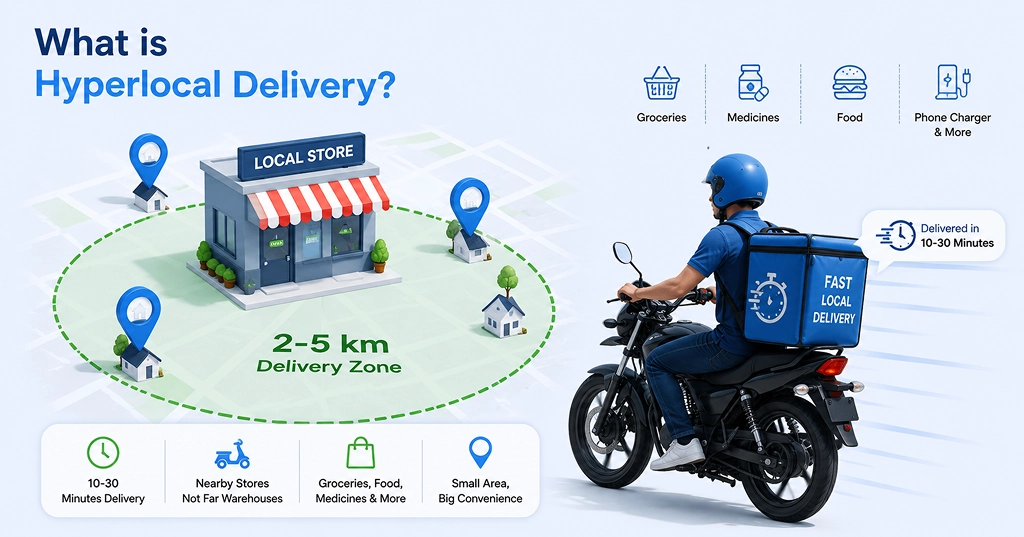
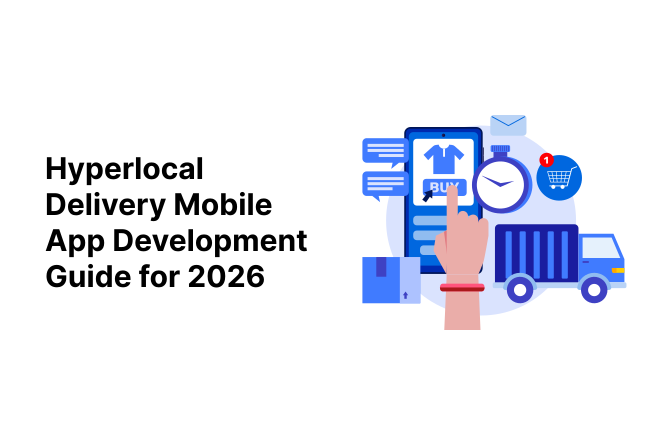
Hyperlocal delivery means getting products from a nearby store to a customer’s door in the shortest time possible, usually within a 2-5 km area. Think groceries, medicines, food, or even a phone charger, delivered in 10-30 minutes.
It’s different from normal online shopping. There’s no big warehouse far away. Instead, small local shops or “dark stores” act like mini warehouses close to the customer.
This is why hyperlocal delivery mobile app development has become such a big business idea in 2026, people don’t want to wait days anymore.
Popular Hyperlocal Delivery Business Models
Before building anything, pick a hyperlocal delivery app business model:
| Business Model | How It Works | Best For |
|---|---|---|
| Aggregator Model | Connects local stores with customers, no stock owned | Food delivery, small shops |
| Inventory-Led Model | Company owns its own dark stores and stock | Hyperlocal grocery delivery app 2026 startups |
| Hybrid Model | Mix of own stores + partner shops | Businesses growing fast in one city |
| Marketplace Model | Many vendors sell under one app | Hyperlocal marketplace app development |
Most mobile apps today go with the hybrid model since it gives both speed and flexibility. Dark stores are almost a must for a hyperlocal grocery delivery mobile app 2026-style platform; they’re the reason 10-minute delivery is even possible.
How Hyperlocal Delivery Mobile Apps Work
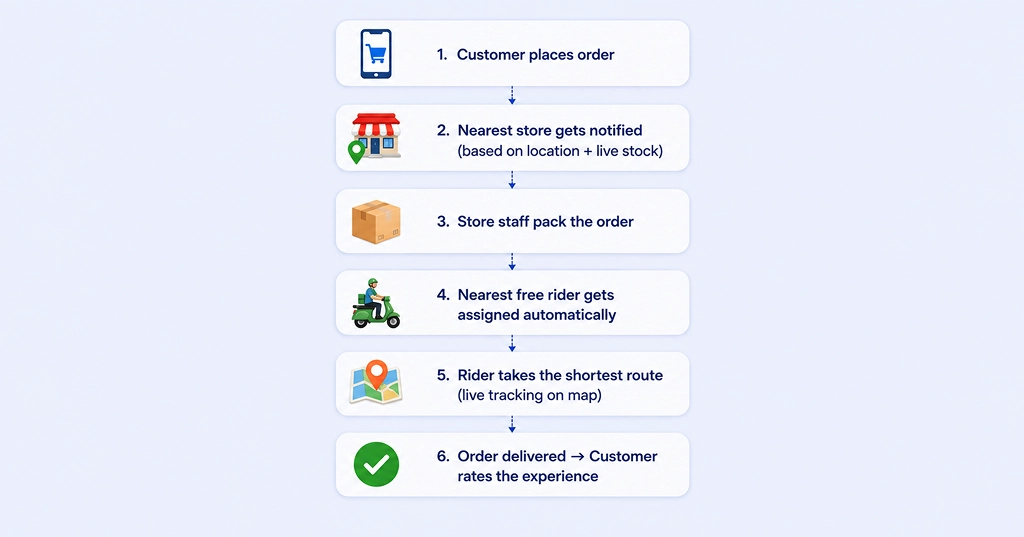
Think of it like a relay race, where each runner passes the baton instantly:
| 📱 Customer places order ↓ 🏪 Nearest store gets notified (based on location + live stock) ↓ 📦 Store staff pack the order ↓ 🛵 Nearest free rider gets assigned automatically ↓ 🗺️ Rider takes the shortest route (live tracking on map) ↓ ✅ Order delivered → Customer rates the experience |
A simple example: A customer in Jaipur orders milk and bread at 8:15 PM. The mobile app checks which nearby store has both items, picks the closest one, and assigns the nearest free rider, no person involved.
The order reaches by 8:35 PM. That automatic matching, happening every few seconds for thousands of orders, is the real engine behind any quick commerce mobile app development 2026 project.
Market Insight: Hyperlocal Delivery Market Size & Growth (2026)
This space is growing fast, backed by real industry research:
| Metric | Insight | Source |
|---|---|---|
| Hyperlocal Delivery App Market (Global) | $3.26B in 2026, expected to reach $7.27B by 2030 (22.2% CAGR) | The Business Research Company |
| Hyperlocal Food Delivery Market | Growing from $562.3B (2025) to $1,091B by 2035 (6.9% CAGR) | Market.us |
| Hyperlocal Services Market | $15.6B (2026) growing to $36.9B by 2033 (13.1% CAGR) | Persistence Market Research |
Growth is driven by more smartphone use and AI tools that predict what customers want. Dark store delivery mobile app development is also rising fast, since dark stores cut delivery time compared to old warehouses.
Must-Have Features for a Hyperlocal Delivery Mobile App
Here are the hyperlocal delivery mobile app features for 2026 that really matter, split by who uses them.
Customer App
- Quick sign-up using mobile number or social login
- Live browsing of stores and products based on your location
- Real-time order tracking
- Multiple payment options — UPI, cards, wallets, cash on delivery
- Push notifications for order updates and offers
- Ratings and reviews to build trust
Vendor / Store Panel
- Real-time stock updates
- Instant alerts to accept or reject new orders
- A simple dashboard for daily sales and earnings
- Tools to run local discounts and offers
Delivery Partner App
- Route guidance that updates with live traffic
- Easy pickup and drop confirmation (OTP or photo proof)
- An earnings tracker
- An online/offline switch so riders control their own hours
Admin Dashboard
- One place to manage every store, rider, and customer
- Live reports on orders, delivery time, and busy areas
- Tools to handle complaints and refunds quickly
- Automatic commission and payout settings
The best hyperlocal delivery mobile app features in 2026 are often the ones users don’t even notice: AI that predicts restocking, smart pricing during busy hours, and location search that only shows stores that can actually deliver fast.
AI and Advanced Features for a Hyperlocal Delivery Mobile App
Basic features get your mobile app running. AI features make it feel smart and keep customers coming back.
- AI Demand Forecasting: predicts what a store will run out of, so it can restock before losing a sale
- Smart Rider & Route Assignment: picks the closest, fastest rider and adjusts for live traffic
- AI Chatbots & Voice Ordering: lets customers order or track deliveries by chat or voice, no human agent needed
- Dynamic & Personalized Pricing: small fee changes during busy hours, plus personalized offers based on past orders
- Fraud & Anomaly Detection: flags suspicious orders or rider mismatches in the background
- Predictive ETA: gives accurate delivery time estimates using real traffic and rider speed data
- Computer Vision Quality Checks: used in grocery/food apps to verify items before they leave the store
Best approach: launch your MVP with core features first, then add AI features once you have enough order data.
AI-powered features can increase development costs depending on their complexity and data requirements. Learn more about AI mobile app development cost in 2026 to understand the investment involved.
Cost to Build a Hyperlocal Delivery Mobile App
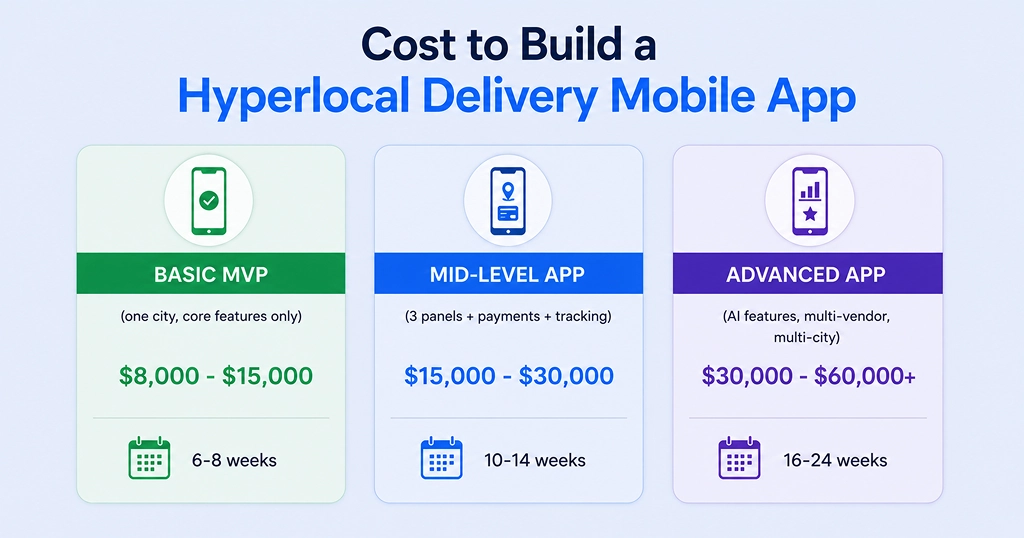
Cost depends on features, platforms, and who builds it. Here’s a simple breakdown for the cost to build a hyperlocal delivery mobile app 2026 projects.
| App Type | Estimated Cost Range | Timeline |
|---|---|---|
| Basic MVP (one city, core features only) | $8,000 – $15,000 | 6-8 weeks |
| Mid-Level App (3 panels + payments + tracking) | $15,000 – $30,000 | 10-14 weeks |
| Advanced App (AI features, multi-vendor, multi-city) | $30,000 – $60,000+ | 16-24 weeks |
Working with an experienced mobile app development company in India helps your budget go further, often at a lower cost than Western agencies.
The final cost also depends on the type of delivery platform you’re building. For a broader cost comparison, check our guide to on-demand app development cost.
Step-by-Step Development Process
Here’s how to build a hyperlocal delivery mobile app, step by step.
Step 1: Discovery & Consultation: Understand your target city, competitors, and budget before any code is written.
Step 2: UI/UX Design: Design simple, fast screens. Fewer clicks, faster checkout; every extra step can cost you a customer.
Step 3: Choosing the Right Tech Stack: This decides how fast and scalable your mobile app will be. A solid hyperlocal delivery app tech stack in 2026 looks like this:
| Layer | Common Technologies | Why It’s Used |
|---|---|---|
| Frontend (Customer/Rider App) | React Native, Flutter | One codebase for iOS and Android |
| Backend | Node.js, Python (Django) | Handles many real-time orders at once |
| Database | MongoDB, PostgreSQL | Fast reads/writes for live stock and orders |
| Maps & Geolocation | Google Maps API, Mapbox | Powers live tracking and routing |
| Payments | Razorpay, Stripe, PayPal | Safe, easy checkout across regions |
| Cloud Hosting | AWS, Google Cloud | Scales automatically during busy hours |
Step 4: MVP Development: Build a lean first version, ordering, tracking, payments, then launch it in one neighborhood.
Step 5: Compliance & Data Security: A hyperlocal mobile app stores sensitive data, addresses, phone numbers, live location, and payments.
Follow data protection rules for your region, use PCI-DSS compliant payment gateways, encrypt customer and rider data, secure your APIs with token-based logins, and add a clear privacy consent screen. Skipping this can mean legal trouble and lost customer trust.
Step 6: Testing & QA: Test order flow, payments, and tracking accuracy during busy hours.
Step 7: Launch: Soft-launch in one neighborhood, gather feedback, then expand city by city.
Step 8: Post-Launch Support: Regular updates and bug fixes keep the app reliable as you grow.
Choosing the right development partner is equally important for keeping your project scalable and cost-effective. You can also compare the top mobile app development companies in India before making your decision.
Monetization Strategies for Hyperlocal Delivery Mobile Apps
- Commission Model: earn a percentage from every vendor sale
- Delivery Fees: charge based on distance or order value
- Subscription Plans: free delivery for a monthly membership fee
- Surge Pricing: slightly higher fees during peak hours
- Sponsored Listings: vendors pay to appear higher in search
Most successful mobile apps mix two or three of these together.
Real-World Hyperlocal Delivery App Development: An AlphaKlick Case Study
The client’s need: A grocery chain with 15 stores in one city wanted its own delivery app instead of paying high commissions to third-party platforms. They asked the AlphaKlick team: “Let customers order from their nearest branch and get it delivered in 30 minutes, using our own riders.”
What we built: a customer mobile app showing live stock from the nearest branch, a store panel for each of the 15 branches, and a rider mobile app with route guidance for their in-house delivery staff.
The result: order-to-rider matching became automatic instead of manual phone calls, delivery times dropped, and the client stopped paying commission to outside platforms.
How AlphaKlick Can Help You Build Your Hyperlocal Delivery App
Building a hyperlocal delivery mobile app isn’t just about writing code. It’s about getting the business logic, tech stack, and user experience right from day one.
As a mobile app development company in India, AlphaKlick has worked on mobile apps, AI-powered tools, and multi-vendor platforms for clients in healthcare, e-commerce, and logistics.
Whether you need a simple MVP or a full hyperlocal marketplace app development project with AI and multi-city support, our team handles design, development, testing, and post-launch support, start to finish. We’ll also help you choose the right hyperlocal delivery app tech stack for your budget and growth plans.
Book a Free Consultation with our team, and let’s turn your hyperlocal delivery idea into a real, working app.
FAQs
Question: Is Blinkit hyperlocal?
Answer: Yes. Blinkit is a well-known example of a hyperlocal grocery delivery mobile app that uses dark stores to deliver orders within 10-20 minutes in select cities.
Question: Can I make my own delivery app?
Answer: Yes. With the right mobile app development partner, you can build a custom hyperlocal delivery app that fits your city, business model, and budget, starting with an MVP and growing from there.
Question: What is hyperlocal ecommerce?
Answer: Hyperlocal ecommerce means buying and selling online where products come from stores very close to the customer, so delivery can happen super fast.
Question: How to develop a delivery mobile app?
Answer: The process includes discovery, UI/UX design, choosing the right tech stack, MVP development, compliance and security setup, testing, launch, and ongoing support, as covered in this guide.
Question: What are the challenges to build a hyperlocal delivery mobile app?
Answer: Common challenges include keeping stock updated across many stores in real time, matching riders to orders quickly, handling sudden order spikes, and keeping user data safe and compliant.
Question: How do AI and automation help hyperlocal delivery?
Answer: AI helps predict restocking, matches riders to orders automatically for faster delivery, powers smart pricing, and personalizes recommendations, making hyperlocal delivery mobile app development smarter overall.