Picture this: it’s 7:42 PM, guests arrive in twenty minutes, and you’ve just realized you’re out of pasta, garlic, and olive oil. Ten years ago, that meant a mad dash to the store. Today, it means opening a mobile app, ordering three items, and having them at your door before your guests even find parking.
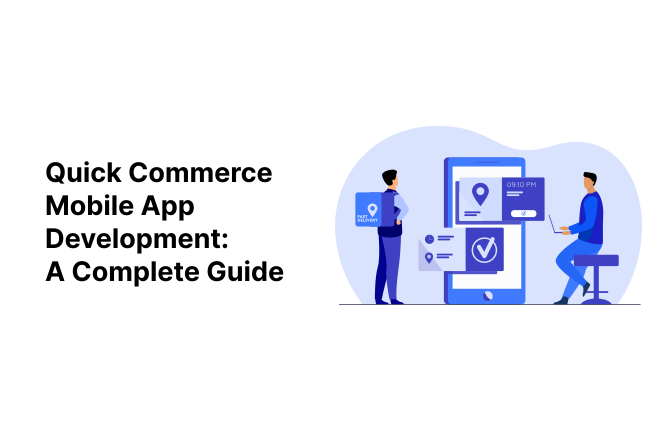
That ten-minute gap has quietly created a whole new industry. If you’re exploring quick commerce mobile app development for your own business, this guide covers what these apps actually do, what they cost to build, and where most founders get it wrong.
What is Quick Commerce?
Quick commerce is a delivery model built around speed, usually 10 to 45 minutes, compared to same-day or next-day e-commerce. The speed comes from a simple setup: small local warehouses called dark stores, tight delivery zones, and inventory that’s already close to the customer instead of being shipped from one central warehouse.
It’s different from regular on-demand delivery, like a restaurant order through a food app. Most q-commerce apps manage their own inventory and fulfillment, not just a marketplace connecting buyers and sellers.
Why Quick Commerce Is Booming
The exact numbers vary by research firm, but the direction is the same everywhere: up, and fast.
| Source | Market Size Estimate | Growth Rate (CAGR) | Forecast Year |
|---|---|---|---|
| Grand View Research | $297.5B (2026) → $1,303.5B | 23.5% | 2033 |
| Fortune Business Insights | $199.92B (2026) → $385.36B | 8.55% | 2034 |
The exact figure matters less than the pattern. Consumer expectations have shifted toward instant delivery, and more businesses want to build a quick commerce mobile app before competitors get there first.
Quick Commerce Isn’t Just Groceries
Grocery mobile apps get most of the attention, but the model works well beyond that.
| Category | Example Players | What’s Different About the App |
|---|---|---|
| Grocery & Essentials | Blinkit, Zepto | Focus on dark store inventory sync and 10–20 min delivery |
| Marketplace / Multi-category | Instacart, DoorDash | Connects multiple stores/restaurants; more complex routing |
| Pharmacy | Regional medicine delivery apps | Needs prescription upload and pharmacist verification |
| Pet Supplies | On-demand pet stores | Smaller catalog, but subscriptions matter more |
| Alcohol (where legal) | Local licensed delivery apps | Needs age verification and delivery-time restrictions |
Many founders say they want to build a quick commerce app like Zepto, but pharmacy and alcohol categories need extra compliance steps that a grocery app simply doesn’t.
How Quick Commerce Apps Actually Work
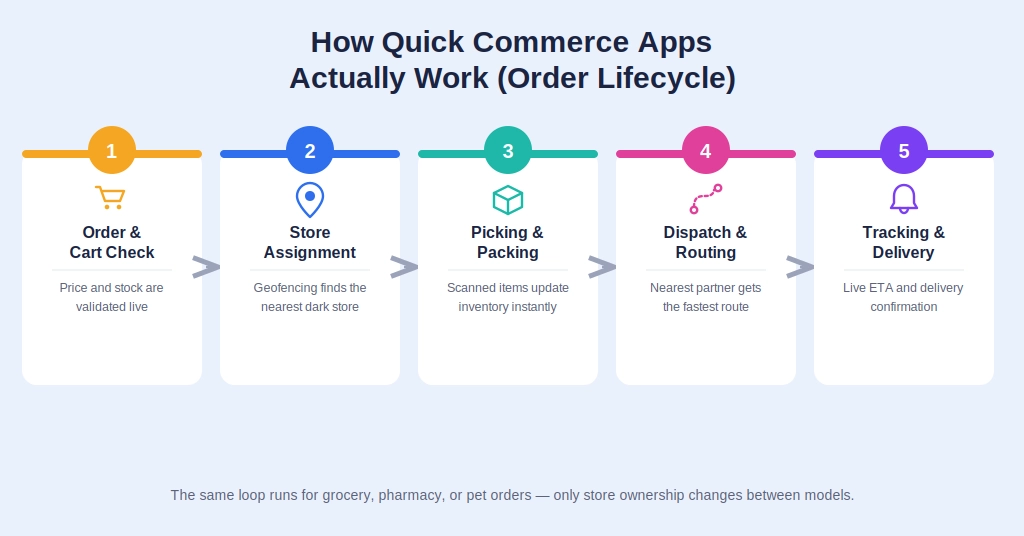
Regardless of category- grocery, pharmacy, or pet supplies- almost every quick commerce order moves through the same technical loop behind the scenes.
1. Order Placement and Cart Validation: At checkout, the mobile app re-validates each item’s price and stock against the live inventory database, since both can change within seconds during busy hours.
2. Store Assignment via Geofencing: A geofencing layer checks which dark store or partner store falls within the customer’s delivery radius, usually picking whichever one is closer or better stocked.
3. Picking and Packing: The assigned store gets an auto-generated picking list. Staff scan each item as it’s picked, updating inventory instantly so the next customer sees accurate stock.
4. Delivery Partner Assignment: A dispatch algorithm matches the packed order to the nearest available delivery partner, batching it with a nearby order where possible.
5. Route Calculation: The delivery partner’s mobile app calculates the fastest route using live traffic data, and recalculates if conditions change mid-trip.
6. Real-Time Tracking and Notifications: The customer sees a live map with an ETA and gets notified at each stage: confirmed, packed, out for delivery, and arriving soon.
7. Delivery Confirmation: Once delivered, the order is marked complete, and the app usually prompts a quick rating, which feeds into the merchant’s performance dashboard.
This loop is what makes dark store mobile app development such a specific discipline within hyperlocal delivery mobile app development; the store-side software has to run just as smoothly as the customer-facing app for any of this to deliver in 10–20 minutes. How the store itself is owned, company-owned versus partner-owned, is a separate question, covered next.
Quick Commerce App Features, by User Type
Every quick commerce mobile app is really three apps stitched together. Here’s what each group needs.
For Customers
| Feature | Why It Matters |
|---|---|
| Live inventory display | Nobody wants to order something that’s out of stock |
| Real-time order tracking | Builds trust during the wait |
| Saved addresses & one-tap reorder | Speeds up repeat orders |
| Multiple payment options | UPI, cards, wallets, cash on delivery |
| Scheduled delivery slots | Useful for pharmacy refills and non-urgent orders |
| Substitution approval | Lets customers approve or reject swaps |
| Loyalty/subscription perks | Free-delivery passes increase order frequency |
For Merchants
| Feature | Why It Matters |
|---|---|
| Real-time inventory management | Stops overselling items already out of stock |
| Picker task assignment | Auto-generates in-store picking routes |
| Demand & sales dashboards | Shows what’s selling, and when |
| Stock replenishment alerts | Flags reorder points before shelves go empty |
| Multi-store management | Needed once you run more than one dark store |
For Delivery Partners
| Feature | Why It Matters |
|---|---|
| Order batching | Lets one partner carry multiple nearby orders |
| Turn-by-turn navigation | Shaves minutes off every delivery |
| Earnings dashboard | Transparency helps partner retention |
| Availability toggle | Lets partners set their own hours |
These quick commerce mobile app features aren’t optional extras. Leave any one user group underserved, and the whole delivery-speed promise starts to break.
AI Features Worth Building In
The mobile apps that consistently deliver fast are the ones using prediction, not just tracking.
- Demand prediction: forecasts order spikes by area, time, or weather so stores are stocked in advance.
- Route optimization: calculates the fastest delivery path in real time, factoring in traffic.
- Inventory forecasting: flags likely stockouts at a dark store before they happen.
- Personalized recommendations: suggest products based on order history.
- Hyper-personalization: goes further, tailoring search results and delivery slots to a person’s own patterns, not just their last order.
Smaller quick commerce mobile app MVP builds now often include basic demand prediction and recommendations from day one.
Quick Commerce App Tech Stack
There’s no single “correct” quick commerce mobile app tech stack, but most builds follow a similar shape.
- Frontend: Choosing between cross-platform and native development depends on performance requirements, budget, and the complexity of the app. Our guide to native vs. hybrid apps explains the key differences for e-commerce businesses.
- Backend: Node.js or Python, sometimes with Go for high-traffic services
- Database: PostgreSQL or MongoDB, paired with Redis for fast inventory lookups
- Maps & Geofencing: Google Maps Platform or Mapbox, used to auto-assign orders to the nearest dark store
- Payments: Stripe, Razorpay, or PayU depending on region
- Notifications: Firebase Cloud Messaging or OneSignal
- AI tools: TensorFlow or Amazon Forecast for demand prediction, Google OR-Tools or Routific for route optimization, AWS Personalize for recommendations, and Prophet for inventory forecasting
Most MVPs skip the AI layer at first and add it once there’s enough order data, but it helps to plan the data pipeline for it from day one.
Quick commerce relies heavily on nearby stores, dark stores, real-time inventory, and fast rider allocation. Our Hyperlocal Delivery Mobile App Development Guide for 2026 covers how these systems work and what it takes to build one.
The Mobile App Development Process: Step by Step
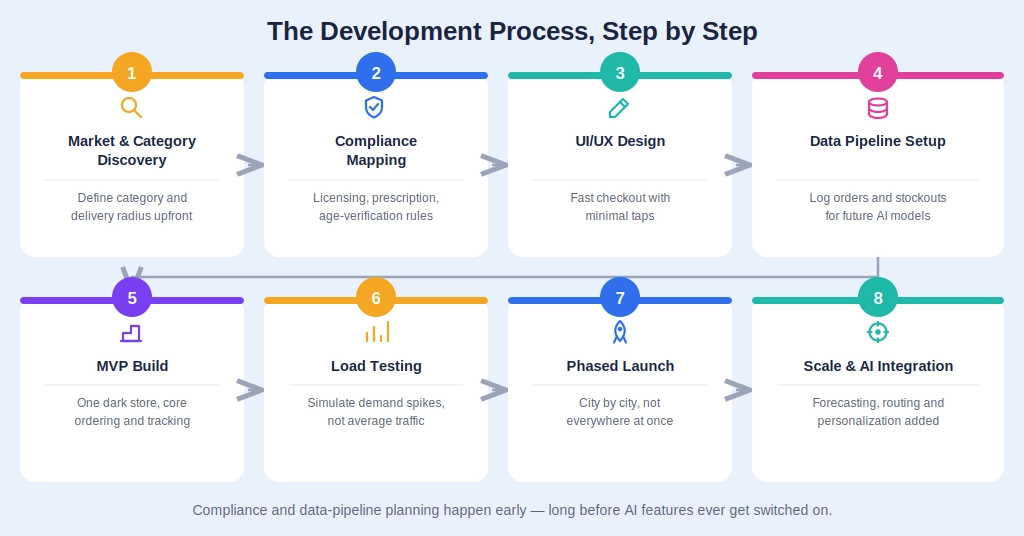
- Market & category discovery: decide your category (grocery, pharmacy, pet, alcohol) and delivery radius first, since this decision shapes almost every technical choice that follows, from inventory structure to compliance workflows.
- Compliance mapping: map out licensing needs before any code is written: food safety certifications for grocery, prescription verification rules for pharmacy, age and ID checks for alcohol. This step is frequently skipped in early planning, and it’s one of the most common reasons a finished app sits waiting for approvals instead of launching on schedule.
- UI/UX design: design for speed, not visual complexity. Every extra tap between “add to cart” and “order placed” costs conversions in a category where users are actively optimizing for time saved, so screens are usually kept deliberately simple.
- Architecture & data pipeline setup: this is where the AI layer gets planned, even if it isn’t built yet. Logging order times, stockouts, and delivery durations from day one means demand forecasting and route optimization models have real, usable data by the time you’re ready to add them, instead of starting from zero.
- MVP build: a quick commerce mobile app MVP typically covers one dark store, core ordering, live tracking, and manual (not AI-driven) delivery assignment. The goal at this stage is proving the operational model actually works before automating any part of it.
- Testing & load simulation: load testing matters more here than in most apps, because demand spikes, evenings, weekends, and weather events are the norm rather than the exception. A crash during peak hours does far more damage to trust than a quiet, slow week would.
- Phased launch: most successful quick commerce apps launch city by city, sometimes even neighborhood by neighborhood, rather than everywhere at once.
- Scale & AI integration: once order volume is consistent and predictable, this is typically when demand forecasting, route optimization, and personalization get layered in, turning a functional app into a genuinely competitive one.
Quick Commerce App Development Cost
| Build Type | Approximate Cost | What’s Included |
|---|---|---|
| Basic MVP | $15,000 – $35,000 | One dark store, core ordering + tracking, no AI |
| Mid-Scale App | $40,000 – $80,000 | Multiple dark stores, delivery partner app, basic analytics |
| Full-Scale Platform | $90,000 – $150,000+ | AI forecasting, route optimization, personalization, multi-category |
What Moves the Number: Cost mainly depends on how many apps you need (customer, merchant, delivery partner), whether AI features are included at launch, how much compliance work your category needs, how many dark stores you’re launching with, and where the development team is based, a mobile app development company in India generally costs less than a similarly skilled team in the US or Europe.
The quick commerce mobile app development cost really comes down to scope.
Build vs. White-Label vs. Custom
- White-label: fastest and cheapest to launch, but limited flexibility and ongoing fees.
- Custom build: costs more and takes longer, but gives full control, useful for regulated categories.
- Hybrid: start with a quick commerce app MVP on a semi-custom base, then move to custom once the model works.
There’s no universal right answer here; it depends on how different your business needs to be from what already exists.
The quick commerce mobile app development cost really comes down to scope. For a broader comparison of pricing models and development factors, see our guide to on-demand app development cost.
A Quick Case Study
Background: UrbanBasket, a regional grocery chain with four stores, was losing regular customers to a nearby q-commerce competitor. Their delivery, run through a third-party aggregator, averaged 52 minutes per order, too slow to compete with 15–20 minute promises.
Requirement: They wanted to test quick commerce without a long, expensive build: launch fast, prove delivery times could drop, and avoid a six-month cycle before seeing results. Two of their four stores also had no real-time stock data, just end-of-day spreadsheets.
Solution: The build started as a quick commerce app MVP for one store and a 3km radius, a customer app, a lightweight inventory panel, and manual delivery assignment. Real-time inventory sync came first, since that’s what makes a fast delivery promise possible at all. AI features were left out of this phase.
Result: Average delivery time dropped from 52 to 19 minutes within three months. A demand-forecasting layer added in month four cut stockouts on top-selling items by about a third. Pharmacy and alcohol, which UrbanBasket had originally asked about, were pushed to a later phase once the core setup was stable.
Why Businesses Choose Alphaklick for Quick Commerce App Development in India
Quick commerce isn’t just “build an app and launch it.” It’s dark store logistics, real-time inventory, AI forecasting, and category-specific compliance, all working together.
That’s why founders often look for a mobile app development company in India with real experience across mobile, AI, and hyperlocal delivery. A few things worth checking with any team:
- Have they built dark store or hyperlocal delivery systems before, not just standard e-commerce apps?
- Can they show real-time inventory sync actually working?
- Do they have experience with AI features like demand prediction and route optimization?
- Is their cost estimate broken down by feature, or just one number?
Thinking about building a quick commerce mobile app of your own?
Book a free consultation with our team, and we’ll walk through your category, timeline, and a realistic cost- no generic pitch, just a straight conversation.
FAQs
Question: How long does it take to build a quick commerce app?
Answer: A basic MVP usually takes 10–14 weeks, covering one dark store, core ordering, and tracking. A full-scale platform with AI-driven forecasting, route optimization, and multi-category support typically takes 5–8 months, since testing for demand spikes and compliance workflows adds significant time on top of the core build.
Question: What’s a realistic quick commerce app development cost for a first version?
Answer: Most serious MVPs fall between $15,000 and $35,000, though this shifts depending on your category, delivery region, and how many apps (customer, merchant, delivery partner) you need at launch. Pharmacy and alcohol builds usually sit at the higher end because of the added compliance work.
Question: Do I need AI features from day one?
Answer: No, and most successful builds don’t start with them. It’s more common to launch with core ordering and tracking first, gather a few months of order data, and then add demand prediction, route optimization, and personalization once there’s enough volume for those models to actually be useful.
Question: What’s the difference between quick commerce and regular e-commerce?
Answer: E-commerce typically ships from a central warehouse and takes anywhere from a day to a week. Quick commerce relies on small, local dark stores placed close to customers, which is what makes 10–30 minute delivery possible in the first place; the business model, not just the app, is built around speed.