Missed appointments are a silent problem in healthcare. A patient books a slot, the clinic blocks time and staff for it, then the patient doesn’t show up.
No call, no cancellation, just an empty chair. For clinic owners, this means lost revenue, wasted staff hours, and a slot another patient could have used.
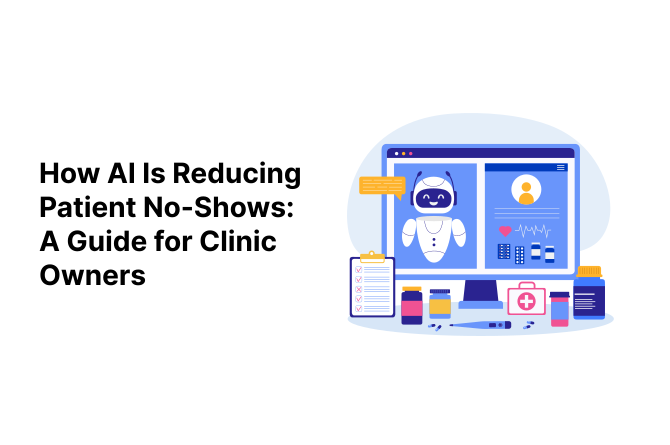
This is exactly where ai reduce patient no-show strategies are making a real difference. Clinics of all sizes are now using patient no-show reduction AI tools to predict, prevent, and manage missed visits before they happen.
This guide covers why no-shows happen, how AI fixes it, and what it costs.
Key Takeaways:
- AI predicts which patients are likely to miss appointments, so clinics can act before it happens, not after.
- Smart, personalized reminders and chatbots make confirming, canceling, or rebooking effortless for patients.
- Automated waitlist management instantly fills cancelled slots, keeping the schedule full.
- Clinics using AI-powered scheduling tools report 20–50% fewer no-shows and recovered revenue each month.
Why patients miss appointments in the first place
Before fixing the problem, it helps to understand why it happens. Most no-shows aren’t about patients not caring; they usually come down to simple, human reasons:
- Forgetfulness: Life gets busy, and a doctor’s visit booked weeks ago is easy to forget.
- Scheduling conflicts: Work, family, or transportation issues come up last minute.
- Anxiety or fear: Some patients avoid appointments because they’re nervous about the results or the procedure.
- Cost concerns: Patients unsure about insurance coverage may skip the visit rather than ask.
- Long wait times: A history of long waits at the clinic can discourage patients from showing up on time, or at all.
Studies across outpatient clinics show no-show rates from 15% to 30%, depending on specialty, a significant chunk of daily appointments going empty.
This is why strong clinic no-show management has become a priority for practice owners, and good clinic no-show management starts with understanding these patterns.
How AI is changing no-show management
Traditional reminder calls and text messages help, but they treat every patient the same way. AI takes a smarter approach. Instead of just reminding patients, it looks at patterns in patient behavior and predicts who is likely to miss their appointment, then takes action before it happens.
This shift from reactive reminders to proactive, predictive care is the core idea behind healthcare scheduling automation. Rather than staff manually calling every patient, healthcare scheduling automation tools handle reminders, rescheduling, and follow-ups on their own, freeing up staff time for patient care.
AI-powered scheduling is one part of a broader digital transformation. If you’re planning a complete healthcare platform, explore our guide on healthcare software development to understand the technologies, features, and development costs involved.
Key AI-powered features that reduce no-shows
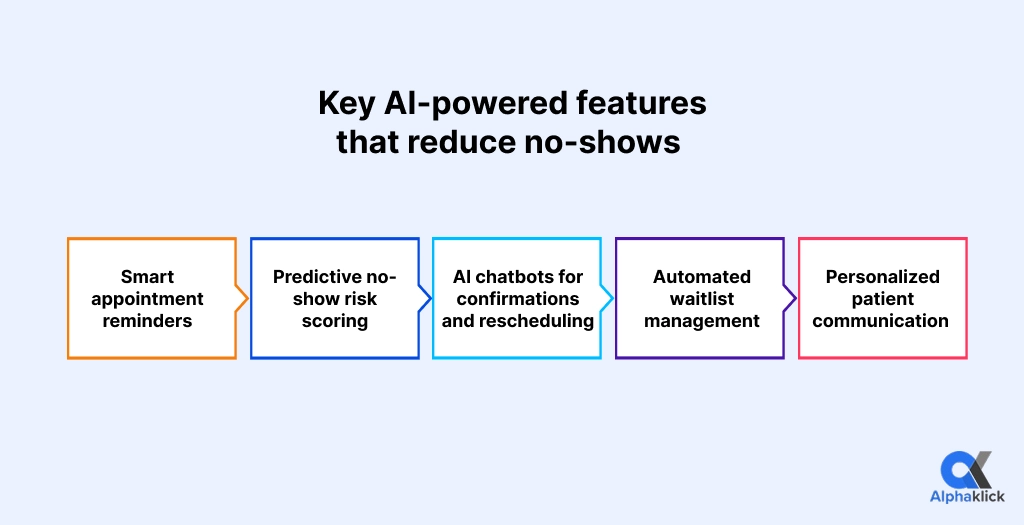
Let’s look at the specific tools clinics use today.
1. Smart appointment reminders
Basic reminders are old news. AI appointment reminders today use SMS, WhatsApp, email, and even voice calls, sent when each patient is most likely to respond.
Some systems learn that a patient opens texts in the evening rather than the morning, and adjust timing accordingly, making automated appointment reminders one of the easiest AI features to start with.
An AI symptom checker can also support patients before their appointments by helping them understand their symptoms and directing them toward the right level of care.
2. Predictive no-show risk scoring
Using past appointment history, demographics, appointment type, and even weather data, AI models assign each patient a “risk score” for missing their visit.
Clinics can then focus extra reminders or calls on high-risk patients instead of contacting everyone equally; this is the heart of predictive no-show analytics, using data to know who needs a nudge rather than guessing.
Good predictive no-show analytics turns years of appointment history into a simple, actionable list.
3. AI chatbots for confirmations and rescheduling
Instead of calling the front desk, an AI chatbot can confirm, cancel, or reschedule appointments through text or a simple app chat, effortlessly for patients instead of just skipping the visit silently.
Modern AI chatbots are often powered by intelligent AI healthcare agents that can answer patient questions, automate appointment workflows, and improve engagement while maintaining healthcare compliance.
4. Automated waitlist management
If a patient cancels, AI can instantly notify the next patient on the waitlist and offer them the open slot, turning what used to be lost time into a filled appointment.
5. Personalized patient communication
Not every patient wants the same reminder in the same language or format. AI patient communication tools tailor messages by language, channel, and tone, friendly for checkups, direct for urgent follow-ups.
Reducing missed appointments is only one step toward better patient engagement. If your organization also struggles with remote follow-ups and continuous care, these are some of the signs you may need a custom patient monitoring system.
Smart AI patient communication makes messages feel personal, not automated, and this patient engagement AI builds trust, so stronger patient engagement AI naturally leads to fewer missed visits.
Real-world impact: Data and examples
Clinics that have adopted patient no-show reduction AI tools report meaningful results. Multiple healthcare studies show no-show rate drops of 20–50% after introducing predictive reminders and automated rescheduling.
For a mid-sized clinic seeing 100 patients a day, even a 20% drop can mean dozens of extra visits and recovered revenue every month.
Here’s a simple look at how traditional methods compare to AI-driven approaches:
| Approach | Method | Typical No-Show Reduction |
| Manual phone reminders | Staff calls each patient | 5–10% |
| Standard SMS/email reminders | Fixed-time automated texts | 10–20% |
| AI-powered reminders + risk scoring | Personalized timing, predictive targeting | 20–50% |
| AI chatbot + waitlist automation | Full self-service rescheduling | 30–50% |
As the table shows, combining multiple AI features together delivers far better results than any single manual method.
This is the real value of clinic appointment no-show AI systems: they don’t just remind patients; they actively manage the whole scheduling process from start to finish.
How to implement AI no-show reduction in your clinic
Getting started doesn’t have to be complicated. Most clinics roll out AI in stages rather than switching everything overnight.
Here’s a simple path to follow:
- Review your no-show data: Look at your last 3–6 months of appointments to identify which types, days, or patient groups miss visits most often. This baseline helps you measure improvement later.
- Choose the right AI tools: Start with reminders and chatbots, since they’re the fastest to set up and show quick wins, before moving to full predictive analytics.
- Integrate with existing systems: Connect the AI tool with your EHR and scheduling software, and confirm it follows HIPAA standards so patient data stays protected.
- Train your front-desk staff: Make sure the team knows how the system works, so they can step in when a patient needs extra help.
- Run a pilot: Test with one department or appointment type first, and track the results over a few weeks.
- Scale gradually: Once you see fewer missed visits, expand the tools clinic-wide and add more advanced features like risk scoring.
This step-by-step approach makes healthcare AI scheduling and clinic appointment no-show AI adoption manageable, even for smaller clinics without a large IT team.
For the best results, AI scheduling should integrate seamlessly with your hospital management system, allowing appointment scheduling, patient records, billing, and communication to work together from a single platform.
Cost of building or integrating an AI no-show reduction system
Costs vary depending on how advanced your healthcare AI scheduling system needs to be.
Here’s a general breakdown:
| System Type | Features Included | Estimated Cost |
| Basic automation | SMS/email reminders, simple scheduling | $5,000 – $15,000 |
| Mid-level system | Reminders + chatbot + waitlist automation | $15,000 – $40,000 |
| Advanced predictive AI | Risk scoring, personalized communication, full EHR integration | $40,000 – $100,000+ |
Clinics don’t need to jump straight to the most advanced option.
Many start with basic automated appointment reminders and add predictive features as they grow comfortable with the technology.
Why Alphaklick is the right AI development partner for clinics
Not every software company understands healthcare. When choosing a partner to build your AI-reduce-patient-no-shows solution, look for real experience in patient-facing platforms, not generic app development.
AlphaKlick has built patient portals, Patient Monitoring System Development, and AI-powered health platforms with HIPAA and HL7 FHIR compliance from day one.
As a trusted AI Development Company, we work on a transparent, milestone-based model to design the right mix of AI appointment reminders, chatbots, and predictive tools for your practice.
If you’re a clinic owner trying to reduce missed appointments clinic-wide, a partner who understands both healthcare compliance and AI is what makes a tool actually work day to day.
Ready to reduce missed appointments clinic-wide and keep your schedule full? Book a free consultation with AlphaKlick to explore how AI can fit into your clinic’s workflow.
FAQs
Question: What is an acceptable no-show rate for a clinic?
Answer: Generally, a no-show rate under 10% is considered healthy. Rates above 20% signal it’s time to introduce automated reminders or predictive tools.
Question: How much does AI scheduling software cost?
Answer: Basic systems start around $5,000, while advanced predictive platforms with full EHR integration can run $40,000 or more, depending on features and complexity.
Question: Is patient data safe with AI reminder systems?
Answer: Yes, as long as the system is built with HIPAA compliance and secure data handling from the start.
Question: Can AI integrate with our existing EHR?
Answer: Most modern AI scheduling tools use HL7 FHIR standards and open APIs, allowing smooth integration with existing EHR and practice management systems.