Key Highlights
- Custom AI healthcare software improves automation, patient management, and operational efficiency for modern healthcare businesses
- Traditional healthcare software works well for basic hospital and clinic operations, but offers limited scalability and automation
- Choosing the right healthcare software solution depends on budget, business goals, integrations, and long-term growth needs
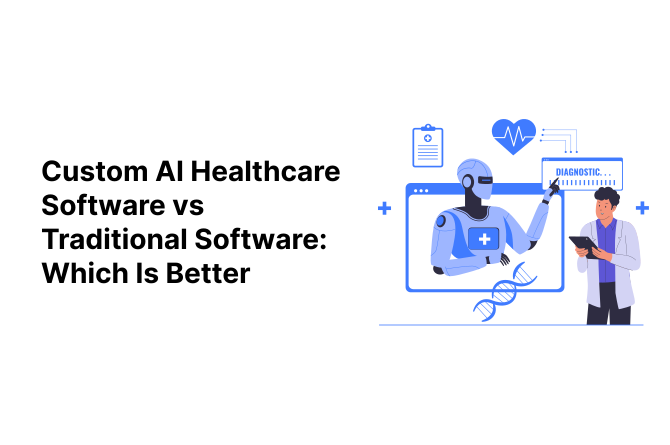
Healthcare businesses are no longer relying only on basic digital systems to manage operations. Hospitals, clinics, and healthcare startups are now comparing custom AI healthcare software with traditional healthcare software to understand which solution offers better automation, scalability, and long-term efficiency.
While traditional platforms still support everyday healthcare operations, AI-powered systems are transforming how providers manage workflows, patient data, and decision-making.
At Alphaklick, we build scalable and secure healthcare software solutions tailored for modern healthcare organizations.
If you are planning to upgrade your healthcare technology, this guide will help you understand which solution is the better fit for your business.
Healthcare AI software market insight
- According to the NextMSC report, the global Healthcare Artificial Intelligence Software Market was valued at USD 16.55 billion in 2023
- The market is projected to reach USD 216.73 billion by 2030
- The industry is expected to grow at a CAGR of 43.1% from 2024 to 2030
- This growth reflects the rising demand for AI in healthcare software, automation, predictive analytics, and smarter healthcare operations
Businesses planning scalable digital healthcare platforms can also read our complete guide on healthcare software development solutions, pricing, features, and implementation strategies.
What is traditional healthcare software?
Traditional healthcare software refers to standard digital systems used by hospitals and clinics to manage operations such as patient records, appointments, billing, pharmacy management, and reporting. These platforms usually follow fixed workflows and require manual input from healthcare staff.
Common examples include hospital management software, billing systems, appointment scheduling platforms, and basic EHR solutions.
Common uses of traditional healthcare software
- Patient registration and records
- Appointment scheduling
- Billing and invoicing
- Inventory management
- Basic reporting and analytics
While these systems support everyday healthcare operations, they often have limited automation, scalability, and predictive capabilities.
What is custom AI healthcare software?
Custom AI healthcare software refers to advanced healthcare platforms built with artificial intelligence, smart automation, and data-driven technologies to improve operational efficiency and patient care. Unlike traditional systems, these solutions support advanced workflow automation, AI automation, predictive analytics, and real-time decision-making.
Modern AI healthcare software development focuses on building scalable and intelligent platforms tailored for hospitals, clinics, telemedicine providers, and healthcare startups.
Common features of custom AI healthcare software
- AI-powered patient management
- Advanced workflow automation
- Smart appointment scheduling
- Predictive analytics and reporting
- Automated billing and documentation
- Real-time patient monitoring
- Intelligent healthcare automation
These modern healthcare software solutions help healthcare businesses reduce manual workload, improve operational accuracy, and deliver better patient experiences.
Businesses planning scalable healthcare platforms can also explore our guide on healthcare software development solutions for insights into features, cost, and development trends.
Custom AI healthcare software vs traditional software: Key differences
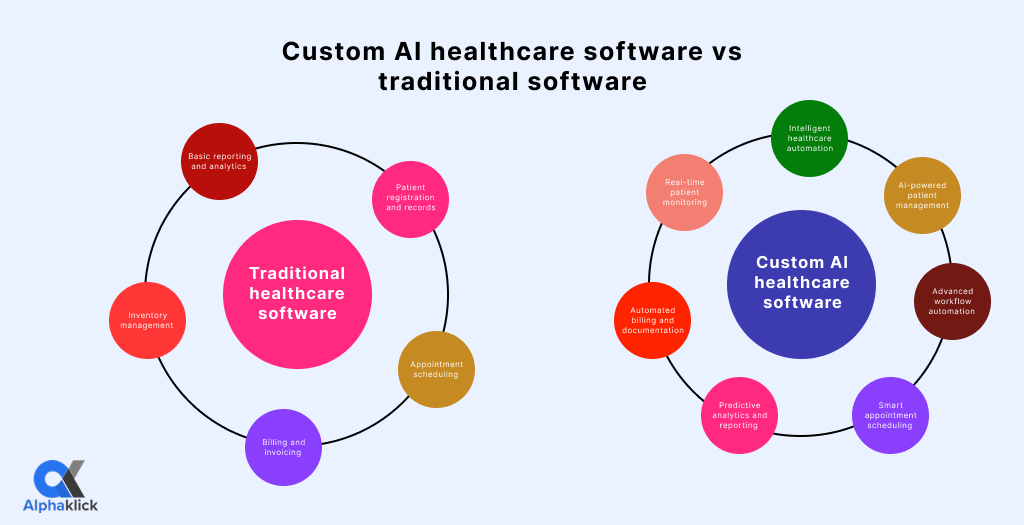
The main difference between traditional healthcare software and custom AI healthcare software lies in automation, intelligence, and scalability.
Traditional systems mainly handle routine healthcare operations, while AI-powered platforms improve workflows, automate tasks, and provide smarter healthcare insights.
| Feature | Traditional Healthcare Software | Custom AI Healthcare Software |
| Workflows | Fixed | AI-powered automation |
| Operations | Manual processes | Smart automation |
| Reporting | Basic reports | Real-time analytics |
| Decision Making | Rule-based | Predictive insights |
| Patient Experience | Standard workflows | Personalized experiences |
| Scalability | Limited | Highly scalable |
This healthcare software comparison highlights how AI-powered systems help healthcare providers improve efficiency, reduce manual workload, and manage operations more intelligently.
AI-powered healthcare platforms support better EHR integration, workflow management, and secure data accessibility. Learn more about EHR integration tools in healthcare and their impact on modern healthcare systems.
Which one is better for hospitals, clinics, and healthcare startups?
Not every healthcare business needs the same type of software. The right choice depends on daily operations, patient volume, automation needs, and future expansion plans.
| Healthcare Business Type | Better Software Choice | Reason |
| Small Clinics | Traditional Healthcare Software | Suitable for basic billing, appointments, and records |
| Multi-Specialty Hospitals | Custom AI Healthcare Software | Handles large-scale operations and workflow automation |
| Telemedicine Platforms | AI-Based Healthcare Software | Supports smart consultations and automation |
| Healthcare Startups | Custom Healthcare Software | Flexible, scalable, and easier to customize |
| Diagnostic Centers | AI Healthcare Software | Better data analysis and reporting |
| Enterprise Healthcare Networks | AI-Powered Healthcare Management Software | Centralized operations and real-time insights |
Healthcare businesses looking for long-term scalability, advanced workflow automation, and smarter operations are increasingly investing in custom AI healthcare software instead of relying only on conventional systems.
Large healthcare organizations often rely on centralized hospital management platforms to manage appointments, diagnostics, pharmacy operations, and patient workflows more efficiently.
Cost comparison: AI healthcare software vs traditional software
The cost of healthcare software mainly depends on features, integrations, automation level, and scalability requirements.
While traditional healthcare software usually has a lower upfront development cost, AI-powered systems provide better long-term operational efficiency and automation benefits.
| Factor | Traditional Healthcare Software | Custom AI Healthcare Software |
| Initial Cost | Lower | Higher |
| Automation Level | Basic | Advanced AI automation |
| Workflow Management | Manual processes | Smart workflow automation |
| Scalability | Moderate | Highly scalable |
| Long-Term Efficiency | Limited | Higher operational ROI |
Healthcare businesses investing in custom AI healthcare software often achieve better long-term value through automation, reduced manual workload, and improved operational accuracy.
Development timeline comparison
The development timeline depends on project complexity, integrations, AI features, compliance requirements, and customization needs.
| Software Type | Estimated Development Time |
| Traditional Healthcare Software | 4–8 Months |
| Custom AI Healthcare Software | 6–12 Months |
AI-powered platforms generally require additional time for AI model integration, workflow automation, analytics, testing, and security compliance implementation.
How to choose the right healthcare software development company
The right healthcare software development company is essential for building secure, scalable, and future-ready healthcare platforms. A reliable company should understand healthcare workflows, compliance standards, integrations, and long-term operational requirements.
Before selecting a healthcare software development company, check for:
- Experience in ai healthcare software development
- Knowledge of HIPAA, GDPR, HL7, and healthcare compliance standards
- Expertise in EHR, telemedicine, and hospital management systems
- Ability to build scalable and custom healthcare platforms
- Strong third-party integration capabilities
- Experience with AI automation and workflow optimization
The right healthcare development partner should focus not only on software delivery but also on security, performance, scalability, and long-term healthcare innovation.
You can also explore our guide on Best Healthcare Mobile App Developers in India, focusing on AI and IoT to understand how healthcare businesses are adopting smart healthcare technologies.
Why choose Alphaklick as your healthcare software development company
Alphaklick is a trusted healthcare software development company specializing in secure, scalable, and AI-powered healthcare platforms for hospitals, clinics, healthcare startups, and enterprise healthcare providers.
Our healthcare software expertise includes:
- Custom AI healthcare software
- Hospital management software
- EHR and EMR systems
- Telemedicine platform development
- Healthcare CRM software
- Medical billing software
- Healthcare automation software
AI tools and technologies we work with
- OpenAI
- AWS HealthLake
- Google Cloud AI (Vertex AI)
- Qventus
- Nuance DAX Copilot
- Aidoc
We follow healthcare compliance standards such as HIPAA, GDPR, HL7, and FHIR to ensure secure and reliable healthcare software solutions tailored to modern healthcare operations.
Looking to build healthcare software?
Book a free consultation with our healthcare software experts to discuss your project requirements, AI integrations, automation needs, and scalable healthcare platform development.
Frequently asked questions (FAQs)
Question: How does AI in healthcare differ from traditional medical software?
Answer: Traditional medical software mainly manages fixed operations such as appointments, billing, patient records, and reporting. In contrast, AI in healthcare software uses automation, predictive analytics, and intelligent decision-making to improve workflow efficiency, patient management, and operational accuracy.
Question: What is the difference between traditional software and AI software?
Answer: Traditional software follows predefined workflows and requires more manual input, while AI software can analyze data, automate repetitive tasks, learn from patterns, and provide real-time insights. This makes custom AI healthcare software more scalable and efficient for modern healthcare operations.
Question: Which AI is better for healthcare?
Answer: The best AI for healthcare depends on business requirements, operational goals, and software complexity. Technologies such as OpenAI, AWS HealthLake, Google Cloud AI, and predictive analytics platforms are commonly used in modern healthcare software solutions for automation, reporting, and patient engagement.
Question: Which healthcare businesses should invest in AI healthcare software?
Answer: Hospitals, clinics, telemedicine providers, diagnostic centers, pharmacies, and healthcare startups can benefit from AI healthcare software development to improve workflow automation, operational efficiency, patient experiences, and healthcare data management.
Question: What is the cost of developing AI healthcare software?
Answer: The cost of developing custom AI healthcare software typically ranges from $30,000 to $300,000+ depending on features, AI integrations, compliance requirements, automation complexity, third-party integrations, and scalability needs. Enterprise-level healthcare platforms with advanced AI automation and analytics usually require higher investment.