Every day, doctors make critical decisions without the full picture. A patient sees a specialist who can’t access their GP’s notes. A hospital’s billing system can’t talk to its own EMR. Lab results sit in one system while the prescribing doctor works in another.
According to a JAMA study, poor health data interoperability contributes to an estimated $8.3 billion in wasted healthcare spending annually in the US alone, and more importantly, it leads to medical errors, duplicate tests, and delayed treatments.
The good news? The healthcare industry finally has a shared answer: FHIR integration.
This FHIR integration guide walks you through everything, from what FHIR actually means to how it connects EHR and EMR systems, what it costs, and how to implement it the right way.
What is FHIR?
FHIR stands for Fast Healthcare Interoperability Resources. It was created by HL7 (Health Level Seven International), the global body that sets standards for how health information is shared.
HL7 released FHIR to solve a very real problem: older healthcare data standards were too complex, too slow, and not built for the modern web. The current widely adopted version is FHIR R4, with FHIR R5 being the newest release offering more flexibility and improved resource definitions.
How FHIR Differs from Older Standards (HL7 v2, HL7 v3, CDA)
Before FHIR, healthcare systems used standards like HL7 v2, HL7 v3, and CDA (Clinical Document Architecture). These worked, but they were painful to implement. HL7 v2 messages were text-based and hard to parse. HL7 v3 was XML-heavy and overly complex. CDA was document-centric, not great for real-time data exchange.
HL7 FHIR integration changed everything. FHIR uses REST APIs, JSON, and modern web protocols that developers already understand. It’s faster to build, easier to test, and far simpler to maintain.
Key FHIR Resources Explained
FHIR organises health data into modular building blocks called “resources.” Each resource represents a specific type of clinical or administrative data:
- Patient: Demographics, identifiers, contact info
- Observation, Lab results, vitals, clinical measurements
- Encounter: A patient’s visit or interaction with a provider
- Medication / Medication Request: Drug information and prescriptions
- Condition: Diagnoses and health problems
- Practitioner: Doctor, nurse, or other care provider details
- Diagnostic Report: Findings from tests or imaging
These resources are the foundation of any FHIR API integration; they define what data is exchanged and how it is structured.
EHR vs EMR: Understanding the Systems You’re Connecting
What is an EHR (Electronic Health Record)?
An EHR (Electronic Health Record) is a digital record of a patient’s health information that is designed to be shared across different healthcare providers and organisations. It follows the patient, from their GP to a hospital to a specialist, and gives each provider a complete view of that patient’s history.
Building an EHR platform? Read our AI-Powered EHR Software Development Guide (2026) for features, compliance requirements, FHIR integration, and development costs.
What is an EMR (Electronic Medical Record)?
An EMR (Electronic Medical Record) is a digital version of the paper chart within a single practice or clinic. It captures the diagnoses, treatments, and notes from one specific provider. It’s not typically built to be shared outside that organisation.
Key Differences Between EHR and EMR
| Feature | EMR (Electronic Medical Record) | EHR (Electronic Health Record) |
| Scope | Single clinic or practice | Multiple providers & facilities |
| Data Sharing | Internal only | Designed for external sharing |
| Patient View | One provider’s records | Full patient health history |
| Interoperability | Limited | Built for cross-system exchange |
| Examples | Legacy in-house clinic tools | Epic, Cerner, Allscripts, Meditech |
Why Both Need FHIR Integration to Communicate
Whether a healthcare business runs an EHR or an EMR, the challenge is the same: getting data out of a siloed system and into the hands of people who need it. FHIR EHR integration and FHIR EMR integration both rely on the same FHIR API layer to enable that exchange in a standardised, secure way.
Without this integration layer, systems simply cannot talk to each other, no matter how good the software inside them is.
Discover how EHR integration tools improve healthcare data security, interoperability, and operational efficiency.
How FHIR Integration Works: The Technical Architecture
1. RESTful API Model in FHIR (GET, POST, PUT, DELETE)
FHIR uses a standard RESTful API model. That means:
- GET: Read a resource (e.g., fetch a patient’s lab results)
- POST: Create a new resource (e.g., submit a new prescription)
- PUT: Update an existing resource (e.g., update a patient’s address)
- DELETE: Remove a resource (used carefully in clinical contexts)
This makes FHIR API integration approachable for any developer familiar with REST.
2. FHIR Server vs FHIR Client, Roles Explained
- A FHIR server stores and serves health data. It could be hosted by a hospital, an EHR vendor, or a cloud provider.
- A FHIR client is the application that requests data, a mobile app, a billing system, a CDSS tool, or a third-party integration.
3. SMART on FHIR: Authorisation Layer Explained
SMART on FHIR is the security framework that sits on top of the API. It answers the question: “Who is allowed to access what?”
It uses OAuth 2.0 to issue access tokens, so only authorised apps and users can retrieve sensitive health data.
4. OAuth 2.0 & OpenID Connect in FHIR Workflows
OAuth 2.0 handles authorisation (what the app can do), while OpenID Connect handles authentication (who the user is). Together, they form the access control backbone of every secure healthcare system integration built on FHIR.
5. JSON vs XML in FHIR Data Format
FHIR supports both JSON and XML as data formats. In practice, JSON is preferred for most modern implementations; it’s lighter, faster, and more developer-friendly. XML is still used in legacy integrations and certain enterprise environments.
6. Architecture: How Data Flows Between EHR ↔ FHIR API ↔ Third-Party App
Here’s a simplified view of how healthcare data exchange flows in a FHIR-based system:
| [ Patient / Clinician ] ↓ [ EHR / EMR System ] ←→ [ FHIR Server ] ←→ [ Third-Party App or Portal ] ↑ [ SMART on FHIR Auth Layer ] [ OAuth 2.0 / OpenID Connect ] |
The FHIR server acts as the neutral exchange layer, receiving requests from apps, fetching data from the EHR, and returning standardised FHIR resources in response.
Beyond hospitals and clinics, FHIR APIs also enable seamless data exchange between providers and insurers, making them a critical component of any modern health insurance software platform that supports real-time eligibility verification and claims processing.
Step-by-Step FHIR Integration Process
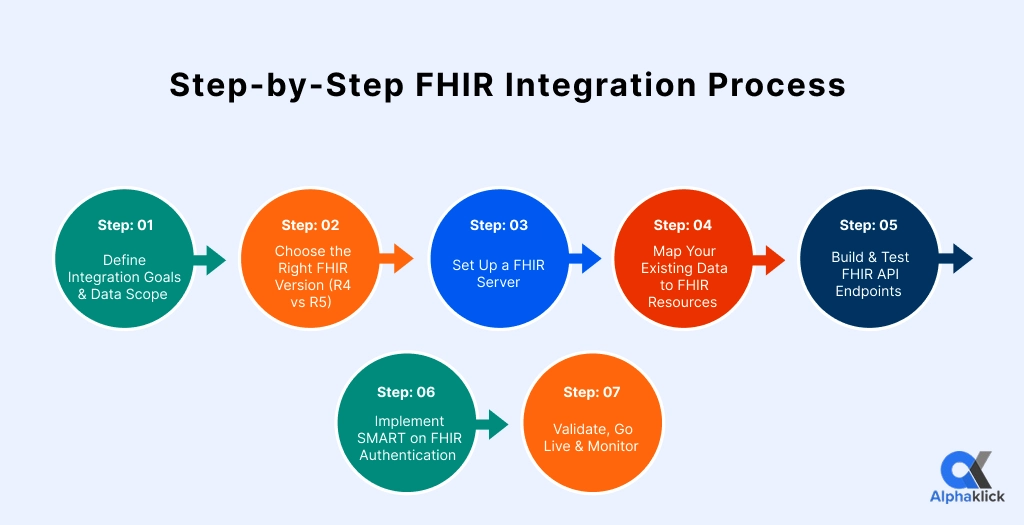
Step 1: Define Integration Goals & Data Scope
Before writing a single line of code, define exactly what you need. Which data types? Which systems? Who will access the data and for what purpose? A clear scope prevents expensive rework later.
Step 2: Choose the Right FHIR Version (R4 vs R5)
FHIR R4 is the current standard; most EHRs and cloud platforms support it fully. FHIR R5 is the latest release and is worth choosing for new builds where long-term flexibility matters. For most FHIR EHR integration projects today, R4 is the right choice.
Step 3: Set Up a FHIR Server
Choose your infrastructure:
- HAPI FHIR, Open-source, Java-based, widely used
- IBM FHIR Server, an enterprise-grade open-source option
- Azure Health Data Services, Microsoft’s managed FHIR platform
- AWS HealthLake, Amazon’s cloud-native FHIR solution
- Google Cloud Healthcare API, Google’s FHIR-compliant data service
Step 4: Map Your Existing Data to FHIR Resources
This is often the hardest step. Your existing data must be translated into FHIR-compliant resources. That means aligning local terminology with standards like SNOMED CT, ICD-10, and LOINC, the backbone of clinical coding in HL7 FHIR integration projects.
Step 5: Build & Test FHIR API Endpoints
Develop the API endpoints that your applications will call. Test them rigorously using tools like Inferno, Touchstone, and Postman to ensure they return correct, well-formed FHIR resources.
Step 6: Implement SMART on FHIR Authentication
Set up OAuth 2.0 and OpenID Connect to control access. Define scopes carefully , a billing app should not have the same access as a clinical decision support tool.
Step 7: Validate, Go Live & Monitor
Run conformance testing, perform load testing, and then go live. Set up monitoring from day one to track API response times, errors, and data quality. Interoperability in healthcare only delivers value when the system stays reliable.
Key Use Cases for FHIR Integration
FHIR integration powers a wide range of real-world healthcare applications:
- Patient Data Portability: Patients can access and move their complete health records across providers, supporting EHR interoperability at a personal level.
- Telemedicine & Remote Patient Monitoring: Apps pull live vitals and history via FHIR API to support virtual care.
- Medical Billing & Claims Automation: Automated healthcare data exchange between providers and payers reduces manual errors and processing time.
- Clinical Decision Support (CDSS): Clinicians receive real-time, data-driven recommendations from tools that read FHIR resources directly.
- Pharmacy Management & e-Prescribing: Prescriptions flow digitally from EHRs to pharmacy systems via FHIR, reducing errors and delays.
- Hospital Management System Integration: Departments share patient data seamlessly, improving coordination and reducing duplication.
- Patient-Facing Mobile Health Apps: Users view appointments, results, and care plans directly on their phones through FHIR-connected portals.
Explore how AI-powered healthcare agents are transforming patient support, clinical workflows, and healthcare automation in our guide on AI Healthcare Agent Development: Use Cases, Compliance & Cost.
FHIR Compliance & Regulatory Requirements
1. ONC 21st Century Cures Act & FHIR Mandates (US)
In the US, the ONC 21st Century Cures Act requires certified EHR developers to provide FHIR R4-based APIs that give patients and third parties access to health data. Non-compliance can result in significant penalties and loss of certification.
2. HIPAA Considerations in FHIR Implementations
FHIR is a data standard, not a compliance framework. But every FHIR EHR integration in the US must be built with HIPAA in mind.
That means encrypting data in transit and at rest, enforcing access controls, maintaining audit logs, and having a signed Business Associate Agreement (BAA) with any third-party service providers.
Learn the best practices for building secure and compliant healthcare applications in our guide on HIPAA-Compliant AI-Powered Healthcare Apps.
3. GDPR & International Healthcare Data Laws
For European healthcare organisations, GDPR applies to any personal health data. FHIR implementations must include mechanisms for patient consent, the right to access, and the right to erasure. Similar regional laws apply in Canada (PIPEDA), Australia (Privacy Act), and the UK (UK GDPR).
4. HL7 FHIR Certification & Conformance Testing
HL7 offers formal conformance testing programs. Testing tools like Inferno (used for ONC certification) and Touchstone validate that your FHIR implementation meets the required profiles and behaviours.
Certification is important for EHR vendors and any organisation seeking to participate in national health information networks.
FHIR Integration Cost & Timeline
| Project Type | Estimated Cost (USD) | Estimated Timeline |
| Simple FHIR API integration (single data type) | $8,000 – $20,000 | 4–8 weeks |
| Mid-level EHR/EMR integration (multiple resources) | $25,000 – $60,000 | 2–4 months |
| Full EHR platform integration (Epic, Cerner, etc.) | $70,000 – $200,000+ | 4–9 months |
| Custom FHIR server setup + app integration | $30,000 – $80,000 | 3–5 months |
Tools & Technologies for FHIR Integration
1. Open-Source FHIR Servers
- HAPI FHIR: the most widely used open-source FHIR server, written in Java. Active community and strong documentation.
- IBM FHIR Server: Enterprise-grade, open-source option with strong compliance support.
2. Cloud-Native FHIR Platforms
- Azure Health Data Services: Microsoft’s fully managed FHIR service with built-in security and compliance tools.
- AWS HealthLake: Amazon’s cloud-native healthcare data store, is FHIR R4 compliant.
- Google Cloud Healthcare API: Google’s managed FHIR service with strong analytics integration via BigQuery.
3. Integration Middleware
- Mirth Connect: Open-source integration engine widely used for HL7 v2 to FHIR translation.
- Rhapsody: Enterprise-grade middleware for complex healthcare data routing.
- Azure Logic Apps: Low-code workflow automation with FHIR connectors.
4. FHIR Testing Tools
- Inferno: The primary tool used for ONC certification testing in the US.
- Touchstone: HL7’s own testing platform for FHIR conformance validation.
- Postman: General-purpose API testing tool, widely used for FHIR endpoint validation during development.
5. SDKs & Client Libraries
FHIR client libraries are available in most major languages: Python (fhirclient), Java (HAPI FHIR client), .NET (Firely SDK), and JavaScript (fhir.js).
These make it faster to build and test FHIR API integration without building from scratch.
Looking beyond interoperability? Explore our complete guide to Healthcare Software Development for features, costs, and healthcare technology solutions.
Why Choose Alphaklick for FHIR Integration Development
As a trusted provider of Healthcare Software Development Services, Alphaklick helps healthcare organizations build secure, scalable, and interoperable healthcare ecosystems powered by modern FHIR standards.
At Alphaklick, we bring all three.
- Real-world healthcare projects delivered: We have built EHR-connected applications, patient portals, billing automation systems, and telemedicine platforms. See our healthcare case studies →
- Healthcare-specific expertise: Our team has hands-on experience with EHR and EMR integration, HL7 FHIR standards, SMART on FHIR, and the major EHR platforms, including Epic, Cerner, and Meditech.
- Compliance-first development: Every FHIR integration we build is designed to be HIPAA and GDPR-ready from the architecture stage, not patched in later.
- Flexible engagement models: Work with us on a fixed-price project, on an hourly basis, or as a dedicated development team embedded with your in-house staff.
Whether you are a health-tech startup building your first FHIR-connected app or a hospital system looking to modernise your interoperability in healthcare infrastructure, Alphaklick is the team that gets it done.
Talk to a FHIR integration specialist at Alphaklick →
Frequently Asked Questions (FAQs)
Question: What is FHIR integration?
Answer: FHIR integration is the process of connecting healthcare systems such as EHRs, EMRs, patient apps, and billing platforms using the HL7 FHIR standard. It enables secure, standardized, and seamless healthcare data exchange across different systems.
Question: What is the difference between HL7 and FHIR?
Answer: HL7 is the organization that develops healthcare data standards, while FHIR is its modern interoperability standard. FHIR uses REST APIs and JSON, making integrations faster, simpler, and more developer-friendly than older HL7 versions.
Question: Is FHIR integration mandatory in the US?
Answer: Yes, for certified EHR systems. The 21st Century Cures Act requires EHR vendors to support FHIR R4 APIs for secure patient and third-party access to healthcare data.
Question: How long does FHIR integration take?
Answer: A basic FHIR integration project can take 4–8 weeks, while a full-scale EHR integration with platforms like Epic or Cerner may require 4–9 months, depending on complexity.
Question: Is FHIR HIPAA compliant?
Answer: FHIR itself is a data exchange standard, not a compliance framework. However, FHIR implementations can be HIPAA compliant when combined with encryption, access controls, audit logs, and proper security practices.