Over the years, I’ve seen one pattern repeat itself across enterprises: growth slows when systems don’t scale. In 2026, enterprise mobile app development is no longer about adding another internal tool; it’s about giving teams the ability to work faster, smarter, and with less friction.
From my experience building enterprise mobile applications across healthcare, logistics, eCommerce, and SaaS, the most successful apps are the ones people don’t struggle with. They fit naturally into daily workflows and quietly improve execution. The ones built without a long-term view usually become obstacles.
The market reflects this shift. According to Grand View Research, the global enterprise application market was valued at USD 320.40 billion in 2024 and is projected to reach USD 625.66 billion by 2030, growing at a CAGR of 11.8%. Enterprises are clearly investing with intent.
At this stage, enterprise mobile app development 2026 is about building a scalable mobile foundation, not just launching an app.
This enterprise mobile app development guide focuses on how to do that the right way.
What is enterprise mobile app development?
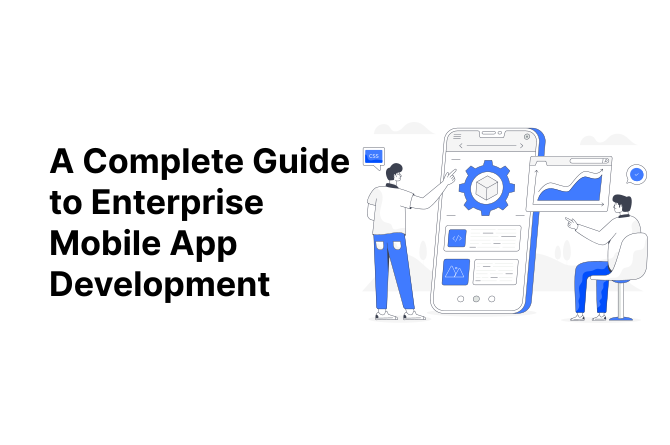
Enterprise mobile app development focuses on building secure, scalable mobile applications designed specifically for business operations. Unlike consumer apps, enterprise mobile applications are created to support internal workflows, complex system integrations, and real-time access to enterprise data.
From my experience delivering enterprise mobile development services across multiple industries, these apps are built for reliability and long-term value, not downloads or public visibility. That’s why custom enterprise mobile apps require careful planning around architecture, security, and scalability from the very beginning.
In enterprise app development 2026, the focus has shifted from simple mobility to building scalable enterprise mobile apps that evolve with the organization.
Types of enterprise mobile applications
In practical enterprise mobile app development, most solutions fall into a few well-defined categories. Each type addresses a specific operational need and often works as part of a connected ecosystem.
- Employee productivity and workforce management apps: Used for task tracking, approvals, attendance, and internal communication.
- ERP and operations management apps: Provide mobile access to inventory, finance, supply chain, and operational systems.
- CRM and customer-facing enterprise apps: Designed for sales teams, account managers, and enterprise customers.
- Business intelligence and analytics apps: Deliver real-time dashboards and performance insights for decision-makers.
- Industry-specific enterprise mobile applications: Highly custom enterprise mobile apps built for healthcare, logistics, manufacturing, fintech, and SaaS.
Key trends shaping enterprise mobile app development in 2026
The direction of enterprise mobile app trends 2026 shows a clear shift toward intelligence, scalability, and tighter system integration.
- AI-driven enterprise applications: AI enterprise mobile development enables automation, predictive insights, and smarter workflows.
As AI becomes a core part of enterprise systems, understanding the AI mobile app development cost in 2026 is essential for planning scalable and intelligent enterprise solutions.
- Cloud-native enterprise apps: Cloud native enterprise apps support rapid scaling, independent deployments, and better performance.
- Low-code enterprise mobile apps: Low-code enterprise mobile apps allow faster internal development while maintaining governance.
- Security-first app architecture: Enterprises embed enterprise mobile security best practices directly into app design.
- Integration-focused development: Modern enterprise mobile apps are built to integrate smoothly with ERP, CRM, and legacy platforms.
From my experience, enterprises that align with these enterprise mobile app trends 2026 build scalable enterprise mobile apps that stay relevant and cost-effective well into the future.
If you’re looking to invest in AI technology but want to know the real numbers, this article on AI personal assistant mobile app development cost gives a clear cost overview.
Essential features of enterprise mobile apps

In enterprise mobile app development, core features directly determine adoption, security, and scalability. From my experience delivering enterprise mobile development services, these elements are what separate high-performing enterprise apps from tools that struggle after launch.
1. Secure authentication & role-based access
Enterprise apps must support secure authentication, such as SSO and MFA, to protect access without slowing users down. Role-based access ensures employees only see what’s relevant to their responsibilities, reducing risk and improving usability. In enterprise mobile app development 2026, identity management is foundational.
2. Real-time data synchronization
Enterprise teams rely on accurate, up-to-date information. Real-time synchronization keeps data consistent across devices and systems, enabling faster collaboration and better decision-making within enterprise mobile applications.
3. Offline functionality
Many enterprise users work in low-connectivity environments. Offline functionality allows them to continue working and sync data automatically once connectivity is restored, critical for scalable enterprise mobile apps used in the field.
4. System integrations (ERP, CRM, legacy systems)
Enterprise apps must integrate seamlessly with ERP, CRM, and existing systems. Strong integrations eliminate data silos and ensure enterprise mobility solutions work as part of a larger ecosystem.
5. Advanced analytics & reporting
Built-in analytics help enterprises monitor performance, identify trends, and act quickly. This turns enterprise mobile applications into decision-support tools, not just operational apps.
6. Enterprise-grade security & compliance
Security is non-negotiable. Following enterprise mobile security best practices, including encryption, secure APIs, and regulatory compliance, protects data and builds trust across the organization.
Enterprise mobile app development platforms
Choosing the right platform is a key decision in enterprise mobile app development because it impacts performance, scalability, and long-term cost. From my experience, the best platform depends on business complexity, user needs, and how the app is expected to scale.
1. Native app development (iOS & Android)
Native apps offer the best performance and security. They are ideal for complex enterprise mobile applications that require deep device access and long-term scalability.
2. Cross-platform enterprise app development
Cross-platform development allows a single codebase for iOS and Android, reducing time and cost. It works well for many custom enterprise mobile apps where speed and consistency matter.
3. Progressive web apps (PWAs) for enterprises
PWAs provide app-like experiences through the browser and are useful for internal tools or dashboards that need quick access and easy updates.
4. Low-code / no-code platforms
Low-code platforms help enterprises build internal apps faster. They are effective for simple workflows but work best alongside fully scalable enterprise mobile apps.
Enterprise mobile app development process
In enterprise mobile app development, process discipline is what separates scalable solutions from expensive rebuilds. From my experience working on enterprise-grade products, most failures don’t happen because of technology; they happen when execution lacks structure.
A well-defined process ensures that business goals, user experience, security, and scalability move forward together.
1. Business requirement mapping
This is the most underestimated phase. Before writing code, we map real business workflows, user roles, dependencies, and long-term goals. In enterprise app development 2026, this step prevents feature overload and ensures the app solves the right problems.
2. UX/UI for enterprise users
Enterprise users value speed and clarity over aesthetics. Interfaces must reduce steps, minimize errors, and support repetitive tasks efficiently. A strong UX directly impacts adoption and productivity in enterprise mobile applications.
3. Agile development cycles
Agile allows enterprises to adapt as requirements evolve. Short development sprints, regular reviews, and continuous feedback help reduce risk and improve alignment between business and technical teams.
4. Enterprise-grade testing
Testing must go beyond basic functionality. Performance under load, security vulnerabilities, system integrations, and data consistency are all tested to ensure the app performs reliably at scale.
5. Secure deployment and ongoing monitoring
Deployment includes version control, rollback strategies, and real-time monitoring. Continuous monitoring ensures stability and helps detect issues early as usage grows.
Working with an experienced Mobile App Development Company in Atlanta, USA ensures that every stage, from requirement analysis to deployment, is aligned with enterprise security standards and scalability goals.

Security & compliance in enterprise mobile apps
Security is a core requirement in enterprise mobile app development, not an afterthought. From what I’ve seen, enterprises that delay security decisions often pay for it later, through compliance issues or operational risk.
Following enterprise mobile security best practices protects both data and trust.
- End-to-end encryption ensures data remains secure in transit and at rest
- Secure APIs protect communication between mobile apps and backend systems
- Device management policies support both corporate devices and BYOD environments
- Regulatory compliance ensures alignment with standards such as GDPR, HIPAA, SOC 2, or industry-specific regulations
In enterprise app development 2026, security must be embedded into architecture, workflows, and deployment pipelines from day one.
Technology stack for enterprise mobile app development
The technology stack plays a critical role in scalability, performance, maintenance, and overall enterprise mobile app development cost. The right stack supports future growth without forcing constant rework.
| Layer | Common technologies | Role in enterprise apps |
| Frontend | Swift, Kotlin, React Native, Flutter | User interface & experience |
| Backend | Node.js, Java, .NET, Python | Business logic & APIs |
| Database | PostgreSQL, MongoDB, Firebase | Secure data storage |
| Cloud services | AWS, Azure, Google Cloud | Scalability & infrastructure |
| Security | OAuth, JWT, IAM tools | Authentication & access control |
| Analytics | Power BI, Firebase Analytics | Reporting & insights |
| DevOps | CI/CD, Docker, Kubernetes | Deployment & monitoring |
From my experience, enterprises that invest in a flexible, cloud-ready stack build apps that scale smoothly, integrate easily, and remain relevant as business needs change.
Choosing the right development partner is critical, and this curated list of the top 10+ mobile app development companies in India can help enterprises evaluate experienced teams for large-scale mobile app development.
Cost of enterprise mobile app development in 2026
The enterprise mobile app development cost in 2026 depends mainly on application complexity, integrations, security needs, and scalability. Since enterprise mobile applications are built for long-term operations, cost planning should always consider future growth, not just the initial launch.
Typical enterprise mobile app development cost ranges
| App type | Estimated cost range |
| MVP enterprise app | $30,000 – $60,000 |
| Mid-level enterprise app | $60,000 – $120,000 |
| Large-scale enterprise system | $120,000 – $250,000+ |
Enterprise mobile app cost based on application type
| Enterprise mobile app type | Cost range (approx.) |
| Employee productivity app | $35,000 – $70,000 |
| CRM or sales enablement app | $50,000 – $100,000 |
| ERP or operations management app | $80,000 – $180,000 |
| Business intelligence & analytics app | $70,000 – $150,000 |
| Industry-specific enterprise app | $100,000 – $250,000+ |
From my experience, underestimating enterprise mobile app development cost often results in rebuilds within 12–18 months. Enterprises that plan architecture, security, and scalability upfront usually spend more initially, but save significantly over time.
For a broader view beyond enterprise use cases, you can also explore the mobile app development cost in 2026, which covers pricing across industries and app types.
How Alphaklick helps enterprises build scalable mobile applications
At AlphaKlick, we specialize in enterprise mobile app development and mobile app development that’s built to scale from day one.
From my experience leading enterprise projects across healthcare, logistics, SaaS, and eCommerce, most scalability issues come from decisions made too late. That’s why we focus early on strategy, enterprise mobile app architecture, security, and system integrations, before development begins.
We build custom enterprise mobile apps using cloud native enterprise apps, AI-driven features, and enterprise-grade security best practices. Post-launch, we continue optimizing so your app grows smoothly with your business.
Thinking about your next enterprise mobile app?
Book a free consultation and let’s map a scalable mobile app development strategy that actually lasts.
Frequently asked questions
Question: What is enterprise application development?
Answer: Enterprise application development is the process of building secure, scalable software for business operations. It focuses on enterprise mobile applications, system integrations, and long-term reliability rather than public users.
Question: How can enterprise mobile app development be the future of your business growth?
Answer: Enterprise mobile app development improves productivity, speeds up decision-making, and enables real-time data access. In enterprise app development 2026, scalable mobile apps help businesses grow faster with fewer operational bottlenecks.
Question: How much does enterprise mobile app development cost in 2026?
Answer: The enterprise mobile app development cost in 2026 usually ranges from $30,000 to $250,000+, depending on complexity, integrations, security, and scalability requirements.
Question: Are low-code enterprise mobile apps suitable for large organizations?
Answer: Low-code enterprise mobile apps are suitable for large organizations when used for internal tools and workflows. For complex systems, they work best alongside custom enterprise mobile apps.
Question: How do I choose the best enterprise app development company?
Answer: The best enterprise app development companies have experience with enterprise architecture, security, integrations, and long-term support. Choose a partner that understands scalable enterprise mobile apps, not just development speed.