Running a chiropractic clinic today is about more than patient care; it’s about how easily patients book appointments, access records, and stay connected. From my experience working with healthcare and wellness clinics, many still struggle with missed visits, manual records, and disconnected systems.
This is where chiropractor mobile app development plays a practical role. A well-planned healthcare mobile app development chiropractor solution helps clinics automate bookings, manage records securely, and deliver a better patient experience without increasing daily workload.
The market supports this shift. According to Mordor Intelligence, the chiropractic care market is expected to grow from USD 1.73 billion in 2025 to USD 3.05 billion by 2030, at a 11.93% CAGR, making this the right time to build chiropractor mobile app solutions that scale with demand.
In this guide, I’ll share real insights from my team’s experience in chiropractic software development, covering features, chiropractic clinic app cost, development process, and monetization, clearly and practically.
Why chiropractic clinics need a mobile app in 2026
When I speak with chiropractors, the real question is never “Do we need a mobile app?”, it’s “Will this genuinely help my clinic run better?”
From my experience working on healthcare mobile app development chiropractor projects, the answer is yes, when the best chiropractic mobile apps in 2026 are built with the clinic’s workflow in mind. Clinics that invest in the right mobile solution see better patient retention, fewer missed appointments, and smoother day-to-day operations.
A chiropractor’s mobile app helps clinics:
- Centralize patient communication in one place
- Automate appointment booking and reminders
- Digitize treatment records securely
- Offer virtual follow-ups and consultations
Instead of juggling multiple tools, clinics can manage everything through a single chiropractic practice management app based on how they actually work.
Clinics looking to modernize their patient experience should work with an experienced Mobile App Development Company in Atlanta, USA that understands healthcare compliance, patient data security, and scalable app architecture.
Types of chiropractor mobile apps
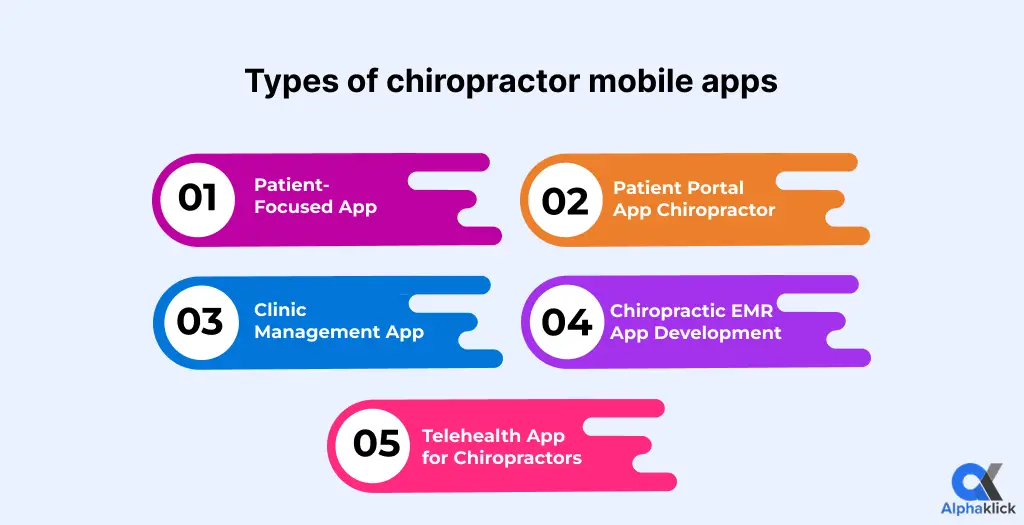
Different clinics have different goals; solo practitioners, multi-location clinics, and wellness chains don’t all need the same solution.
Based on the chiropractor app development projects my team has delivered, these are the five most common and effective app types.
| App Type | Primary Use Case | Ideal For |
| Patient-Focused App | Appointment booking, exercise plans, progress tracking | Clinics looking to improve engagement and loyalty |
| Patient Portal App Chiropractor | Access to reports, treatment history, and invoices | Clinics aiming for transparency and self-service |
| Clinic Management App | Scheduling, billing, staff management, analytics | Medium to large chiropractic clinics |
| Chiropractic EMR App Development | Digital medical records, SOAP notes, and compliance | Clinics replacing paper-based systems |
| Telehealth App for Chiropractors | Virtual consultations, posture checks, follow-ups | Clinics offering remote or hybrid care |
For clinics planning wellness-focused or behavioral care solutions, this guide on how to build an AI-powered mental health mobile app offers valuable insights into features, compliance, and development cost.
Features of a modern chiropractor’s mobile app
From my experience delivering chiropractor app development solutions for clinics, the most effective apps are not overloaded with features, they are thoughtfully designed around patient care, clinic efficiency, and compliance. Modern chiropractic apps combine essential operational tools with AI-powered enhancements that support better decisions and better outcomes.
Below is a clear breakdown of core features every clinic needs and advanced, AI-enabled features used by forward-thinking clinics.
Core features every chiropractor’s mobile app must have
These features form the operational foundation of a reliable chiropractic practice management mobile app and are essential for day-to-day clinic operations.
- Patient Registration & Secure Profiles: Digital intake forms, consent documents, and medical history are stored securely with role-based access.
- Appointment Booking & Scheduling (AI-Assisted): A smart appointment booking app for a chiropractor system that uses AI to suggest optimal time slots, send predictive reminders, and reduce no-shows based on patient behavior.
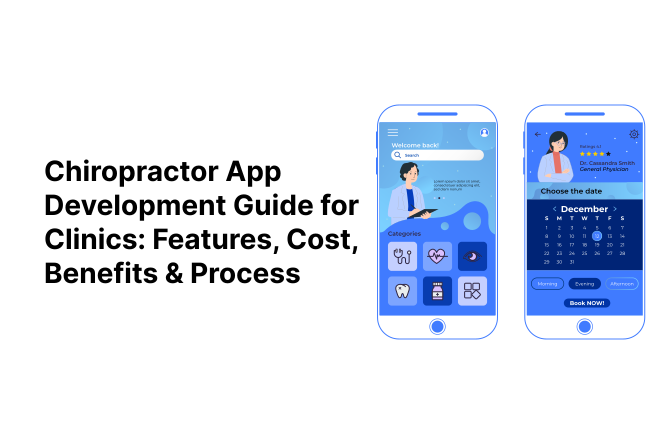
- Patient Portal Access: A self-service patient portal app that chiropractors use to allow patients to access visit history, care plans, invoices, and upcoming appointments anytime.
- Chiropractic EMR & Record Management (AI-Enhanced): Structured SOAP notes and visit records with AI-assisted data entry and quick clinical summaries through modern chiropractic EMR app development.
- In-App Payments & Billing: Secure online payments, packages, subscriptions, and automated invoices integrated into the clinic workflow.
- HIPAA-Compliant Security & Compliance: Encryption, access controls, audit trails, and secure cloud infrastructure to ensure a fully HIPAA-compliant chiropractor app.
If continuous patient tracking and data-driven care are part of your roadmap, you may also want to review the top health monitoring mobile app features and their development cost in 2026.
Advanced & AI-powered features for scalable chiropractic clinics
These features help clinics move beyond automation and deliver smarter, more personalized care, commonly seen in the best chiropractic apps 2026.
- Telehealth & Virtual Consultations: Secure video visits and follow-ups using a dedicated telehealth app for chiropractors, ideal for posture checks, recovery reviews, and remote care.
- AI-Based Posture & Movement Analysis: AI analyzes patient images or videos to identify posture imbalances, mobility issues, and progress trends over time.
- AI-Driven Treatment Recommendations: Personalized exercise routines, recovery plans, and follow-up schedules generated using patient history and engagement data.
- Automated Patient Communication & AI Chatbots: AI chat assistants handle FAQs, appointment queries, and care instructions, reducing front-desk load and improving response times.
- Predictive Analytics & Clinic Insights: AI-powered dashboards provide insights into patient retention, treatment outcomes, and appointment patterns for data-driven decisions.
Before launching an AI-powered assistant, it’s important to explore the complete AI personal assistant mobile app development cost, including design, AI models, and maintenance.
Chiropractor mobile app development cost breakdown
Cost is always the first practical question chiropractors ask me, and from my experience delivering multiple chiropractor mobile app development projects, it’s a fair one.
Pricing isn’t about a single fixed number; it depends on how advanced the app needs to be and how the clinic plans to use it long term.
Below is a transparent breakdown based on real projects my team has delivered for chiropractic clinics.
Chiropractic clinic app cost by app complexity
The scope and feature set have the biggest impact on chiropractic clinic app cost.
| App Type | What It Includes | Estimated Cost Range |
| Basic Patient App | Appointment booking, notifications, and patient profiles | $8,000 – $15,000 |
| Mid-Level Clinic App | Patient portal, payments, EMR basics, admin dashboard | $18,000 – $30,000 |
| Advanced EMR + Telehealth App | Full EMR, video consultations, AI features, analytics | $35,000 – $60,000+ |
A simple patient portal app chiropractor solution requires lower investment, while advanced solutions that include a telehealth app for chiropractors, AI-driven insights, and compliance layers naturally cost more.
Platform-based app development cost comparison
When planning to build chiropractor mobile app solutions, the platform choice has a direct impact on development budget, timelines, and long-term maintenance.
| Platform | Estimated Development Cost |
| Android App | $10,000 – $25,000 |
| iOS App | $10,000 – $25,000 |
| Cross-Platform App | $15,000 – $35,000 |
If you’re evaluating advanced technologies beyond chiropractic apps, this detailed guide on AI Mobile App Development Cost in 2026 explains how AI features impact overall app pricing and long-term maintenance.
Step-by-step chiropractor mobile app development process
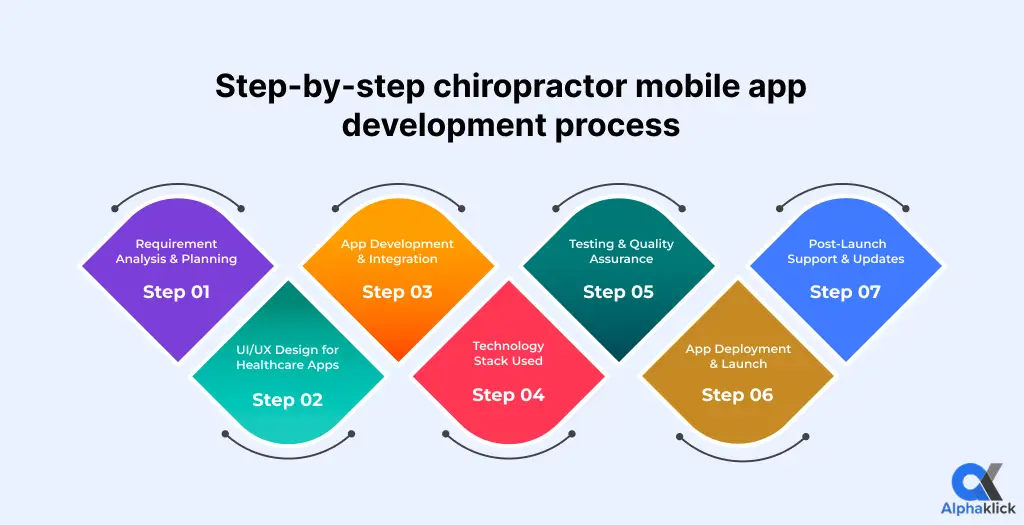
When clinic owners ask me how we build chiropractor mobile app solutions, I always explain that the success of the app depends far more on process than on code alone.
Over the years, my team and I have refined this structured approach while delivering multiple healthcare app development chiropractor projects for solo practitioners, growing clinics, and multi-location practices.
Our focus is always the same: build a system that fits naturally into your clinic’s daily workflow, supports compliance, and is easy for both staff and patients to adopt.
1. Requirement Analysis & Planning
This phase sets the direction for the entire project. We take the time to understand how your clinic operates today and where you want it to go.
During planning, we:
- Review appointment handling, follow-ups, and cancellations
- Analyze patient intake, documentation, and treatment workflows
- Identify EMR, billing, and third-party integration needs
- Define security and compliance requirements for a HIPAA-compliant chiropractor app
- Prioritize features and outline a phased rollout plan
Clear planning at this stage helps control timelines, budgets, and future scalability.
2. UI/UX Design for Healthcare Apps
Once requirements are locked, my design team focuses on usability. Chiropractic mobile apps must be simple enough for patients of all age groups while remaining efficient for practitioners.
Design work focuses on:
- Clear and simple onboarding flows
- Intuitive appointment booking and rescheduling
- Easy access to care plans, reports, and history
- Clean dashboards for practitioners and staff
This step is especially important for patient-facing tools like a patient portal app chiropractors, where ease of use directly impacts engagement and retention.
3. App Development & Integration
With designs approved, development begins using proven chiropractic software development practices.
Key development activities include:
- Building secure appointment and calendar modules
- Integrating online payments, invoices, and packages
- Developing EMR workflows and digital treatment records
- Implementing notifications, reminders, and alerts
- Connecting required third-party systems and APIs
Each feature is developed with performance, security, and long-term maintenance in mind.
If you’re still researching development partners, this list of the top 10+ mobile app development companies in India can help you compare experience, capabilities, and service offerings.
4. Technology Stack Used
Choosing the right technology stack plays a major role in the success of any chiropractor mobile app development project. From my experience, the stack must be secure, scalable, and easy to maintain, especially when the app handles sensitive patient and treatment data.
We rely on proven technologies that work well in healthcare environments:
- Frontend: Flutter or React Native to create smooth, cross-platform apps for both Android and iOS with a consistent user experience
- Backend: Node.js or Laravel to power secure APIs, appointment scheduling, and system integrations
- Database: PostgreSQL for structured medical records and MongoDB for flexible patient data
- Cloud: AWS or Firebase for reliable hosting, automated backups, and performance scalability
- Security & Compliance: HIPAA-aligned encryption, role-based access control, and audit logging
- AI & Analytics: AI-driven posture analysis, smart appointment reminders, and patient engagement insights
This technology stack allows us to build everything from a simple patient portal app chiropractor to a full-featured clinic management platform, while keeping performance, security, and future growth in mind.
Clinics planning AI-powered diagnostics, posture analysis, or predictive insights may also find this guide useful on how AI is taking over healthcare mobile apps and transforming patient care delivery.
5. Testing & Quality Assurance
Before launch, we rigorously test the app to ensure it performs well in real-world clinic environments.
Our testing process includes:
- Functional testing across devices and OS versions
- Performance and load testing for peak usage
- Security audits and vulnerability assessments
- Compliance checks to meet healthcare standards
This reduces the risk of issues after launch and protects sensitive patient data.
6. App Deployment & Launch
We manage the complete deployment process so your clinic team doesn’t have to deal with technical complexities.
Deployment includes:
- App Store and Play Store submissions
- Environment configuration and final checks
- Clinic staff onboarding and walkthroughs
- Early-stage monitoring post-launch
7. Post-Launch Support & Updates
After launch, ongoing support ensures the app continues to perform and improve over time.
Post-launch activities include:
- Monitoring performance and fixing issues
- Enhancing features based on patient and staff feedback
- Applying security patches and compliance updates
- Gradually rolling out new features as the clinic grows
This ongoing support helps your app stay relevant, secure, and valuable long after launch.
Clinics often look for partners experienced in connected healthcare systems, which is why exploring AI and IoT healthcare app developers in India can be a smart starting point.
Benefits of chiropractor mobile app development for clinics
From my personal involvement in multiple clinic tech rollouts, I’ve learned that the real impact of chiropractor app development isn’t technical; it’s operational. The right mobile app simplifies daily workflows, reduces dependency on manual processes, and allows chiropractors to focus more on patient care than administration.
Some of the most noticeable benefits clinics experience include:
- Reduced Administrative Workload: Automated scheduling, digital intake forms, and AI-assisted reminders significantly cut down front-desk tasks and repetitive follow-ups.
- Stronger Patient Loyalty & Engagement: With easy access to records, care plans, and follow-ups through a patient portal app, chiropractors, patients feel more connected and involved in their recovery.
- Higher Appointment Adherence: Smart notifications, rescheduling options, and AI-based reminder systems help minimize no-shows and last-minute cancellations.
- Improved Data Accuracy & Compliance: Digital records and secure access ensure consistent documentation while supporting a fully HIPAA-compliant chiropractor mobile app environment.
- Scalable Operations for Growing Clinics: Whether adding new practitioners or expanding to multiple locations, a centralized app supports growth without increasing operational complexity.
A thoughtfully built mobile solution doesn’t just improve efficiency; it delivers the frictionless, on-demand experience that chiropractic patients expect in 2026 and beyond.
Why partner with AlphaKlick for chiropractor mobile app development
I’ve personally worked on healthcare mobile app projects where success came from understanding clinic workflows, not just writing code. Chiropractic mobile apps need compliance, usability, and scalability built in from day one.
At AlphaKlick, my team:
- Understands healthcare compliance and data security
- Builds scalable, future-ready platforms
- Prioritizes patient experience and clinic efficiency
- Delivers transparent pricing and clear timelines
As a reliable mobile app development company in India, we help clinics develop patient app chiropractic solutions and modernize operations without unnecessary complexity.
Book a free consultation, and let’s discuss how we can build the right chiropractor mobile app for your clinic.
FAQs on chiropractor mobile app development
Question: Is a chiropractor’s mobile app suitable for small clinics and solo practices?
Answer: Yes. Even small or solo chiropractic clinics benefit from chiropractor app development. A mobile app helps automate appointment scheduling, reduce administrative workload, and improve patient engagement, without the need to hire additional staff.
Question: How long does chiropractor mobile app development usually take?
Answer: Chiropractor mobile app development typically takes 8 to 16 weeks, depending on the complexity of features, third-party integrations, and compliance requirements. Basic apps can be launched faster, while advanced solutions with EMR or AI features take more time.
Question: Is HIPAA compliance mandatory for chiropractor mobile apps?
Answer: Absolutely. Any app that handles patient health data must be a HIPAA-compliant chiropractor app. This includes secure data storage, encrypted communication, role-based access controls, and detailed audit logs.
Question: Can telehealth features be added later to a chiropractor’s mobile app?
Answer: Yes. Many clinics start with core features and later add a telehealth app for chiropractors functionality, such as virtual consultations, follow-ups, and remote care, allowing them to scale gradually and control costs.