Key highlights: AI workflow automation is transforming how businesses operate by turning repetitive processes into smart, self-managed workflows. It reduces manual effort, speeds up decision-making, and brings more accuracy to everyday operations. As businesses grow, it becomes a powerful way to stay efficient, agile, and ahead of the competition.
Businesses today are expected to move faster, operate smarter, and scale without increasing complexity. This is where AI workflow automation is changing the way companies run their operations.
By automating repetitive tasks and enabling intelligent decision-making, organizations can streamline processes and unlock powerful AI workflow automation benefits like efficiency, accuracy, and cost savings.
The adoption of automation is accelerating quickly. According to Grand View Research, the global AI automation market was valued at USD 129.92 billion in 2025 and is expected to reach USD 1,144.83 billion by 2033, growing at a 31.4% CAGR.
In this guide, we’ll explore how AI workflow automation works, its key benefits, and why businesses are rapidly adopting it.
What is AI workflow automation?
AI workflow automation is the combination of artificial intelligence and workflow management that helps businesses automate complex processes with minimal human effort. Instead of relying only on fixed rules, AI systems analyze data, recognize patterns, and make intelligent decisions to keep operations running smoothly.
At its core, AI-powered workflows use technologies like machine learning, data analytics, and automation platforms to automatically handle tasks such as approvals, data processing, and operational activities.
Key components of AI workflow orchestration include:
- Data collection and analysis
- Intelligent decision-making algorithms
- Automated task execution
- Continuous optimization through machine learning
With advanced systems, companies can build AI agentic workflows, where AI agents manage tasks, coordinate processes, and improve outcomes independently.
This is why many organizations are adopting AI business process automation to run smarter, faster, and more efficiently.
Also, a custom AI agent can take workflow automation further by reasoning through tasks, using connected tools, and taking actions with minimal human input.
Traditional workflow automation vs. AI workflow automation
Traditional automation follows predefined rules, while AI-powered automation can learn from data and adapt over time.
| Feature | Traditional automation | AI workflow automation |
| Decision making | Rule-based logic | AI-driven insights and predictions |
| Flexibility | Limited adaptability | Highly adaptive and intelligent |
| Data processing | Structured data only | Structured and unstructured data |
| Learning ability | No learning capability | Continuous improvement |
The difference becomes clearer when comparing AI agents vs AI assistants: assistants typically respond to requests, while agents can execute multiple steps toward a defined outcome.
My perspective on AI workflow automation
As a founder, I rely on automation workflows daily to keep operations running efficiently. Tasks like lead routing, follow-ups, and internal coordination are automated, which reduces delays and ensures consistency.
From my experience, automation isn’t just about saving time; it brings structure, accuracy, and scalability to business operations. It’s one of the key systems that helps a growing business stay organized and move faster.
Founder of AlphaKlick
Common business processes that can be automated with AI
AI workflow automation can improve efficiency across multiple departments by reducing repetitive manual work.
| Business process | AI automation example |
| Customer support | AI chatbots and automated ticket routing |
| HR recruitment | Resume screening and candidate ranking |
| Finance | Invoice processing and fraud detection |
| Sales | Lead scoring and CRM updates |
| Marketing | Campaign automation and personalization |
These practical AI workflow automation examples show how businesses are using AI business process automation to streamline operations, improve productivity, and scale workflows more effectively.
Key technologies behind AI workflow automation
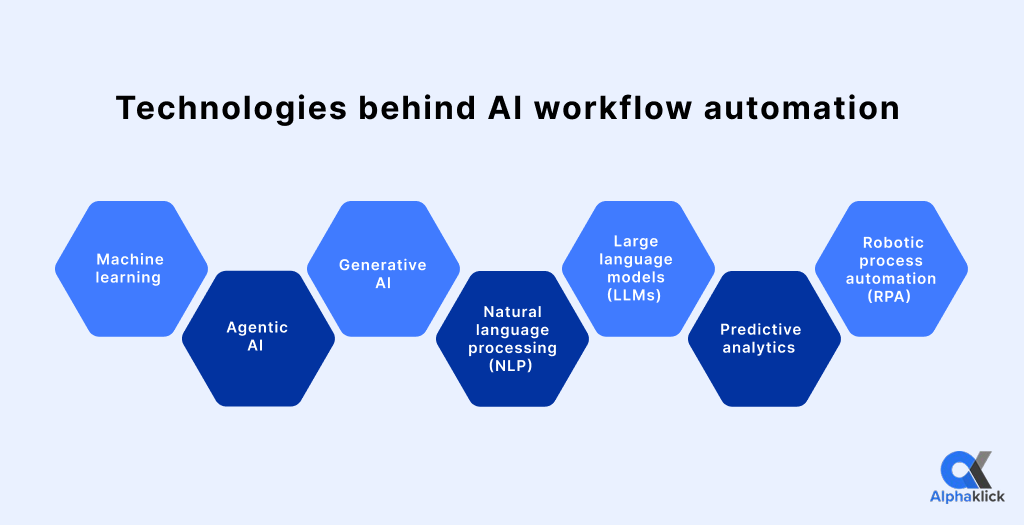
AI workflow automation is powered by several advanced technologies that help businesses automate processes, analyze data, and improve decision-making. These technologies work together to create intelligent workflows that adapt and optimize operations over time.
1. Machine learning
Machine learning enables systems to analyze large datasets, identify patterns, and make predictions. In AI workflow automation, it helps automate decisions like lead scoring, fraud detection, and demand forecasting while continuously improving performance.
2. Generative AI
Generative AI focuses on creating new content such as text, reports, summaries, or automated responses. In workflow automation, generative AI can generate emails, customer replies, workflow documentation, and data summaries automatically.
This helps teams save time and improve productivity in content-heavy processes.
3. Agentic AI
Agentic AI refers to AI systems that can independently plan, make decisions, and execute tasks with minimal human input.
In modern automation environments, agentic AI can manage workflows, coordinate tasks between systems, and optimize operations automatically, forming the foundation of AI agentic workflows.
4. Large language models (LLMs)
Large language models allow AI systems to understand, generate, and process human language. They power chatbots, automated emails, document analysis, and knowledge assistants.
LLMs are becoming essential for AI business process automation because they can handle complex communication-based workflows.
5. Natural language processing (NLP)
NLP allows AI systems to understand and interpret human language. It is widely used for customer support automation, sentiment analysis, and document processing in automated workflows.
6. Robotic process automation (RPA)
RPA automates repetitive digital tasks such as data entry, invoice processing, and report generation. When combined with AI, it becomes more intelligent and capable of handling complex operational workflows.
7. Predictive analytics
Predictive analytics uses historical data to forecast outcomes and support better decision-making within automated workflows.
Modern automation also relies on MLOPs AI workflow automation, and AI workflow orchestration, which connect AI models, automation tools, and systems together.
These technologies enable businesses to build advanced AI agentic workflows that manage operations autonomously.
Modern automation systems are increasingly powered by intelligent AI agents capable of managing tasks independently. To understand this evolution, read our guide on Generative AI vs Agentic AI and why it matters.
Real-world AI workflow automation examples
Businesses across many industries are adopting AI workflow automation to streamline operations, reduce manual work, and improve efficiency. By automating repetitive processes and enabling smarter decisions, organizations can manage complex workflows more effectively.
1. Healthcare automation
In the healthcare industry, hospitals and clinics use AI systems for patient scheduling, medical record processing, and appointment reminders.
These solutions show strong AI workflow automation scalability, helping healthcare providers manage large patient volumes while improving service efficiency.
Additionally, developing HIPAA-compliant AI-powered healthcare apps ensures secure handling of patient data through encryption and compliant infrastructure, enabling safer, more efficient, and personalized healthcare services.
2. Finance automation
In the finance sector, AI-powered systems are widely used for fraud detection, compliance monitoring, and risk assessment.
These solutions deliver major AI workflow automation cost savings by reducing manual reviews and identifying suspicious transactions faster.
3. Retail and ecommerce automation
The retail and eCommerce industry uses AI to automate inventory management, order processing, and personalized marketing campaigns. These are common AI workflow automation examples that help businesses handle large sales volumes while improving customer experiences.
4. Education automation
Institutions use AI to automate student enrollment, course recommendations, grading systems, and learning analytics. These systems support AI workflow automation 2026 trends by helping universities and online learning platforms deliver more personalized and scalable learning experiences.
AI can also automate educational institutions by streamlining administrative tasks, optimizing resource allocation, and enhancing student engagement through intelligent insights.
5. Logistics and supply chain automation
In the logistics industry, AI helps optimize delivery routes, forecast demand, and schedule shipments efficiently. These solutions demonstrate the power of AI business process automation in improving supply chain performance and reducing operational delays.
Similar AI innovations are also driving improvements in mobile platforms, which you can explore in how AI benefits mobile apps in various industries.
Benefits of AI workflow automation for businesses
Businesses are increasingly investing in AI workflow automation because it helps improve efficiency, reduce operational costs, and enhance decision-making.
By automating repetitive tasks and optimizing workflows, organizations can streamline operations and focus on higher-value activities.
1. Increased operational efficiency
AI systems automate routine tasks such as data entry, approvals, reporting, and workflow management. These ai automation workflow benefits allow teams to focus on strategic work while improving productivity and reducing manual effort.
2. Cost reduction
One of the key advantages of automation is ai workflow automation cost savings. Automated processes reduce labor costs, minimize human errors, and improve operational efficiency across departments.
3. Improved decision-making
AI-powered systems analyze large volumes of data and generate insights quickly. This helps businesses make faster and more accurate decisions based on real-time information.
4. Greater scalability
With AI workflow automation scalability, organizations can manage increasing workloads without adding extra staff or resources, making it easier to grow and expand operations.
5. Better customer experience
Automation improves response times, service quality, and personalization. As a result, businesses can deliver faster support and create better customer experiences.
These advantages clearly explain why to use AI workflow automation across industries such as healthcare, education, finance, retail, logistics, and technology.
Best AI workflow automation tools in 2026
Choosing the right AI workflow automation tools helps businesses automate processes, integrate apps, and scale operations efficiently.
Below are some of the best AI workflow automation software solutions used in AI workflow automation 2026.
| Tool | Key Features | Best For |
| Zapier | No-code platform to automate workflows between apps | Small and medium businesses |
| n8n | Open-source automation platform with high customization | Developers and advanced workflows |
| UiPath | Enterprise RPA platform with AI capabilities | Large organizations |
| Microsoft Power Automate | Automation integrated with the Microsoft ecosystem | Businesses using Microsoft tools |
| Make (Integromat) | Visual drag-and-drop workflow automation builder | Managing complex integrations |
Steps to implement AI workflow automation in your organization
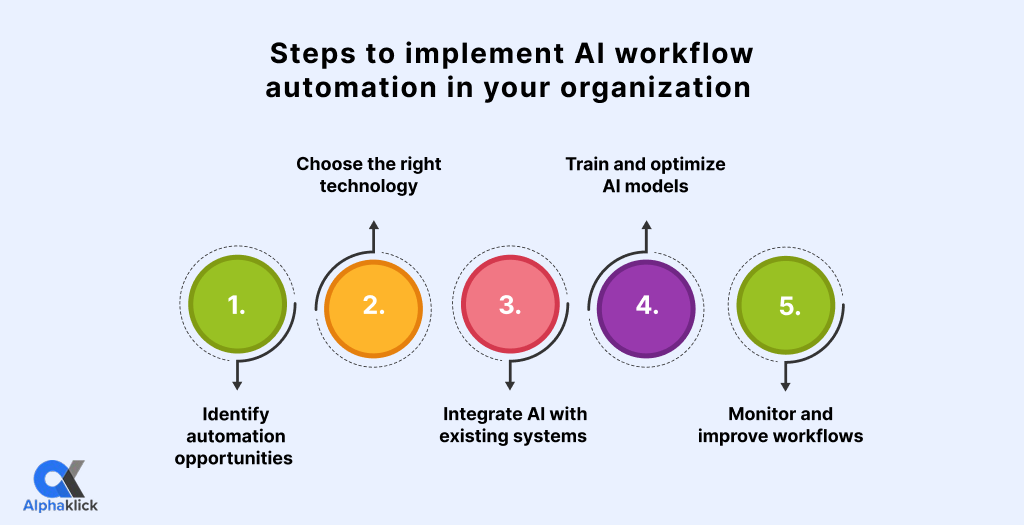
Implementing AI workflow automation requires a structured approach to ensure smooth adoption and long-term success.
Businesses should focus on identifying the right processes, selecting suitable tools, and continuously improving automated workflows.
Step 1: Identify automation opportunities
Start by analyzing repetitive and time-consuming tasks such as data entry, approvals, customer responses, and reporting. Automating these processes helps organizations quickly realize the AI workflow automation benefits.
Step 2: Choose the right technology
Selecting the right AI workflow automation tools is essential. Businesses should choose platforms that support automation, data analysis, and integration with existing systems.
Step 3: Integrate AI with existing systems
Automation solutions should connect with CRM, ERP, and other operational tools. Strong AI workflow orchestration ensures smooth communication between systems and workflows.
Step 4: Train and optimize AI models
Organizations using MLOPs AI workflow automation continuously train and improve AI models using real data to enhance accuracy and performance.
Step 5: Monitor and improve workflows
Automation systems should be monitored regularly to identify improvements and ensure AI workflow automation scalability as business operations grow.
Conclusion
AI is redefining how businesses operate. With AI workflow automation, companies can streamline processes, reduce manual work, and unlock greater efficiency across their operations. From improving productivity to achieving AI workflow automation cost savings and AI workflow automation scalability, intelligent automation is becoming a core part of modern business strategy.
As we move into the era of AI workflow automation in 2026, organizations that adopt smarter workflows and AI business process automation will gain a strong competitive advantage.
If you’re ready to automate and scale your operations, Alphaklick can help you design and implement custom AI workflow automation solutions tailored to your business.
Book a free consultation with Alphaklick and start building smarter workflows for your business.
FAQs
Q1: What is AI ?
Answer: AI workflow automation refers to using artificial intelligence to automate business processes, decision-making, and repetitive tasks. It combines technologies like machine learning, data analytics, and automation platforms to streamline workflows and improve operational efficiency.
Q2: What is the best AI workflow automation tool?
Answer: Some of the best AI workflow automation tools include Zapier, n8n, UiPath, Microsoft Power Automate, and Make (Integromat). The best tool depends on your business needs, integration requirements, and the complexity of workflows you want to automate.
Q3: What is an example of workflow automation?
Answer: A common AI workflow automation example is automatically routing customer support tickets. When a customer submits a request, AI can categorize the issue, assign it to the right support team, and send an automated response without manual intervention.
Q4: Is AI workflow automation expensive?
Answer: The cost of AI automation varies depending on the tools and complexity of the workflow. However, businesses often achieve significant AI workflow automation cost savings over time by reducing manual work, improving productivity, and minimizing operational errors.