Over the years, I’ve worked with many healthcare founders who want to build smarter digital health products. The demand for AI-powered healthcare apps is growing rapidly as hospitals and clinics adopt technology to improve patient care.
But healthcare mobile apps are very different from regular apps. When patient data is involved, security and privacy become critical. According to Statista, the number of healthcare data breaches affecting 500 or more individuals in the U.S. has increased significantly between 2009 and 2025, highlighting the need for stronger protection.
That’s why HIPAA-compliant mobile app development is essential for any healthcare platform handling sensitive medical information.
At Alphaklick, we help healthcare startups build secure digital solutions. As an AI-based healthcare app development company, our focus is on building scalable and compliant healthcare platforms.
This guide explains how to build secure AI-powered healthcare apps in 2026 while meeting compliance and data protection standards.
What is a HIPAA-compliant healthcare app?
A HIPAA-compliant healthcare app is a mobile or web application built to securely store, process, and share patient health information while following healthcare privacy regulations.
Many modern HIPAA-compliant AI healthcare apps handle sensitive medical records, which means developers must follow strict healthcare data security requirements.
This is why secure healthcare app development is essential. Strong encryption, controlled access, and secure APIs help protect patient information and ensure regulatory compliance.
Key characteristics of HIPAA-compliant apps
| Requirement | Description |
| PHI protection | Secure handling of patient health records |
| Data encryption | Encryption of data during storage and transfer |
| Access controls | Role-based authentication for healthcare staff |
| Audit logs | Activity tracking for compliance monitoring |
| Secure APIs | Safe communication between healthcare systems |
Why HIPAA compliance is important for AI-powered healthcare apps
Healthcare providers are increasingly using digital platforms to improve patient care and automate workflows.
Since these systems process sensitive data, PHI data protection in healthcare apps becomes critical. Healthcare platforms must follow strict healthcare app compliance standards to protect patient information.
Secure EHR integration in healthcare apps also ensures safe data exchange between healthcare systems.
Key reasons HIPAA compliance matters
- Protects sensitive patient health data
- Ensures legal compliance with healthcare regulations
- Builds trust among patients and healthcare providers
- Prevents costly security breaches and legal penalties
- Supports secure integration with healthcare record systems
How AI supports HIPAA compliance in healthcare apps
Artificial intelligence is helping healthcare platforms manage security and compliance more efficiently. AI systems can monitor data access, detect unusual activity, and identify potential security risks in real time.
Many healthcare platforms also use AI to support PHI data protection in healthcare apps by analyzing how patient data is stored, accessed, and shared across systems. This helps reduce human errors and improve data security.
By using AI alongside strong security practices, healthcare organizations can maintain strict healthcare app compliance standards while safely managing large volumes of patient information.
Key HIPAA rules developers must understand before building a healthcare app
Before building a healthcare application, developers must understand the key HIPAA regulations that protect patient health information. These rules ensure that healthcare apps handle medical data securely and responsibly.
For teams developing AI-powered healthcare apps, following these regulations is essential from the start.
1. Privacy rule: Protects patient health information and limits who can access or share medical data.
2. Security rule: Defines the safeguards needed to protect electronic patient records.
3. Breach notification rule: Requires organizations to report data breaches affecting patient information.
4. Enforcement rule: Explains the penalties for failing to follow HIPAA regulations.
Understanding these rules helps teams focus on secure healthcare app development and build trusted healthcare platforms.
Essential security requirements for HIPAA-compliant healthcare apps
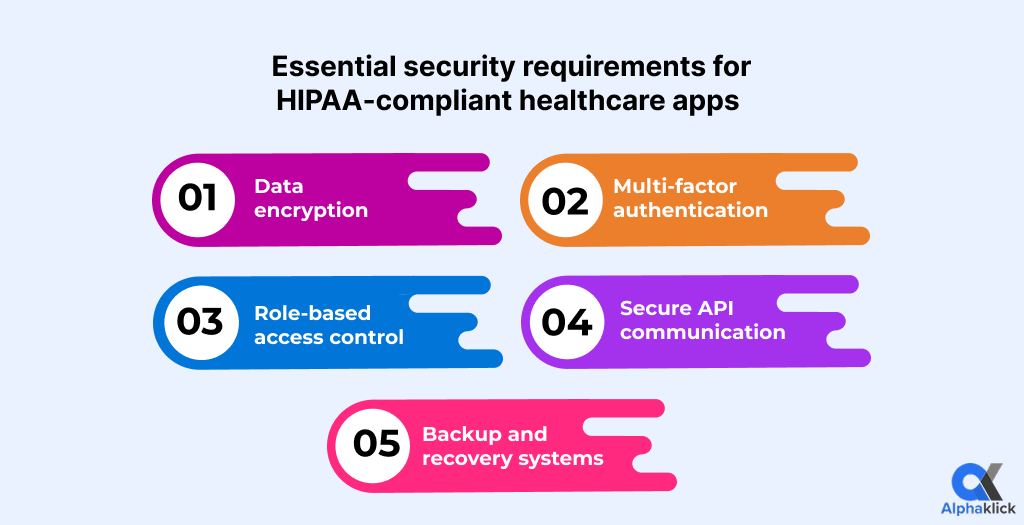
Security is the most important part of HIPAA-compliant mobile app development. Healthcare apps handle sensitive medical information, so patient data must remain protected at every stage.
To meet strict healthcare data security requirements, developers need to implement strong security measures during the development process.
Core security measures
1. Data encryption: Sensitive patient information should be encrypted both during storage and data transfer.
2. Multi-factor authentication: Additional authentication layers help ensure that only authorized users can access healthcare systems.
3. Role-based access control: Access to patient data should be limited to authorized healthcare staff based on their roles.
4. Secure API communication: All system integrations must use encrypted APIs to safely exchange medical data.
5. Backup and recovery systems: Regular secure backups help prevent data loss and maintain system reliability.
Another critical aspect is PHI data protection in healthcare apps. Any data related to patient identity, diagnosis, or treatment must be handled securely.
Since many modern AI-powered healthcare apps use cloud infrastructure, developers must also ensure that cloud services follow strict healthcare app compliance standards.
Step-by-step process to develop a HIPAA-compliant AI healthcare app
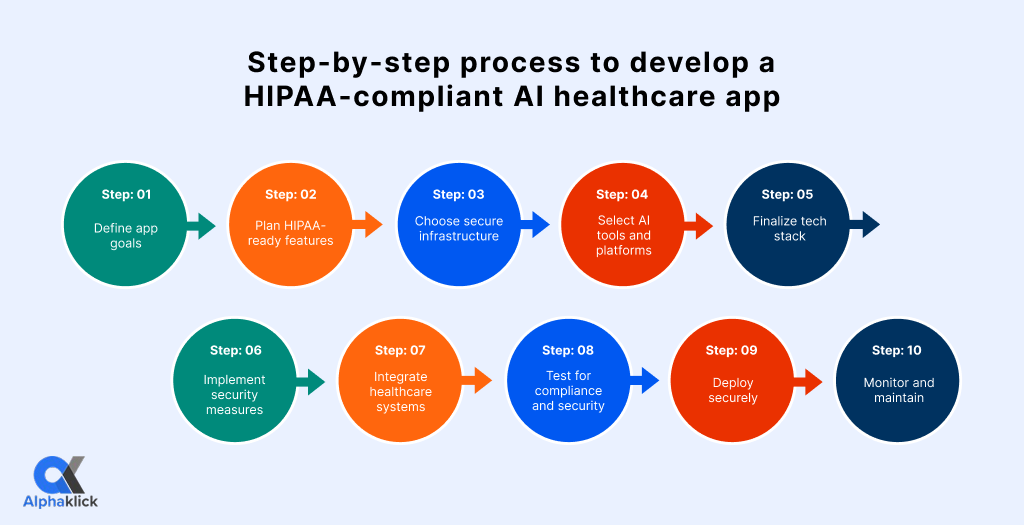
Developing healthcare software is very different from building a typical mobile app. Since these applications handle sensitive patient data, security and compliance must be prioritized from the start. For teams planning HIPAA-compliant mobile app development, every stage should focus on protecting patient information and meeting healthcare regulations.
Below is a practical process many healthcare startups follow when building AI-powered healthcare apps.
Step 1: Define the healthcare use case and compliance scope
The first step is clearly defining the purpose of the application. Developers and stakeholders must understand how the app will be used and who the primary users will be: patients, doctors, clinics, or healthcare administrators.
This stage also includes identifying how patient data will be collected, stored, and shared. Defining these workflows early helps ensure the product meets regulatory standards and aligns with healthcare compliance requirements.
Step 2: Plan the essential HIPAA-compliant app features
Before development begins, teams should outline the security-focused features required for healthcare applications.
Key features of a HIPAA-compliant healthcare app
- End-to-end encryption to protect patient data during storage and transmission
- Secure authentication and multi-factor login to prevent unauthorized access
- Role-based access control to manage permissions for doctors, nurses, and administrators
- Secure medical record storage for patient history and clinical data
- Activity audit logs to track user actions and system access
- Data backup and recovery systems to prevent data loss
- Secure communication channels for patient and doctor interactions
- AI-powered health insights and automation tools
These features help ensure the application meets strict healthcare data security requirements and protects sensitive patient information.
Step 3: Choose a secure healthcare infrastructure
Healthcare apps require a reliable infrastructure that supports compliance and data protection.
Developers typically choose HIPAA-compliant cloud services that offer encryption, identity management, monitoring tools, and secure data storage. A secure infrastructure is the backbone of secure healthcare app development, helping healthcare organizations protect patient records and maintain system reliability.
Step 4: Select HIPAA-compliant AI tools and platforms
Artificial intelligence plays a major role in modern healthcare solutions. When developing intelligent healthcare platforms, choosing the right AI tools and technologies is essential.
List of top HIPAA-compliant AI tools & platforms:
| Tool / Platform | Purpose |
| AWS HealthLake | Secure storage and analysis of healthcare data |
| Google Cloud Healthcare API | Healthcare data interoperability |
| Azure Health Data Services | HIPAA-compliant cloud infrastructure |
| TensorFlow | AI and machine learning model development |
| PyTorch | Advanced machine learning frameworks |
| FHIR APIs | Standardized healthcare data exchange |
| NLP tools | Medical documentation and data processing |
These technologies help developers build scalable AI-powered healthcare apps while maintaining healthcare compliance.
Artificial intelligence is transforming healthcare rapidly. Learn more in our guide How AI is Taking Over Healthcare Mobile Apps.
Step 5: Design the healthcare app architecture and tech stack
Choosing the right technology stack is important for building scalable healthcare platforms.
Typical AI-based healthcare app tech stack are as follows:
| Layer | Technology |
| Frontend | React Native, Flutter |
| Backend | Node.js, Python, Django |
| Database | PostgreSQL, MongoDB |
| Cloud | AWS, Azure, Google Cloud |
| AI frameworks | TensorFlow, PyTorch |
| Security | AES-256 encryption |
| Authentication | OAuth 2.0, Multi-factor authentication |
| APIs | REST APIs, FHIR APIs |
A well-designed architecture ensures better performance, scalability, and long-term maintainability.
Step 6: Implement security and compliance safeguards
Security must be integrated into every part of the healthcare application. Developers must implement strong encryption, authentication systems, access control mechanisms, and monitoring tools.
These safeguards help ensure PHI data protection in healthcare apps and prevent unauthorized access to patient records.
Step 7: Integrate healthcare systems and medical records
Many healthcare platforms need to connect with hospital systems and digital medical records.
Secure EHR integration in healthcare apps allows doctors and healthcare providers to access patient information safely. This integration improves workflow efficiency and ensures better data sharing between healthcare systems.
Step 8: Conduct security testing and compliance audits
Before launching the application, developers must perform extensive testing.
Security audits, penetration testing, and compliance checks ensure the platform follows healthcare app compliance standards and protects patient information from potential vulnerabilities.
Step 9: Deploy the healthcare application securely
Once testing is completed, the healthcare application can be deployed on a secure cloud infrastructure.
During deployment, developers must configure monitoring systems, data protection settings, and compliance policies to ensure the platform operates safely.
Step 10: Monitor, update, and maintain the platform
Healthcare applications require continuous monitoring after launch. Regular security updates, system monitoring, and compliance reviews help maintain long-term security and performance.
Following this structured process allows organizations to successfully build secure and scalable AI-powered healthcare apps while protecting patient data and maintaining regulatory compliance.
You can also explore our list of the Best Healthcare Mobile App Developers in India 2026 to understand the top companies building modern healthcare apps.
Cost to develop a HIPAA-compliant AI healthcare app in 2026
The cost of building a healthcare application depends on the app’s features, AI functionality, and compliance requirements. Since healthcare platforms manage sensitive medical data, extra investment is required for security, infrastructure, and regulatory compliance.
For startups planning HIPAA-compliant mobile app development, budgeting for compliance and security is essential.
| App complexity | Estimated cost |
| Basic healthcare app | $40,000 – $70,000 |
| AI-powered healthcare platform | $70,000 – $150,000 |
| Enterprise healthcare solution | $150,000 – $300,000+ |
Costs usually include AI model development, compliance implementation, secure infrastructure setup, EHR integration in healthcare apps, and testing.
Startups planning healthcare mobile app development in 2026 should allocate sufficient budget for security and compliance.
For a broader cost breakdown of AI applications, you can explore our guide on AI Mobile App Development Cost in 2026.
How Alphaklick helps build HIPAA-compliant AI-powered healthcare apps
Building healthcare software requires more than just development skills. It requires a deep understanding of security, compliance, and healthcare workflows. At Alphaklick, we work closely with startups and healthcare organizations to build secure and scalable AI-powered healthcare apps.
As an experienced AI-based mobile app development company, our team helps turn healthcare ideas into compliant digital platforms, from planning and architecture to secure deployment.
Our expertise includes HIPAA-compliant mobile app development, AI-powered healthcare automation, secure cloud infrastructure, and healthcare system integrations.
If you’re planning to build a healthcare product or exploring a new digital health idea, we’d love to help.
Let’s turn your healthcare idea into a secure digital solution. Book a free consultation or reach out to us at info@alphaklick.com, our team is ready to discuss your requirements.
FAQs
Q1. What is the cost to build a HIPAA-compliant healthcare app?
Answer: The cost of developing a healthcare application depends on the features, AI capabilities, and compliance requirements. A basic healthcare app may cost $40,000–$70,000, while advanced AI-powered healthcare apps with integrations and automation features can range between $70,000–$150,000 or more.
Q2. Why is HIPAA compliance important for healthcare businesses?
Answer: HIPAA compliance helps healthcare businesses protect patient data and follow legal privacy regulations. It ensures sensitive medical information is handled securely, reduces the risk of data breaches, and builds trust between patients, hospitals, and digital health platforms.
Q3. How to build a HIPAA-compliant healthcare app?
Answer: To build a HIPAA-compliant healthcare app, developers must implement strong security practices such as encryption, secure authentication, role-based access control, and secure data storage. It also requires proper infrastructure, compliance testing, and secure integration with healthcare systems.
Q4. What is required to be HIPAA compliant?
Answer: To meet HIPAA requirements, healthcare applications must protect Protected Health Information (PHI) using encryption, access control, audit logs, and secure data storage. Organizations must also follow privacy policies, conduct security assessments, and ensure healthcare systems meet regulatory standards.