
Most founders, creators, and EdTech startups who reach out to me want one thing upfront: a clear idea of the cost to build a learning mobile app like Coursera, which typically ranges from $20,000 to $250,000+.
And the demand is massive: According to the Grand View Research, the global e-learning market is projected to cross $430 billion by 2026, with mobile learning becoming the fastest-growing segment.
I have worked with many EdTech teams over the years, and the biggest realization is this: people often underestimate the planning, backend architecture, and video infrastructure required to build a truly world-class learning platform.
I am Abhishek Bhatnagar, with 18+ years of experience in mobile app development, and through my journey, I have helped many EdTech founders understand the real cost to build a learning mobile app like Coursera, plan their MVP properly, and avoid overspending in the initial phases.
As the founder of a mobile app development company, I have guided dozens of teams through feature planning, LMS backend decisions, and video streaming setups.
This guide gives you a clear e-learning mobile app cost breakdown, based on real 2026 market rates and my own hands-on experience.
Total Estimated Cost to Build a Coursera-Like App
Here’s a quick snapshot of the e-learning mobile app cost breakdown along with the development timeline for each version:
| App Type | Cost Range | Development Time |
| MVP Learning App | $20,000 – $40,000 | 3–4 months |
| Mid-Level Coursera Clone | $50,000 – $95,000 | 4–6 months |
| Enterprise Coursera Clone | $120,000 – $250,000+ | 6–8 months |
I usually recommend founders start with an MVP, validate user interest, and then scale into mid-level or enterprise features based on real demand. It keeps the budget in control and ensures you build what learners actually want.
For a broader understanding of the EdTech landscape, explore our e-learning mobile app development guide 2025 covering costs, features, and top companies.
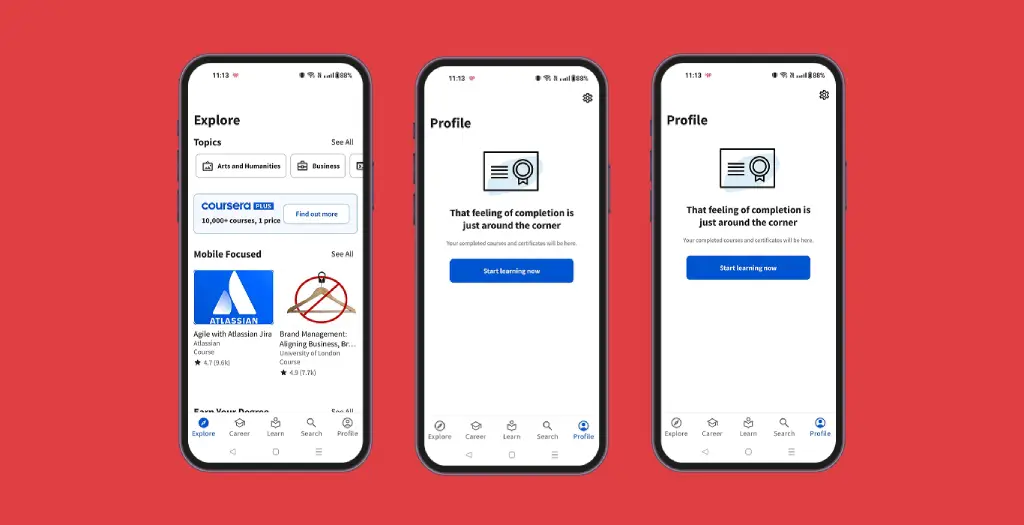
Cost Breakdown by Mobile App Complexity
Here’s a practical breakdown you can rely on:
A. Basic Learning App (MVP Version)
Cost: $20,000 – $40,00
This version focuses only on the essential student journey, log in, watch content, take simple quizzes, and receive certificates. It’s the fastest and most budget-friendly way to enter the market.
Typical MVP includes:
- Student login & onboarding
- Course list with categories
- Basic video playback (no adaptive streaming)
- Simple quizzes & assessments
- Basic certificate generation
- Simple admin panel to upload/manage content
This level keeps your online course mobile app development pricing low and helps you enter the market faster.
This is the typical edtech MVP development cost in India, which gives you a solid foundation to test user engagement and collect early feedback.
Ideal for: Creators, coaches, small academies, and startups validating market demand.
B. Mid-Level Coursera-Like App
Cost: $50,000 – $95,000
Once the MVP works, most founders expand into a more complete platform. This version adds instructor capabilities, better video quality, payments, and engagement features.
What’s added at this stage:
- Multi-instructor system (each teacher has their own dashboard)
- HD video streaming with adaptive bitrate
- Assignments, grading, and progress tracking
- Push notifications & reminders
- Integrated payment gateway for subscriptions
- Course recommendations powered by basic algorithms
This is usually the stage where your e-learning mobile app cost breakdown begins to increase but the platform becomes truly scalable.
Ideal for: Growing EdTech startups, institutes with multiple educators, and platforms planning subscription revenue.
C. Advanced Coursera Clone with AI Features
Cost: $120,000 – $250,000+
This is where the mobile app becomes truly competitive with platforms like Coursera. It includes AI-driven learning paths, community features, advanced analytics, and enterprise-grade LMS capabilities.
Included in this tier:
- AI-based personalized learning paths
(adaptive courses based on behavior) - Discussion forums, chat rooms & community spaces
- Offline downloads for learning without internet
- Gamification & badges to increase retention
- Real-time analytics for instructors and admins
- Advanced LMS modules
(roles, permissions, bulk uploads, automation) - Enterprise features
SSO, team onboarding, corporate dashboards, API access
These features significantly increase the Coursera clone mobile app development cost, but they are essential for platforms that want to scale globally or work with enterprises and universities.
Ideal for: VC-funded startups, universities, large EdTech companies, and enterprise training solutions.
For a wider comparison beyond EdTech, you can also read our full breakdown of mobile app development cost in 2026.
Cost Breakdown by Platform (iOS, Android, Web)
This is one of the most common questions I get from founders:
“Should we build for iOS first, Android first, or launch on both?”
My honest advice is simple, build where your audience actually spends time.
For example, if you’re targeting India or Southeast Asia, Android dominates. If you’re targeting the US or Europe, iOS usually brings higher-paying users. And if your learners mostly use laptops, launching a web-based LMS first makes more sense.
Here’s a realistic e-learning mobile app cost breakdown by platform based on projects I’ve personally managed:
| Platform | Estimated Cost |
| Android Only | $20,000 – $60,000 |
| iOS Only | $25,000 – $70,000 |
| Web App LMS | $30,000 – $90,000 |
| Cross-platform (Flutter/React Native) | $35,000 – $80,000 |
Most founders choose cross-platform because it lets you launch on both iOS and Android with one codebase, faster development, and lower total cost.
If you plan to build for Android first, you can explore the top Android mobile app development companies in India to find reliable development partners.
Development Team Structure & Hourly Rates
When founders ask me for an accurate education mobile app development estimate 2026, most are surprised to learn how much the team structure influences the final cost. Building a learning app isn’t just about coding; it requires coordinated efforts across design, development, testing, and video infrastructure.
A Typical EdTech Development Team Includes:
- Project Manager – handles planning, timelines, and communication
- UI/UX Designer – creates the user flows and learning experience
- 2–4 Mobile Developers – build the iOS/Android or cross-platform app
- Backend Developer – manages the LMS architecture and APIs
- QA Engineers – test all features, from videos to quizzes
- DevOps Engineer – sets up servers, video streaming, and scaling
A well-balanced team like this ensures your platform is stable, secure, and ready for real learners, not just a prototype.
Global Hourly Rates You Can Expect in 2026
| Region | Hourly Rate |
| India | $20–$40/hr |
| Eastern Europe | $40–$60/hr |
| USA/UK | $80–$150/hr |
This is why most global startups trust India for edtech MVP development cost India, the quality is high while pricing stays founder-friendly.
However, if your primary audience is in North America, partnering with a trusted mobile app development company in New York, USA can offer advantages like smoother communication, local compliance expertise (FERPA, data privacy), and easier collaboration with investors or institutions.
Backend Development & Admin Dashboard Cost
The backend is the core of any EdTech mobile app. It powers everything users don’t see but rely on, course delivery, video handling, payments, progress tracking, and the overall LMS structure.
In almost every project I have worked on, the backend ends up deciding a major part of the backend for learning management apps cost.
This is where key activities happen:
- Course creation and management
- Instructors uploading and organizing videos
- Students tracking progress and quiz results
- Payments, subscriptions, and renewals
- LMS roles, access levels, and permissions
What Backend Development Typically Covers
- Database setup
- API development
- Video hosting and streaming logic
- Notifications and messaging
- Instructor dashboards
- Payments and billing management
Because these systems are more complex than the front end, backend development can significantly influence your overall LMS mobile app pricing guide.
Backend Cost: $15,000 – $80,000+
Basic MVPs fall on the lower side, while advanced platforms with analytics, AI features, or corporate LMS modules quickly reach the higher range.
Third-Party Integrations & Additional Costs
Many founders underestimate how much third-party tools add to the total development budget.
These integrations directly impact the factors affecting EdTech mobile app cost, especially for apps that rely heavily on video, personalization, or subscriptions.
1. Video Streaming Learning App Cost: Learning apps with video content need secure, fast, and scalable streaming. Services like AWS MediaConvert, Wowza, or Vimeo OTT handle encoding, streaming quality, and bandwidth.
Cost: $200–$2,000/month
(Depends on how many students watch videos and how long they stream.)
2. Gamification in Education Apps Pricing: Badges, points, streaks, and levels make learners stay longer and complete more courses. Adding gamification increases engagement but also development effort.
Add-on Cost: $5,000 – $25,000
This contributes to the overall interactive course mobile app development price.
3. AI Recommendation Engine: AI-driven learning paths give students personalized course suggestions and improve retention. This requires behavioral tracking and machine learning models.
Cost: $10,000 – $40,000
To understand how AI enhances engagement and course completion rates, explore our guide on the impact of AI on personalized learning apps.
4. Payment Gateways & Subscriptions: Integrations like Stripe, PayPal, and Razorpay handle recurring billing, refunds, and renewals. These workflows directly impact the reliability of your subscription model.
Integration Cost: $2,000 – $8,000
These form a core part of your subscription-based learning mobile app cost.
App Maintenance, Updates & Scaling Costs
After launch, every learning mobile app requires ongoing support to stay secure and run smoothly. This is an important part of your long-term online course app development pricing.
Maintenance usually includes:
- Feature enhancements
- Security and technical updates
- Server and performance scaling
- Video storage and bandwidth handling
- Bug fixes and minor improvements
Yearly Cost: Approximately 15–25% of the total development cost
This ongoing investment keeps your EdTech platform stable, secure, and ready to scale as your user base and course content grow.
If your project focuses on step-by-step academic solutions, learn costs to build a learning mobile app like Photomath.
How to Reduce EdTech Mobile App Development Cost
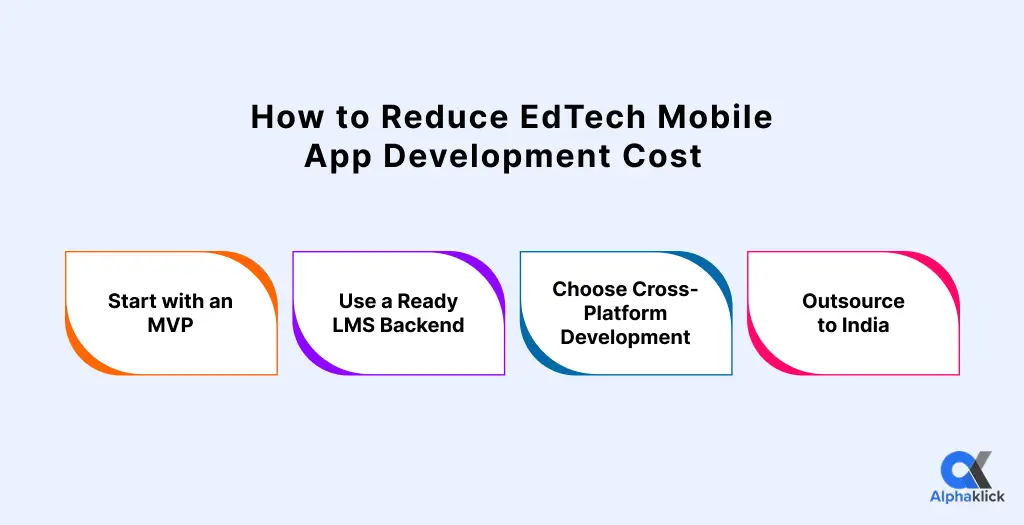
Many founders overspend simply because they tried to build too much too early. With the right approach, you can reduce your overall budget without compromising the quality of your learning app.
Here are the cost-saving strategies I always recommend:
1. Start with an MVP
Launching a full Coursera-style platform on day one is unnecessary.
A lean MVP helps you test real learner behavior, refine your features, and keep the edtech MVP development cost India far more manageable.
2. Use a Ready LMS Backend
Instead of building everything from scratch, course management, roles, permissions, and analytics, you can start with existing LMS frameworks or modular backends.
This reduces engineering time and lowers your education mobile app development estimate for 2026 significantly.
3. Choose Cross-Platform Development
Using Flutter or React Native lets you build for both iOS and Android with one codebase.
This approach can cut your LMS mobile app pricing guide almost in half while still delivering a great user experience.
4. Outsource to India
India remains the most cost-effective location for EdTech development.
You get strong engineering talent, fast delivery, and predictable pricing, making it the best choice for keeping your online course mobile app development pricing under control.
If you’re looking for reliable development partners, check our curated list of the top mobile app development companies in India.
Why Choose Alphaklick for Learning Mobile App Development?
I have worked extensively in the EdTech industry for years, and I’ve seen firsthand what makes a learning app succeed or fail. As a leading mobile app development company, my team at Alphaklick focuses on building platforms that are not just functional but truly future-ready.
At Alphaklick, we create learning apps that are:
- Scalable for thousands of learners
- Video-optimized for smooth streaming
- Secure with strong data protection
- Gamified to boost engagement
- AI-powered for personalized learning
- Budget-friendly for early-stage startups
We’ve helped founders validate their ideas, launch successful MVPs, raise funding, and then scale their platforms globally.
If you need clarity on the Coursera clone app development cost, want guidance on feature planning, or need a realistic education app development estimate 2026, my team and I are ready to support you at every step.
Book a Free Consultation with Alphaklick!
We’ll help you plan the right features, timeline, and a practical e-learning mobile app cost breakdown based on your vision.
FAQs
1. How much does it cost to build a learning app like Coursera in 2026?
Anywhere between $20,000 to $250,000+, depending on features, platforms, and backend complexity.
2. What affects the EdTech development cost the most?
Video streaming setup, backend architecture, AI personalization, and multi-instructor management are major factors affecting edtech app cost.
3. Is subscription-based model expensive to build?
Yes, because billing, renewals, and failed payment handling add to the subscription-based learning app cost.
4. What is the cheapest way to start?
Build a simple MVP to reduce edtech MVP development cost India, then scale based on user feedback.