An AI personal assistant mobile app doesn’t come with a fixed price tag, but in real projects, I’ve seen it land anywhere between $30,000 and $150,000+, depending on how intelligent, voice-enabled, and scalable the assistant needs to be.
This wide range is exactly what confuses founders when they start planning AI personal assistant app cost.
What makes the decision even more interesting is the market momentum. According to Global News Wire, the AI assistant market is projected to reach $83.66 billion by 2030, growing at a rapid 34.13% CAGR. That growth is pushing more teams to invest early, but only if the numbers make sense.
In this guide, I’ll break down the cost to build an AI personal assistant, using real AI mobile app development scenarios my team has worked on, so you can understand where the money actually goes, and where it shouldn’t.
What is an AI personal assistant app?
An AI personal assistant mobile app is a smart mobile application that helps users complete tasks and interact naturally using text or voice. It understands user intent, learns from behavior, and improves responses over time using artificial intelligence.
From my experience, a well-designed assistant feels more like a digital companion than a traditional app. Features such as task management, personalized suggestions, and voice interaction directly influence the AI personal assistant app cost, which is why the cost to build AI personal assistant solutions varies based on intelligence level, customization, and scalability.
In 2026, businesses looking to develop AI assistant mobile app 2026 solutions are focusing more on personalization and context rather than basic automation.
Popular examples of AI assistant mobile apps
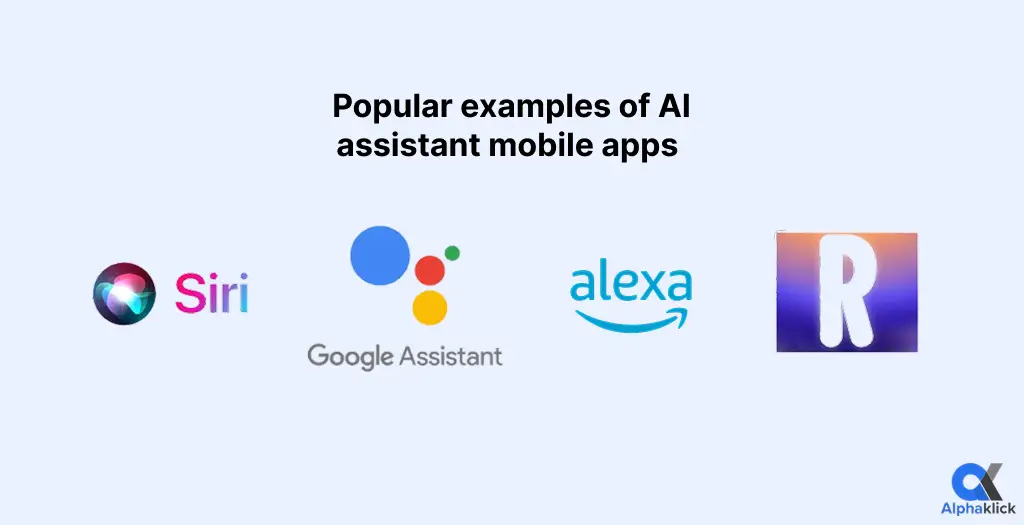
Before estimating AI assistant mobile app development cost, many founders evaluate existing AI assistants to understand feature expectations, user experience standards, and scalability requirements.
| AI assistant app | Primary use case | Key capabilities |
| Siri | Personal productivity | Voice commands, reminders, and device control |
| Google Assistant | Search and automation | Voice search, smart device integration |
| Alexa | Smart home and voice AI | Voice interaction, skills, IoT control |
| Replika | AI companion | Conversational AI, emotional context |
Clients often ask me about build Siri like app cost or Google Assistant clone development, but it’s important to understand that even simplified versions of these assistants require advanced AI architecture.
As a result, custom AI assistant mobile app cost depends heavily on how closely you want to match these benchmarks in intelligence, voice accuracy, and user experience.
Core technologies behind AI assistants
Behind every AI assistant is a technology stack that directly impacts both performance and long-term cost.
In my experience, this layer plays the biggest role in determining how much AI assistant mobile app development will require beyond initial launch.
Core technologies include:
- Natural language processing (NLP) to understand user intent and context
- Machine learning models that improve responses based on usage patterns
- Speech-to-text and text-to-speech engines for voice interaction
- Context and memory systems to store user preferences and history
- Cloud infrastructure and AI APIs to support scalability and performance
Voice-based solutions significantly increase the AI voice assistant development price, especially when real-time accuracy and multilingual support are required.
Similarly, assistants inspired by generative AI models increase ChatGPT personal assistant mobile app cost due to ongoing API usage and computation requirements.
As assistants become more autonomous, understanding Generative AI vs Agentic AI is crucial for choosing the right architecture and predicting long-term development costs.
AI integration tools for building AI personal assistant apps
Using the right AI tools helps teams build AI assistants faster while controlling complexity and cost. These tools provide ready-made intelligence, conversation handling, and on-device AI capabilities.
| Tool name | How it helps build AI assistants |
| OpenAI API | Adds GPT-based conversational intelligence and natural language responses |
| TensorFlow Lite | Runs AI models directly on mobile devices for faster performance |
| Dialogflow | Builds conversational flows for chatbots and voice assistants |
| Hugging Face Transformers | Integrates pretrained AI models for text understanding and customization |
Selecting the right combination of tools allows teams to speed up development, improve assistant accuracy, and optimize long-term AI maintenance costs.
Key features of an AI personal assistant mobile app
1. User profile and personalization engine
This feature stores user preferences, habits, and interaction history to deliver tailored responses. As personalization deepens, the AI personal assistant features cost increases due to data processing and learning models.
2. Voice commands and speech recognition
Voice interaction allows hands-free communication and natural engagement. Implementing accurate voice processing directly affects the AI voice assistant development price.
3. Smart task and reminder management
Enables users to automate reminders, schedules, and alerts. Advanced logic and automation increase the AI assistant mobile app development cost beyond basic task handling.
4. Calendar, email, and app integrations
Allows the assistant to connect with third-party tools for productivity and automation. API management and security considerations add to the cost to build AI personal assistant apps.
5. Conversational chatbot interface
Supports natural, human-like conversations using NLP. While basic chatbots are affordable, advanced flows raise the AI chatbot personal assistant cost and the ChatGPT personal assistant app cost.
6. Context awareness and predictive suggestions
Uses time, location, and behavior patterns to proactively suggest actions. This intelligence layer transforms the app into a true assistant and increases custom AI assistant mobile app cost significantly.
AI personal assistant mobile app development cost breakdown
AI assistant mobile app pricing depends mainly on intelligence level, voice capability, and personalization.
Even mobile apps with similar interfaces can differ greatly in AI personal assistant mobile app cost based on what happens behind the scenes.
AI personal assistant mobile app development cost overview
From real projects my team has delivered, the cost to build AI personal assistant apps generally falls into the following ranges.
These estimates include UI/UX, backend development, AI integrations, testing, and deployment.
| App type | Estimated cost range | Typical scope |
| Basic AI assistant (MVP) | $20,000 – $35,000 | Chat-based assistant, basic NLP, task handling |
| Mid-level AI assistant | $40,000 – $75,000 | Personalization, integrations, and limited voice support |
| Advanced AI companion app | $90,000 – $150,000+ | Voice AI, context awareness, predictive intelligence |
A basic MVP is best for idea validation and budget control. A mid-level assistant supports scaling and automation, while an advanced AI companion, often compared with Siri or ChatGPT, significantly increases AI assistant app development cost due to voice processing and ongoing AI usage.
If you’re evaluating budgets beyond assistants, our detailed guide on AI mobile app development cost in 2026 explains how pricing varies across different AI-powered mobile applications.
Average cost by complexity
The overall AI personal assistant mobile app cost increases as intelligence, voice capability, and automation depth increase. From my experience, most pricing discussions with clients come down to how advanced the assistant needs to be rather than how it looks on the surface.
The table below reflects real-world AI chatbot personal assistant cost conversations I’ve had with startups and enterprises planning to develop AI assistant mobile app 2026 solutions.
| App type | Estimated cost range | Complexity level |
| Chat-based assistant | $20,000 – $30,000 | Basic NLP, text-only interaction |
| Voice-enabled assistant | $35,000 – $60,000 | Speech recognition, voice responses |
| AI companion app | $70,000 – $120,000 | Personalization, context awareness |
| Enterprise AI assistant | $120,000+ | Advanced AI, security, and scalability |
A chat-based assistant is suitable for MVPs and controlled budgets.
A voice-enabled assistant increases the AI voice assistant development price due to real-time speech processing.
An AI companion mobile app focuses on personalization and memory, pushing up custom AI assistant mobile app cost.
An enterprise AI assistant requires compliance, integrations, and scalability, making it the highest investment tier.
If you’re comparing options among the top mobile app development companies in India, choosing a team with proven AI experience can significantly reduce risk and long-term costs.
Platform-wise development cost
The platform choice directly impacts how much AI assistant app development will cost, especially when voice performance, scalability, and future upgrades are considered.
From my experience, this decision often defines both budget and launch speed.
| Platform | Estimated cost range |
| Android | $25,000 – $60,000 |
| iOS | $30,000 – $65,000 |
| Cross-platform | $40,000 – $85,000 |
Native Android and iOS mobile apps offer better performance for complex use cases like Google Assistant clone development or estimating the build Siri-like app cost, but they increase long-term maintenance.
Cross-platform development is popular when founders want to develop an AI assistant mobile app 2026 faster using a shared codebase.
It’s also a practical choice for MVPs, fitness-focused products like AI personal trainer mobile app development, and projects where controlling the AI companion app development price matters early on.
Region-wise development cost
The mobile app development team’s location plays a key role in the AI personal assistant app cost, especially for projects that require long-term AI updates and maintenance.
Based on my hiring experience, hourly rates vary widely across regions.
| Region | Average hourly rate |
| India | $20 – $40 |
| Europe | $60 – $90 |
| USA | $100 – $150 |
Many startups work with offshore or hybrid teams to manage the cost to build AI personal assistant apps, while enterprise projects often prefer higher-cost regions for compliance and support needs.
Over time, region choice also influences ongoing maintenance and scaling costs.
Working with a specialized Mobile App Development Company in Atlanta, USA offers a balance between cost efficiency and high-quality development standards compared to other U.S. tech hubs.
Development timeline and cost correlation
Development time has a direct impact on the AI personal assistant development pricing, especially when advanced intelligence and automation are involved. From my experience, longer timelines usually indicate deeper AI logic, more training cycles, and extended quality testing.
Typical development timelines include:
- MVP: 8–10 weeks for validating core workflows
- Mid-level app: 12–16 weeks with automation and integrations
- Advanced AI assistant: 5–7 months for voice interaction, predictive behavior, and memory
As projects move beyond basic functionality, additional time is needed for tuning AI responses, improving accuracy, and ensuring stability.
This makes timeline planning essential when estimating AI assistant development timeline cost and avoiding unexpected overruns.
Hidden and ongoing costs
Initial development is only part of the investment when building an AI assistant. From my experience, many founders plan for launch costs but overlook the ongoing expenses required to keep the assistant accurate, secure, and scalable.
Over time, these factors play a major role in the custom AI assistant mobile app cost.
Typical ongoing costs include:
- Cloud hosting and infrastructure to support data storage, AI processing, and growing user traffic
- AI model retraining and tuning to improve response quality and adapt to new usage patterns
- Security updates and compliance to safeguard user data and meet regulatory requirements
- Feature updates and performance improvements to stay competitive and meet evolving user expectations
Individually, these costs may seem manageable, but together they can significantly impact long-term budgets.
Planning for them early helps avoid surprises and ensures the AI assistant remains reliable and relevant after launch.
Monetization models for AI personal assistant apps
Choosing the right monetization model plays a major role in recovering the AI personal assistant mobile app cost and scaling the product sustainably.
From my experience working with SaaS founders and enterprise clients, monetization decisions often shape both product design and long-term revenue.
Common monetization models include:
- Subscription-based pricing: This is the most reliable model for AI assistants. Monthly or yearly subscriptions work well because users receive ongoing value from continuous AI improvements, directly supporting long-term maintenance and development costs.
- Freemium model with paid upgrades: A free version helps drive adoption and user trust, while premium features such as voice interaction, advanced personalization, or automation unlock revenue. This model is often used to balance growth with the AI companion app development price.
- Enterprise licensing and white-labeling: Enterprises prefer predictable pricing through annual contracts or licensing models. This approach offers revenue stability and works well for large-scale AI virtual assistant deployments.
- Usage-based or API-driven pricing: Some AI assistants charge based on interactions, voice usage, or AI API consumption. This model aligns well with advanced assistants but requires careful cost control due to variable AI processing expenses.
Selecting the right model early helps align product capabilities with revenue goals and ensures the AI assistant remains financially viable as it scales.
Future trends impacting AI personal assistant mobile app cost
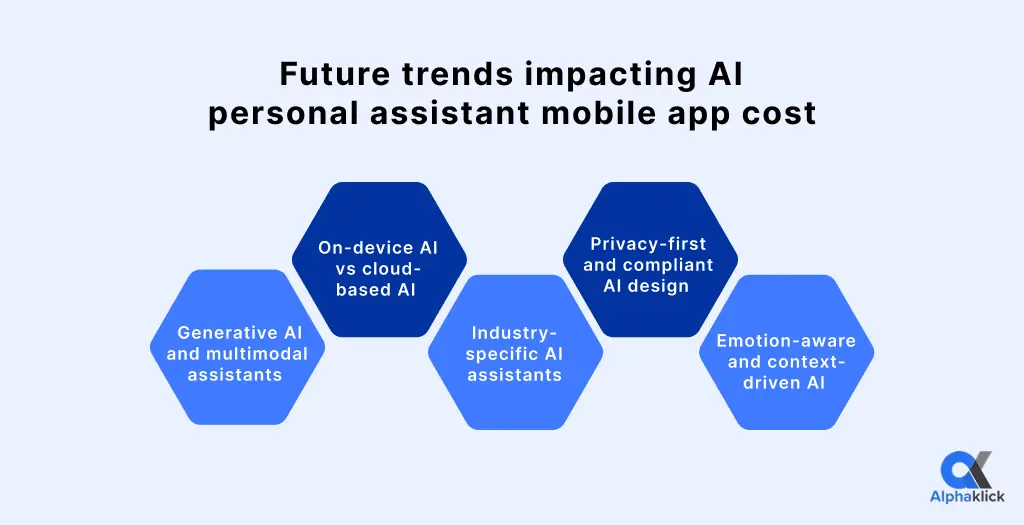
AI personal assistant apps are evolving quickly, and upcoming trends will significantly influence both development and long-term costs. From what I’m seeing across projects, these trends are shaping how teams plan budgets and feature roadmaps.
1. Generative AI and multimodal assistants
Generative AI enables assistants to handle text, voice, and images in a single experience. While this improves engagement and usability, it increases the ChatGPT personal assistant mobile app cost due to higher AI processing and API usage.
2. On-device AI vs cloud-based AI
On-device AI reduces dependency on cloud services and lowers recurring costs over time. However, it raises the upfront AI voice assistant development price because of complex optimization and hardware compatibility requirements.
3. Industry-specific AI assistants
Businesses are moving away from generic assistants toward niche solutions. Growth in areas like AI personal trainer mobile app development, healthcare assistants, and finance-focused companions adds domain complexity and increases development cost.
4. Privacy-first and compliant AI design
Rising data privacy regulations are pushing teams to invest more in security and compliance, which affects both development effort and ongoing maintenance budgets.
5. Emotion-aware and context-driven AI
Assistants are becoming more human-like by understanding tone, intent, and behavior patterns. While this enhances user experience, it also raises the custom AI assistant mobile app cost due to advanced AI modeling and testing.
Planning for these trends early helps avoid cost surprises and ensures the AI assistant remains competitive and scalable in the years ahead.
The growing demand for industry-focused assistants aligns closely with how AI benefits mobile apps in various industries, from fitness and healthcare to finance and enterprise automation.
Final thoughts
AI personal assistant mobile apps are no longer experimental ideas; they’re becoming the backbone of how users plan, train, communicate, and make decisions. From what my team and I have built, the opportunity is huge, but only for products designed with clarity and purpose, not hype.
If you’re planning to develop an AI assistant app in 2026, the winning approach is simple: start with a focused MVP, validate real user value, and scale intelligence where it truly matters.
Thinking about building your own AI personal assistant mobile app?
At AlphaKlick, we help founders and businesses turn AI ideas into scalable, production-ready products. If you’re shortlisting mobile app development companies, let’s talk strategy before code.
Book a free consultation with AlphaKlick and get a clear roadmap, honest cost insights, and expert guidance, no fluff, no pressure.
Your AI assistant shouldn’t just exist. It should create impact.
FAQs on AI personal assistant mobile app development cost
Q1: How much does an AI assistant app cost in 2026?
Answer: From my experience, the cost typically ranges between $30,000 and $150,000+, depending on feature complexity, AI intelligence level, voice capabilities, and long-term scalability. Simple chat-based assistants fall on the lower end, while advanced AI companions increase overall cost.
Q2: Is building a Siri-like app realistic for startups?
Answer: Yes, it’s realistic, but the build Siri-like app cost can be high unless the scope is carefully defined. Most startups begin with limited voice features and scale gradually instead of attempting a full Siri replacement from day one.
Q3: Can I build a Google Assistant-style app?
Answer: Yes, but Google Assistant clone development requires advanced NLP, voice recognition, and strong backend infrastructure. This significantly impacts development cost and is better suited for well-funded startups or enterprise projects.
Q4: Are AI trainer apps cheaper to build?
Answer: Not always. While they may look simpler, AI personal trainer mobile app development often includes analytics, personalization, and recommendation engines, which can raise the overall cost depending on feature depth.