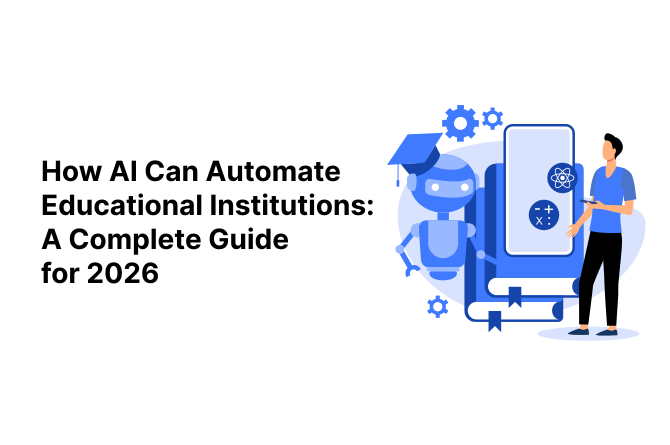
Key Highlights: AI helps schools and universities automate routine tasks like admissions, attendance, and scheduling, saving time and effort. It can also improve learning by offering personalized content and tracking student performance. Institutions can make better decisions using data insights while reducing manual errors. Overall, it can make education systems more efficient, organized, and student-focused.
Imagine a school where attendance is tracked automatically, student performance is analyzed in real time, and administrative tasks run smoothly without endless paperwork. This is the impact of AI in education, which is helping institutions operate smarter and more efficiently.
The adoption of AI in education automation is growing rapidly as schools and universities look for ways to simplify operations and improve learning experiences. In fact, according to Grand View Research, the global AI in education market was valued at USD 5.88 billion in 2024 and is expected to reach USD 32.27 billion by 2030, growing at a CAGR of 31.2%.
In this guide, we will explore how AI is transforming education, how institutions are using AI in educational institutions to automate operations, and how schools and universities can adopt AI-powered solutions in 2026.
What does AI automation mean for educational institutions?
AI automation in education industry uses intelligent technologies like machine learning and analytics to automate routine tasks and improve academic operations. With AI in educational institutions, schools and universities can manage student data, track performance, and streamline workflows more efficiently.
For example:
- AI chatbots answer student queries instantly
- Automated grading systems evaluate assignments
- Predictive analytics helps identify at-risk students
These capabilities show how automation in the education industry processes is improving efficiency.
Another key use case is AI for academic administration automation, where tasks like admissions, scheduling, and attendance tracking can be handled automatically.
Why are educational institutions adopting AI automation
Schools and universities are increasingly adopting AI automation for schools and universities to manage complex academic and administrative operations.
Institutions handle large volumes of student records, schedules, and academic data. By implementing AI-powered education management, many of these tasks can be automated, reducing manual workload and improving accuracy.
Some key reasons institutions are adopting AI in education include:
- Reducing administrative workload
- Improving decision-making through data insights
- Enhancing personalized learning experiences
- Increasing student engagement
These advantages highlight the major benefits of AI in educational institutions, especially in improving efficiency and scalability.
Key areas where AI can automate educational institutions
Artificial intelligence is helping schools and universities simplify many daily operations. By implementing AI in education automation, institutions can reduce manual work, improve accuracy, and manage academic processes more efficiently.
Many institutions are already adopting AI-powered education management systems to automate tasks that previously required significant administrative effort.
Major automation areas in educational institutions
| Area | How AI helps | Example use cases |
| Administrative processes | Automates scheduling, reporting, and institutional management | AI for academic administration automation manages timetables, faculty schedules, and reports |
| Student admissions and enrollment | Simplifies application screening and admission workflows | AI tools for educational institutions analyze applications and verify eligibility |
| Attendance and classroom management | Tracks student attendance automatically | Facial recognition or biometric attendance systems |
| Student performance analysis | Evaluates student data to identify academic progress | Predictive analytics detects students who need extra support |
| Personalized learning systems | Delivers customized learning experiences | AI-based learning management systems adapt lessons based on student performance |
| Communication and student support | Provides instant assistance to students and staff | AI chatbots answer questions related to courses, schedules, and academic resources |
These applications clearly show how AI is transforming education by improving operational efficiency and enhancing student learning experiences.
AI technologies used in educational institutions
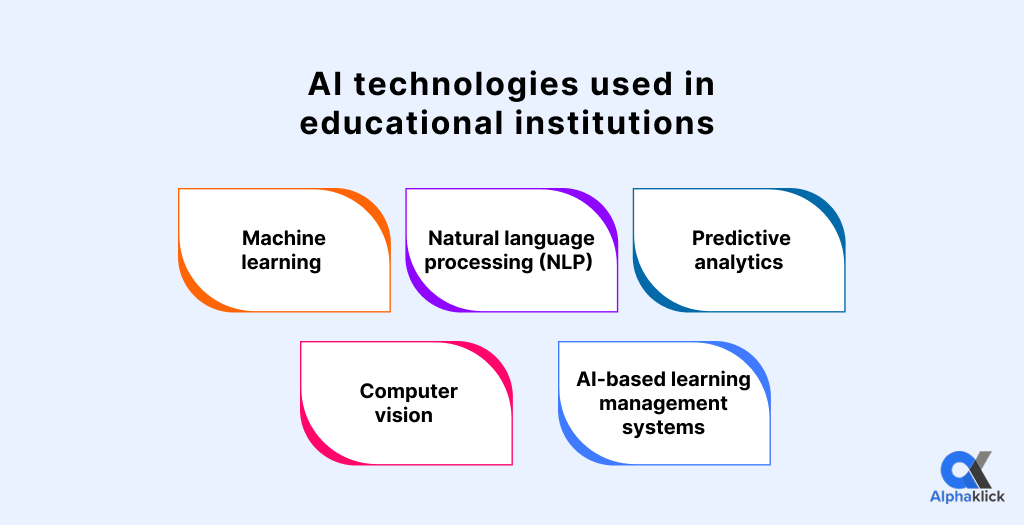
Several advanced technologies are enabling the growth of AI in educational institutions and helping schools and universities automate academic and administrative processes.
1. Machine learning
Machine learning is widely used in AI-powered education management to analyze student data, predict academic performance, and recommend learning resources. It helps institutions identify learning gaps and improve decision-making.
Example tools: TensorFlow, Google Vertex AI, IBM Watson.
2. Natural language processing (NLP)
Natural language processing powers AI chatbots and virtual assistants that answer student queries related to admissions, courses, and campus services. These systems improve communication and reduce administrative workload.
Example tools: ChatGPT, IBM Watson Assistant, Drift AI Chatbots.
3. Predictive analytics
Predictive analytics helps institutions analyze academic data and identify students who may need additional support. It plays an important role in AI in education automation by improving data-driven decision-making.
Example tools: Tableau AI, Microsoft Power BI AI, RapidMiner.
4. Computer vision
Computer vision technologies are used for automated attendance tracking, facial recognition systems, and campus security monitoring in AI automation for schools and universities.
Example tools: OpenCV, Amazon Rekognition.
5. AI-based learning management systems
Modern AI-based learning management systems personalize learning experiences by adapting course content based on each student’s performance and learning pace.
Example tools: Moodle AI plugins, Blackboard Learn AI.
These technologies are shaping major AI in education technology trends 2026, helping institutions improve efficiency, automation, and learning outcomes.
Many institutions are adopting AI-powered learning platforms to deliver personalized education experiences. If you’re planning to build a similar platform, explore our detailed guide on How Much Does It Cost to Build a Learning Mobile App Like Coursera.
Step-by-step guide to implement AI in educational institutions
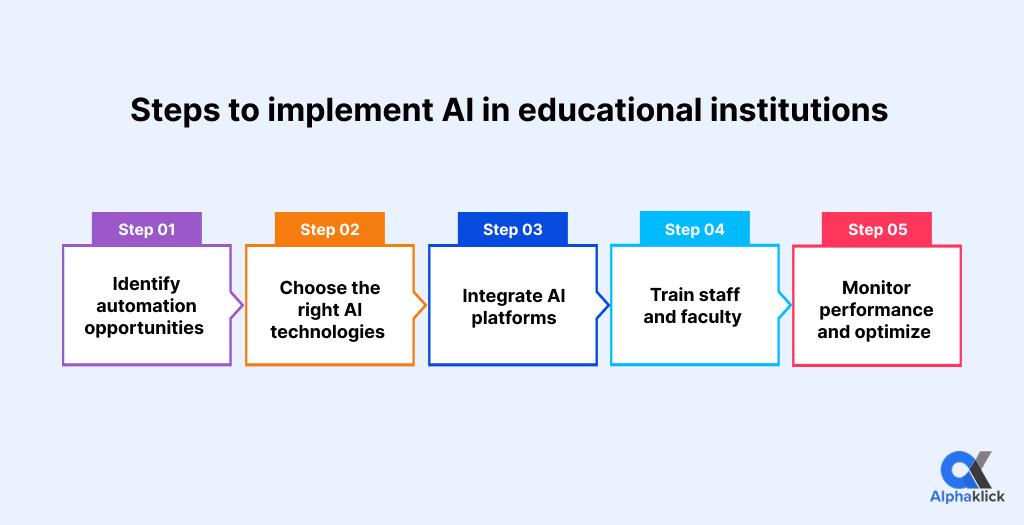
Educational institutions can follow a structured approach to successfully adopt AI in educational institutions.
A well-planned implementation strategy helps schools and universities integrate intelligent systems while improving both academic operations and administrative efficiency.
Step 1: Identify automation opportunities
Start by identifying processes that can benefit from AI for school management systems. Areas such as admissions management, attendance tracking, scheduling, and student performance analysis are ideal for automation.
Step 2: Choose the right AI technologies
Select technologies that align with the institution’s goals and existing infrastructure. Solutions related to AI in education automation, such as predictive analytics, AI chatbots, and machine learning systems, can help improve both academic and administrative workflows.
Step 3: Integrate AI platforms
Integrate intelligent platforms into existing systems. This may include implementing AI-based learning management systems, student analytics tools, and automated administrative software to streamline operations.
Step 4: Train staff and faculty
Provide training sessions so educators and administrators understand how to use AI tools effectively. This ensures better adoption of AI-powered education management systems across the institution.
Step 5: Monitor performance and optimize
After implementation, monitor key metrics such as student engagement, academic performance, and operational efficiency. Continuous evaluation helps measure the impact of AI in education automation and allows institutions to improve their systems over time.
Following this approach enables schools and universities to successfully implement AI automation for schools and universities while ensuring long-term efficiency and scalability.
If you’re exploring the financial aspect of building AI solutions, you can also read our guide on AI Mobile App Development Cost in 2026.
My thoughts:
From my perspective, implementing AI in education is about improving efficiency and making systems more organized. It helps reduce repetitive tasks and supports better, data-driven learning experiences.
However, it’s important to use it in a way that adds real value and keeps processes simple. When implemented thoughtfully, AI can make education more effective and future-ready.
Founder of AlphaKlick
Challenges of implementing AI in education
Despite the growing adoption of AI in education automation, educational institutions may face several challenges when implementing AI-driven systems. Understanding these barriers early helps institutions plan better and ensure successful implementation.
Some common challenges include:
- High implementation costs – Developing AI solutions, upgrading infrastructure, and integrating new platforms can require significant investment for schools and universities.
- Data privacy and security concerns – Educational institutions handle sensitive student and academic data. Strong security measures are essential when using AI in educational institutions to protect this information.
- Technical infrastructure limitations – Some institutions may need to upgrade their digital infrastructure to support modern AI-powered education management systems.
- Staff training and adaptation – Teachers and administrators must be trained to effectively use AI tools and integrate them into their daily academic and administrative processes.
- Integration with existing systems – AI platforms must work smoothly with current school management systems, databases, and learning platforms.
However, with proper planning, the right technology partners, and structured implementation strategies, institutions can overcome these challenges and successfully adopt AI automation for schools and universities.
Addressing these issues early helps build scalable and efficient AI-driven education systems.
Real-world examples of AI in educational institutions
Many schools and universities are already using AI in education to automate operations and improve learning outcomes.
These examples show how AI in education automation is being applied in real educational environments.
| Institution / Platform | AI Application | Purpose |
| Georgia State University | Predictive analytics | Identifies students at risk of dropping out and improves student success |
| Arizona State University | AI chatbots | Answers student queries related to admissions, courses, and financial aid |
| Duolingo | AI learning algorithms | Personalizes language learning based on student progress |
| Coursera / edX | AI recommendation systems | Suggests relevant courses based on learner behavior |
These examples demonstrate how AI is transforming education by improving student learning experiences and simplifying administrative operations through AI automation for schools and universities.
AI technologies are not only transforming education but also revolutionizing multiple sectors such as healthcare, ecommerce, and finance. Learn more about how AI Benefits Mobile Apps in Various Industries.
How Alphaklick helps build AI-powered education platforms
At Alphaklick, we help educational institutions turn innovative ideas into intelligent digital platforms. As an experienced AI software development company, our team builds scalable solutions that simplify academic operations and enhance modern learning environments.
We support schools, universities, and edtech startups with solutions such as:
- Custom AI tools for educational institutions to automate academic and administrative tasks
- Intelligent learning platforms that support personalized education
- Automated student management systems for admissions, attendance, and academic records
- Data-driven dashboards to monitor student performance and institutional insights
Our goal is to help institutions build smarter systems that improve efficiency, reduce manual work, and create better learning experiences.
If you are planning to introduce intelligent automation into your educational platform, our team can help you design the right solution.
Book a free consultation to explore how AI-powered solutions can transform your institution.
FAQs
Q1. How is AI used in educational institutions?
Answer: AI is used to automate many academic and administrative processes in schools and universities. It helps manage student records, track academic performance, personalize learning experiences, and provide instant support through AI chatbots and learning platforms.
Q2. What are the benefits of AI in educational institutions?
Answer: The benefits of AI in educational institutions include improved efficiency, reduced administrative workload, better student performance analysis, and personalized learning experiences. AI also helps institutions make better decisions using data-driven insights.
Q3. What AI tools are commonly used in education?
Answer: Educational institutions use several AI tools, such as AI chatbots for student support, predictive analytics systems for monitoring student performance, and AI-based learning management systems that personalize course content and learning paths.
Q4. How can schools start implementing AI automation?
Answer: Schools can begin by identifying administrative tasks like admissions, attendance tracking, and scheduling that can be automated. After that, they can gradually integrate AI solutions and train staff to effectively use these technologies in daily operations.